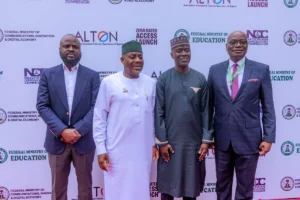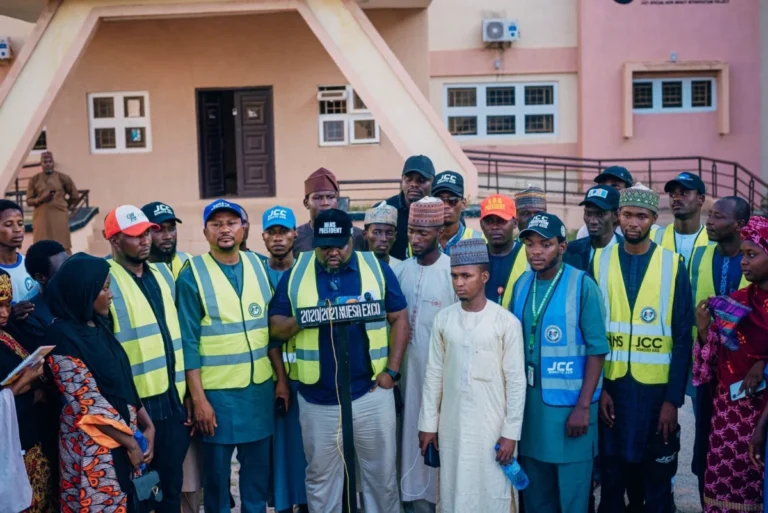
The National Association of Nigerian Students (NANS) has taken a decisive stand on the intersection between public infrastructure and academic accessibility, officially declaring that federal roads leading to higher education institutions constitute a fundamental component of Nigeria’s broader education infrastructure. This declaration was made by NANS President Afeez Akinyele during a comprehensive World Press Conference convened on Saturday to mark the successful conclusion of the North-West leg of the association’s nationwide inspection tour of federal road projects.
According to the student leadership, the physical condition of access routes directly dictates the safety, mobility, and overall welfare of the student population, bridging the gap between infrastructural development and academic productivity. The tour, which spanned several weeks, allowed student representatives to personally evaluate the progress, quality, and strategic alignment of major federal transport arteries intersecting Kano, Jigawa, Kaduna, and Sokoto states. By expanding the definition of academic infrastructure beyond lecture theatres, laboratories, and student hostels, NANS aims to reframe national discourse on budgetary allocations and infrastructure maintenance, ensuring that the federal government accounts for student mobility in its national development frameworks.
Anatomy of the Inspection Tour: Assessing the North-West Arteries
The North-West leg of the Nationwide Federal Roads Project Tour was meticulously designed to scrutinize transit corridors that serve as primary lifelines for academic communities in the region. Speaking to journalists at the press briefing, Akinyele outlined the scope of the inspection, noting that the delegation focused heavily on routes facilitating daily commutes for thousands of undergraduates, postgraduates, and academic staff.
In Kano State, the student delegation traversed some of the busiest economic and educational corridors in the country. Among these was Section II of the Kano-Kwanar Danja-Hadejia Road, the Kano-Tsalle route, and the expansive Kano Northern Bypass. The inspection team also evaluated the Kano-Maiduguri Road—a critical transnational highway linking Kano through Jigawa, Bauchi, and Yobe all the way to Borno State—alongside the Kano-Katsina Road (Phase II) and the Yakasai-Badume-Damargu-Markenzalli network.
Highlighting the structural significance of these routes, Akinyele drew particular attention to the Kano Northern Bypass. He described it as a transformative engineering undertaking designed to divert heavy vehicular traffic away from the urban center, thereby providing a safer and more efficient alternative route for commuters and students alike. Most importantly, the bypass serves as a strategic connective tissue linking no fewer than 10 higher education institutions dispersed across the northwestern corridor.
Further compounding the importance of these transport networks, the Kano-Maiduguri Road serves as the primary gateway for students and faculty accessing the Aliko Dangote University of Science and Technology (ADUSTECH) located in Wudil. Similarly, the interconnected road networks of Kano-Katsina and Kaduna-Kano facilitate daily interstate movement for scholars attending institutions such as the Sa’adatu Rimi College of Education in Kano. In Jigawa State, the inspection covered the continuation of the Kano-Kwanar Danja-Hadejia corridor, as well as the Kano-Kongolam Road, which bridges Kano, Jigawa, and Katsina states, providing seamless access to Federal University Dutse and the Jigawa State Polytechnic.
In Kaduna State, the delegation’s itinerary was equally extensive. Inspectors evaluated the critical Abuja-Kaduna-Zaria-Kano expressway (specifically Section II covering Kaduna to Zaria), the Nnamdi Azikiwe Road—widely known as the Western Bypass—stretching from the Command Second Junction to Kawo, the Zaria-Funtua-Sokoto highway, and the Kaduna-Pambegua-Jos Road (Section I). Other routes subjected to scrutiny included the Wusasa-Jos Road, the Turunku-Mararaban Jos Federal Road (Phase II), and the historically volatile Mando-Birnin Gwari Road. The Abuja-Kaduna-Zaria-Kano trunk line remains the central spine connecting Nigeria’s Federal Capital Territory to the northwestern economic hubs, providing vital transit to institutions such as the Federal Co-operative College in Kaduna.
Concluding the regional tour in Sokoto State, the NANS leadership inspected segments of the Sokoto-Badagry highway and the Illela-Dukamaje Road, completing a comprehensive matrix of evaluation that captured the lived realities of students navigating these pathways for academic pursuits.
The Philosophical Shift: Redefining Education Infrastructure
The core thesis of the NANS press conference challenged traditional bureaucratic definitions that compartmentalize infrastructure into distinct ministerial silos—separating the Ministry of Works from the Ministry of Education. Akinyele emphasized that the conceptual boundaries of a university or college do not terminate at the campus gates.
"What we have seen firsthand during this tour has reinforced one important fact: the road to our campuses is part of the education infrastructure," Akinyele asserted. "Students do not exist only within the four walls of their classrooms. We commute every day. We travel to lecture theatres, examination halls, and for other academic activities. We travel from our homes to campuses; as such, we depend on these roads to access our institutions."
This perspective addresses a long-standing vulnerability within the Nigerian academic ecosystem. Historically, poor road networks surrounding campuses have contributed to severe logistical bottlenecks, increased transport costs for students, heightened vulnerability to highway security incidents, and tragic vehicular accidents involving members of the university community. By categorizing access roads as core educational infrastructure, NANS is advocating for prioritized funding, accelerated project completions, and dedicated maintenance schedules for roads leading to tertiary institutions across the federation.
Commendations for Federal Interventions and Strategic Partnerships
Despite highlighting the historical challenges associated with road deterioration, the NANS leadership adopted a constructive tone, offering formal commendations to the administration of President Bola Ahmed Tinubu and the Minister of Works, Engr. David Umahi. The student body acknowledged what it described as demonstrable political will, fiscal commitment, and architectural foresight in tackling long-neglected federal road networks.
"We commend President Bola Ahmed Tinubu for the investment in infrastructural development. Particularly, we acknowledge the strategic positioning of these roads, ensuring that they directly pass through and provide access to our campuses," Akinyele stated. He further lauded Minister Umahi for his hands-on management style, technical competence, and strategic acumen in identifying critical transportation chokepoints across the country.
The appreciation extended to the speed and quality of construction observed at various project sites across the North-West. NANS noted that the deployment of modern construction methodologies and rigid quality control measures would significantly reduce transit times, mitigate wear and tear on commercial and private vehicles, and drastically lower the frequency of accidents once the projects reach full completion.
However, this praise was accompanied by a stern institutional caveat. NANS urged the Federal Ministry of Works to maintain the current construction momentum, ensure strict adherence to engineering specifications, and deliver the projects within realistic, binding timelines to prevent the perennial problem of abandoned public works.
Broader Economic and Safety Implications for the Academic Community
A fact-based analysis of the implications of the NANS project tour reveals several critical socioeconomic dimensions that extend far beyond student welfare:
-
Economic Efficiency and Cost of Living: Transportation costs constitute a major portion of a Nigerian student’s monthly budget, particularly for those who reside off-campus due to inadequate hostel accommodations. Degraded roads inflate transport fares as commercial drivers pass on the high cost of vehicle maintenance caused by potholes and unpaved surfaces. Well-constructed federal roads directly translate to reduced travel times, lower vehicle operating costs, and, theoretically, more stable or affordable transport fares for students.
-
Safety and Security: Many federal roads passing through or near Nigerian campuses have historically been flashpoints for security challenges, ranging from highway banditry to fatal road traffic accidents caused by blind spots, failed bridges, and lack of signage. Improved lighting, dualization, and smooth asphalt surfaces enhance visibility and response times for security agencies, creating a safer commuting environment for young academics.
-
Institutional Productivity and Attendance: Punctuality and regular attendance are core components of academic success. Frequent traffic gridlocks caused by failed bridge segments or impassable federal highways often force universities to disrupt academic schedules, delay examinations, or excuse mass lateness. Reliable road infrastructure ensures uninterrupted academic calendars and fosters seamless regional integration among institutions.
Future Outlook and Nationwide Expansion
As the North-West leg concludes, the National Association of Nigerian Students has indicated that the Nationwide Federal Roads Project Tour will systematically progress into other geopolitical zones of the country. Subsequent phases will target the North-East, North-Central, South-West, South-East, and South-South regions, where similar systemic infrastructure deficits impact student populations.
NANS has promised to compile a comprehensive dossier containing photographic evidence, project status updates, and stakeholder feedback gathered during these regional tours. This document is expected to be formally presented to the Federal Ministry of Works, the National Assembly committees overseeing works and education, and relevant state governors as an empirical reference guide for student-centric infrastructural advocacy.
"Our position is simple: when you improve the road to our campuses, you improve the journey to education," Akinyele concluded, reinforcing the association’s commitment to holding public officeholders accountable through objective oversight and constructive engagement.