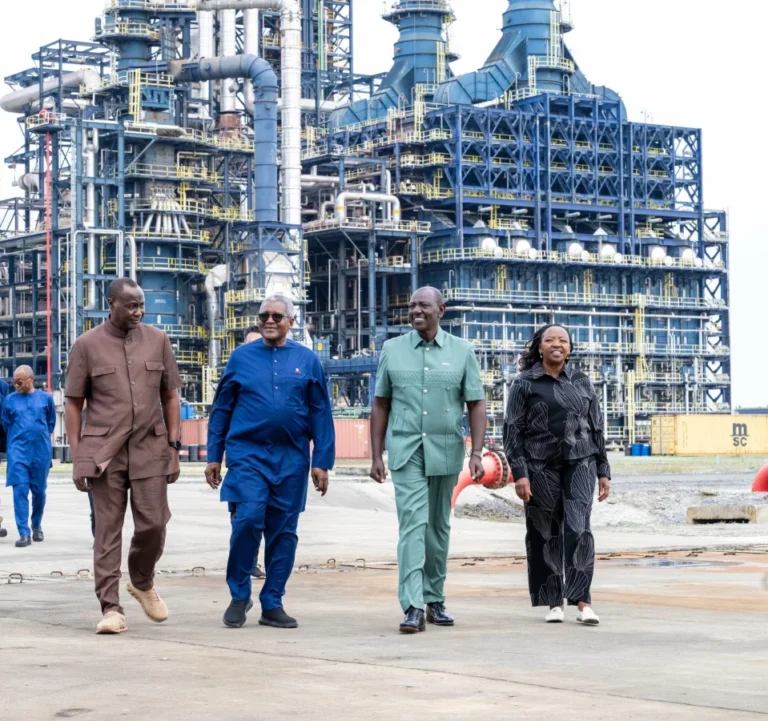
Kenyan President William Ruto undertook a high-profile official visit to the multi-billion-dollar Dangote Petroleum Refinery in Lekki, Lagos State, inspecting the massive industrial complex alongside Africa’s richest man and CEO of the Dangote Group, Aliko Dangote. The visit served as a strategic precursor to the much-anticipated groundbreaking ceremony for the proposed Dangote East African Refinery, slated to be established in the coastal city of Lamu, Kenya.
The tour highlights an increasingly robust framework of South-South cooperation, demonstrating how African-led industrial ambitions and cross-border partnerships can reshape the continent’s economic landscape. President Ruto’s inspection of the Lagos facility provides a blueprint for what East Africa hopes to achieve in terms of energy security, domestic refining capacity, and robust industrialization.
A Testament to African Engineering and Collaboration
During his extensive tour of the Lekki-based facility, President Ruto took to his official social media channels to express profound admiration for the scale and sophistication of the Nigerian refinery. With a staggering crude oil refining capacity of 700,000 barrels per day (bpd), the mega-refinery stands as the largest single-train petroleum refinery in the world.
Ruto emphasized that the complex produces over 100 million liters daily of high-quality refined petroleum products, including premium motor spirit (petrol), automotive gas oil (diesel), and aviation turbine kerosene (jet fuel). Beyond the core processing units, the Kenyan leader marveled at the supporting logistics network integrated into the facility, noting in particular the construction of 120 kilometers of subsea pipeline infrastructure designed to seamlessly transport crude oil directly from maritime vessels to the refinery storage tanks.
According to the Kenyan head of state, this monumental undertaking is a shining testament to what African governments, visionary private investors, and regional financial institutions can accomplish when they pool resources, capital, and technical expertise together. The visit underscored a growing consensus among African leaders that intra-continental trade and localized value addition are vital antidotes to historical reliance on foreign refined petroleum imports.
The Lamu Project: Expanding the Industrial Footprint to East Africa

Building on the success of the Nigerian venture, the Dangote Group is extending its industrial footprint to East Africa through a strategic partnership with the Kenyan government. The cornerstone of this expansion is the upcoming Dangote East African Refinery, scheduled for an official groundbreaking ceremony in Lamu on September 30, 2026.
President Ruto revealed that the planned Kenyan facility is designed to match or even exceed the operational scale of its Nigerian counterpart. The Lamu refinery aims to fundamentally transform the petroleum sector not only within Kenya but across the broader East African Community (EAC) region. By establishing a world-class refining hub on the East African coast, the project seeks to insulate member states from the extreme volatility of global fuel prices and supply chain bottlenecks that have historically plagued net-importing nations.
Energy reliability and national security sit at the core of the Lamu project. For decades, East African nations have exported raw crude or imported refined petroleum products at steep economic costs, losing out on valuable downstream economic benefits. The new refinery is projected to reverse this trend by ensuring a steady, predictable domestic supply of petroleum products, thereby stabilizing local transport costs, manufacturing expenses, and overall consumer price indices.
Economic Ripple Effects: Job Creation and Ancillary Industries
One of the most compelling aspects of the upcoming Lamu refinery project is its projected socioeconomic impact on Kenya’s labor market and secondary industrial sectors. President Ruto projected that the construction and subsequent operation of the facility will directly and indirectly create approximately 60,000 jobs, providing a much-needed boost to youth employment and specialized technical training in the region.
Beyond the immediate employment figures, the establishment of a mega-refinery in Lamu is expected to serve as a powerful catalyst for secondary and tertiary industrial development. Economists and regional planners anticipate a significant surge in spin-off industries, particularly in petrochemical manufacturing.
When completed, the facility will pave the way for domestic production of crucial industrial inputs such as synthetic fertilizers—a critical boon for Kenya’s agricultural sector—as well as various chemical derivatives, plastics, and advanced packaging materials. This vertical integration will allow Kenya to retain a larger share of value within its borders, fostering a self-sustaining industrial ecosystem that attracts further foreign and domestic investment.
Broader Implications for the African Continental Free Trade Area

The collaboration between the Dangote Group and the Kenyan government arrives at a pivotal juncture for the African continent, aligning closely with the strategic objectives of the African Continental Free Trade Area (AfCFTA). By decentralizing heavy industrial capacity and establishing major refining nodes on both the western and eastern shores of the continent, African enterprise is actively rewriting the rules of global commerce.
Analysts note that projects of this magnitude successfully challenge the long-standing paradox of resource-rich African nations exporting raw commodities only to re-import finished goods at exorbitant prices. By keeping the refining process within the continent, countries like Nigeria and Kenya are cutting down shipping turnaround times, reducing carbon footprints associated with long-haul maritime transport of refined goods, and conserving vital foreign exchange reserves.
Furthermore, the involvement of diverse financial institutions in financing these capital-intensive projects signals a maturation of Africa’s banking and investment sectors. Local and regional syndications are increasingly proving capable of backing high-risk, high-reward mega-infrastructure, reducing absolute dependence on traditional Western or Asian lending agencies.
Looking Ahead to the Groundbreaking
As the countdown to the September 30, 2026 groundbreaking ceremony in Lamu begins, anticipation continues to build among regional stakeholders, policymakers, and business leaders. Preparations on the ground in Kenya are shifting into high gear, supported by technical insights and operational lessons gleaned from President Ruto’s recent tour of the Lekki facility.
The partnership between the Dangote Group and Kenya underscores a transformative shift in Africa’s economic narrative—one defined by self-reliance, cross-border industrial synergy, and a resolute commitment to sustainable, job-rich growth. As the project transitions from the drawing board to physical execution, the Lamu refinery stands poised to become a landmark achievement in East Africa’s modern industrial history.