
Health authorities across Africa are intensifying containment protocols and epidemiological investigations following a series of cross-border Ebola transmissions linked to the ongoing public health crisis in the Democratic Republic of Congo (DRC). Investigators are examining a potential epidemiological link at Uganda’s Entebbe International Airport on October 3, where Nigeria’s first documented case of Ebola Bundibugyo may have crossed paths with Kenya’s recently deceased index patient.
The Africa Centres for Disease Control and Prevention (Africa CDC) revealed that health officials are exploring whether an inadvertent exposure or contact occurred between the two travelers at the major East African transit hub. This cross-continental puzzle highlights the extraordinary complexities of tracking viral pathogens in an era of high-mobility air travel and porous land borders, putting public health infrastructure from West to East Africa on high alert.
The Chronology of Exposure: Mapping the Movement of Index Patients
The investigation centers on the movements of two individuals who traveled through Uganda from or via regional hotspots before developing symptoms that triggered national health alerts.

The first individual, a Kenyan national, had spent several weeks inside the DRC—specifically navigating through regions deeply affected by the current outbreak, which stands as the fastest-growing Ebola epidemic ever recorded. According to Africa CDC health emergency officials, the man bypassed official designated points of entry, utilizing illegal land crossings to slip from the DRC into Uganda.
On October 3, he transited through Entebbe International Airport, boarding a flight to Nairobi’s Jomo Kenyatta International Airport. Upon arrival, a family member met him directly at the terminal and transported him straight to Nairobi Hospital. His condition deteriorated rapidly, and he succumbed to the virus just two days later.
Simultaneously, investigators are tracking the timeline of Nigeria’s first Ebola Bundibugyo patient. Identified by public health officials as the Ugandan-born wife of a Swiss diplomat stationed in Nigeria, she also departed from Uganda on October 3, flying directly into Abuja, Nigeria’s capital. Her itinerary included a two-week stay in Uganda starting in mid-September.
Her symptom onset began on October 7, featuring initial manifestations that masked the true nature of the infection. She sought outpatient care and was admitted to a health facility on October 11, where her initial diagnosis pointed toward malaria—a common diagnostic hurdle in malaria-endemic regions that frequently delays viral hemorrhagic fever detection.
It was not until October 19, as her clinical picture evolved and failed to respond to standard malaria treatments, that attending physicians suspected a viral hemorrhagic fever. Immediate isolation and testing confirmed Ebola infection, a finding validated by a follow-up test the subsequent day, prompting Nigerian federal health authorities to officially declare the outbreak.
The Intersection Theory and Contact Tracing Efforts
Dr. Wessam Mankoula, head of health emergencies at the Africa CDC, addressed media briefings to outline the theories currently guiding international epidemiological teams. While the shared presence of both patients at Entebbe Airport on October 3 is a primary point of interest, health officials emphasize that definitive conclusions remain premature.
"Has there been any touch or contact between the two cases at the airport at the same time? This is one of the theories that is currently under investigation," Dr. Mankoula stated during a press briefing. "There are a lot of possibilities. A lot of effort is going into the investigation to verify the source of the infection. So let’s avoid anticipating the investigation and try to reach a conclusion at this stage."
The complication surrounding the Nigerian patient is particularly profound because Uganda was officially declared Ebola-free in August following the successful containment of an earlier, imported outbreak from the DRC. Consequently, public health experts are scrutinizing whether the diplomat’s wife contracted the virus via an undetected chain of transmission within Uganda, through an environmental exposure, or directly via a transient encounter at Entebbe Airport with the infected Kenyan traveler.
In response to these exposures, aggressive contact tracing and quarantine protocols have been deployed across multiple jurisdictions:

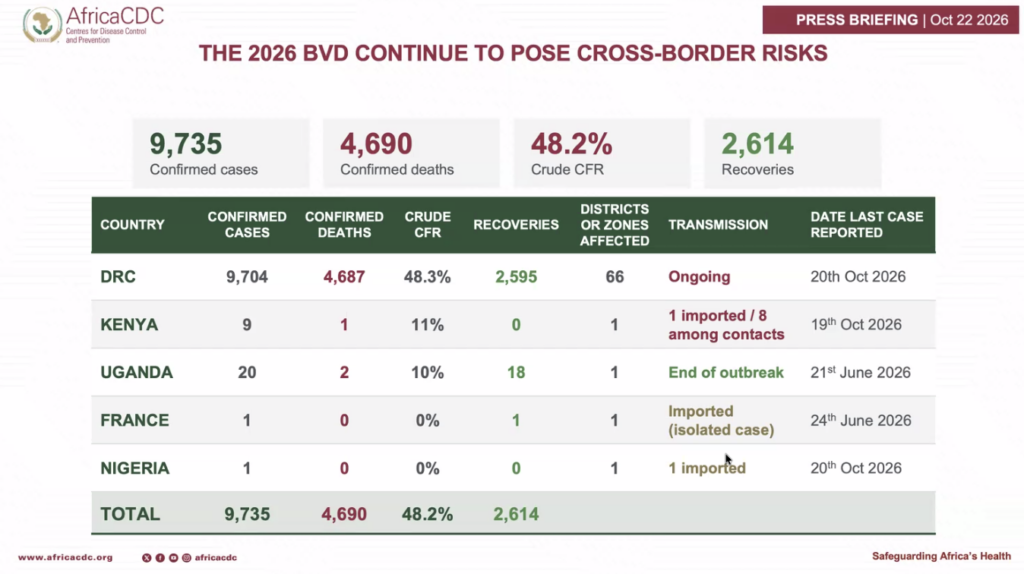
- In Kenya: Authorities have successfully traced all known contacts of the deceased index patient. Out of 135 total contacts identified, 118 individuals have been placed under strict quarantine. Tragically, the virus has already sparked secondary transmissions within medical and familial circles, infecting eight secondary contacts—comprising four healthcare workers and four family members who cared for the patient before his hospital admission.
- In Nigeria: Federal and state health agencies have isolated 44 "high-risk" contacts of the diplomat’s wife in a designated containment facility, where they are undergoing continuous monitoring for fever and other early symptoms of Ebola virus disease.
The Epicenter: The DRC Crisis and Regional Vulnerabilities
To fully comprehend the cross-border spread, epidemiologists point to the relentless severity of the outbreak within the DRC. Official figures released on October 20 outline a grim statistical reality: the DRC has recorded 9,704 confirmed cases and 4,687 deaths. The provinces of Ituri and North Kivu remain the epicenter, accounting for a staggering 94% of the total caseload.
While epidemiological reports indicated a slight decline in reported cases following epidemiological week 37, the Africa CDC has issued strong caveats against premature optimism. Dr. Mankoula cautioned that persistent reporting lags, community resistance, ongoing regional security conflicts, and operational bottlenecks continue to obscure the true trajectory of the epidemic.
Alarmingly, data indicates that more than 80% of current cases are originating from outside established contact tracing lists—a clear indicator of invisible transmission chains circulating within communities. Furthermore, over half of all recorded fatalities are occurring outside formal healthcare settings within local communities, amplifying the risk of nosocomial and household spread.
Porous Borders and the Risk to Neighboring Nations
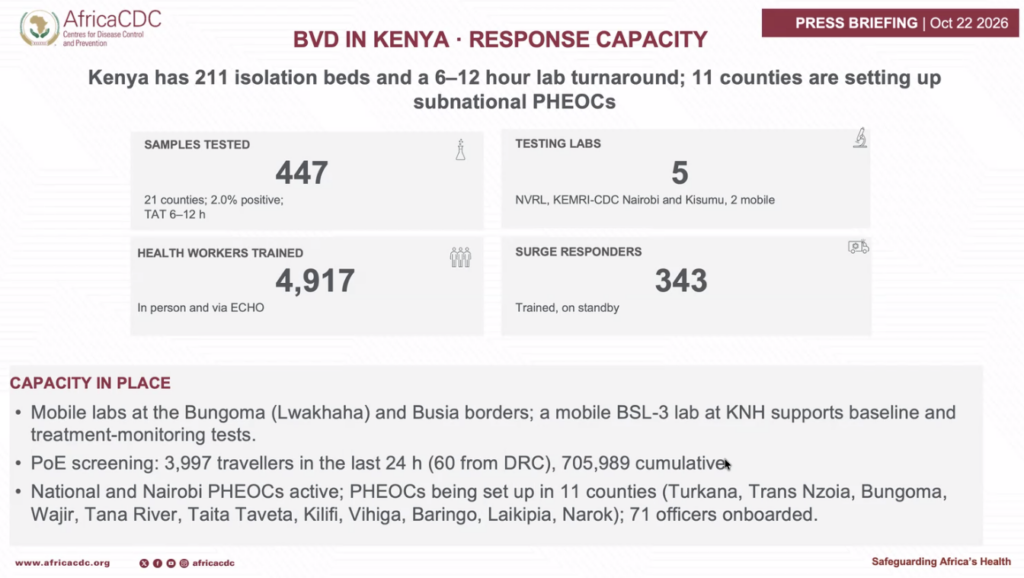
The reliance on illegal border crossings remains a critical vulnerability in Central and East Africa. While official land borders between the DRC and Uganda are strictly regulated—open primarily for commercial cargo trucks and authorized humanitarian missions—informal pathways continue to be exploited by travelers evading health screenings.
The case of the deceased Kenyan traveler, who utilized an unauthorized land route to transition from the DRC into Uganda before boarding his flight, underscores the urgent need for enhanced border security and surveillance harmonization.
In response, the Africa CDC has issued operational warnings to all nations sharing borders with the DRC, particularly those situated along the northern tier where the viral transmission is most intense. Countries identified as being at the highest risk include South Sudan, the Central African Republic, Burundi, and Rwanda.
Public health authorities are urging these frontline nations to fortify screening protocols at all official and unofficial points of entry, implement rigorous temperature and symptom checks, and establish robust community-based surveillance systems capable of identifying travelers who may be asymptomatic during their transit periods.
Implications for Global Health Security
The recent events in Nigeria and Kenya serve as a stark reminder of how rapidly localized hemorrhagic fever outbreaks can transform into international security concerns through modern transportation networks. Public health analysts note that the multi-country spillover tests the resilience of regional health architectures established in the wake of past West African and Central African Ebola epidemics.
The prompt identification of the cases in both Kenya and Nigeria demonstrates improvements in diagnostic capacity and clinical suspicion compared to previous decades. However, the secondary infections among healthcare workers in Kenya highlight ongoing vulnerabilities in infection prevention and control (IPC) practices within primary and secondary care facilities.
As epidemiological investigations continue to unravel the precise sequence of events at Entebbe Airport and trace the transmission vectors in Uganda and Nigeria, international health organizations are mobilizing financial and technical resources to support local governments. Preventing further regional dissemination will depend heavily on cross-border intelligence sharing, community engagement to combat misinformation, and unwavering adherence to rigorous quarantine and infection control standards.