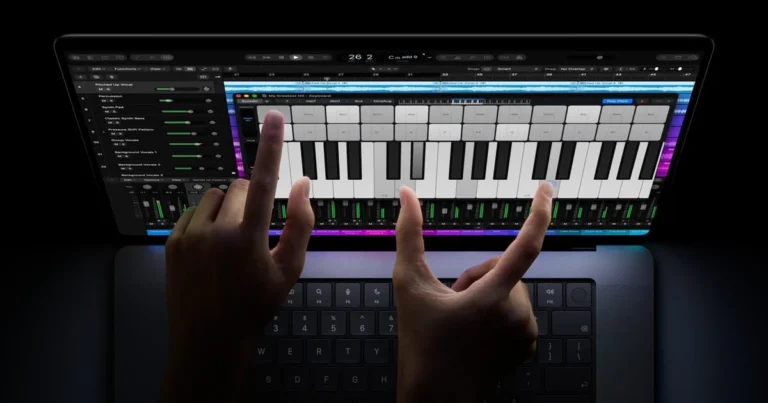
After decades of resisting the integration of touch interfaces into its desktop operating system, Apple has officially shattered the barrier. In a surprise announcement today, the technology giant introduced the MacBook Pro with a PROLED XDR touchscreen, fundamentally altering the trajectory of the Mac lineup. This development marks the most significant architectural shift in the company’s history since the transition to Apple Silicon, challenging long-held design philosophies and inviting a new paradigm of user interaction.
The new 14-inch and 16-inch MacBook Pro models, powered by the high-performance M5 Pro chip, feature an integrated touch sensor within the OLED display. This hardware evolution allows users to engage with macOS through intuitive gestures—swiping to navigate, pinching to manipulate visual media, and dragging windows with tactile precision. According to Apple’s technical documentation, the macOS kernel has been updated to interpret touch inputs as native click events, ensuring that existing software ecosystems remain largely compatible from the moment of purchase.
A Chronological Shift in Apple’s Hardware Philosophy
To understand the weight of this announcement, one must look at the historical skepticism Apple held toward touchscreen laptops. For over a decade, the late Steve Jobs and later Tim Cook argued that touch interfaces on a vertical surface led to "gorilla arm"—the physical fatigue caused by reaching out to interact with a screen for extended periods. As recently as 2021, Apple executives maintained that the iPad served the touch-centric market, while the Mac remained the domain of the mouse, trackpad, and keyboard.
The shift appears to be a response to the blurring lines between creative workflows. Professionals in creative industries have increasingly relied on "sidecar" setups, using iPads as secondary touch-enabled inputs for their Macs. By merging these capabilities, Apple is effectively consolidating its product categories. The timeline of this transition began in earnest with the refinement of the M-series chips, which unified the architecture between iPadOS and macOS, eventually making the current hardware integration a logical, albeit delayed, evolution.
Pricing, Specifications, and Market Segmentation
The introduction of the PROLED XDR touchscreen technology carries a premium price tag, creating a distinct tiering within the MacBook lineup. As of October 28, 2026, the pricing structure for the new models reflects both the display technology and the upgraded internal processing power.
The 14-inch MacBook Pro with the M5 Pro chip and the new touchscreen display starts at $2,899, while the 16-inch variant begins at $3,399. For those requiring the maximum power of the M5 Max chip, prices scale significantly, starting at $4,499 and $4,799 respectively. These figures stand in contrast to the standard 14-inch MacBook Pro with the M6 chip, which retails for $1,999 and maintains the traditional non-touch display interface.
The cost disparity of $900 between the entry-level M6 model and the touchscreen M5 Pro model is substantial. However, market analysts point out that this gap accounts for more than just the screen; it reflects a broader shift toward the "Pro" branding that integrates high-end OLED technology with specialized silicon. The arrival date for all units is set for November 6, 2026, setting the stage for a critical holiday sales quarter.
Strategic Implications for Creative Professionals
The immediate question for power users is whether the hardware provides a tangible improvement to their daily workflow. For graphic designers, video editors, and audio engineers, the benefits are clear. Applications such as Final Cut Pro, Logic Pro, and Pixelmator Pro have been optimized to take advantage of the touchscreen. The ability to manipulate timelines, adjust audio levels with precision, and paint directly onto a high-fidelity OLED canvas provides a degree of fluidity that was previously impossible without peripheral hardware like a drawing tablet.
Conversely, for the general user, the impact may be more muted. Apple has indicated that touch-optimized versions of productivity mainstays—including the Microsoft Office suite and Zoom—are slated for release later in the year. This phased rollout suggests that while the hardware is ready, the software ecosystem is still undergoing a period of adjustment to ensure that touch inputs do not conflict with traditional keyboard shortcuts.
Consumer Guidance: Who Should Wait?
Industry experts are advising consumers to evaluate their usage patterns carefully before upgrading. Those who rely on their machines primarily for administrative tasks, web browsing, and video conferencing may find that the premium cost of the touchscreen model is not yet justified by the current software support.
Furthermore, history suggests that first-generation hardware often undergoes iterative improvements in subsequent releases. Issues regarding screen durability, oleophobic coating longevity, and software stability are common concerns for "early adopters." For those who do not require touch functionality immediately, the M6 MacBook Pro offers a more cost-effective entry point into the latest generation of Apple hardware without the risks associated with a new interface technology.
For those who purchased a Mac within the last two weeks, a note of caution: Apple’s return policy permits a 14-day window for returns on products purchased directly from their retail or online channels. Customers whose devices arrived on or after October 15, 2026, may be eligible to return their purchase and apply the credit toward the new touchscreen models, provided they act within the specified timeframe.
The Broader Impact on the PC Industry
The move to a touchscreen Mac puts immense pressure on the wider PC market. Windows-based laptops have featured touch interfaces for years, but the quality of implementation has varied wildly. Apple’s entry into this space with an OLED display and a highly optimized macOS experience will likely force competitors to elevate their standards for display technology and touch sensitivity.
The implications for the iPad lineup are equally significant. With the MacBook Pro now capable of performing many tasks previously reserved for the iPad, Apple faces the internal challenge of cannibalization. If a MacBook can offer the same touch-based interactivity as an iPad while maintaining the power of a desktop operating system, the value proposition of the high-end iPad Pro may need to be re-evaluated by the company.
Unanswered Questions and Future Outlook
Despite the excitement, several questions remain regarding the long-term integration of this technology. One of the primary concerns is the longevity of the OLED panel when subjected to constant touch interaction. OLED technology, while visually superior in terms of color accuracy and contrast, is susceptible to burn-in and wear over time. Apple has yet to disclose specific warranty extensions or specialized repair programs for these new displays, which will likely be a point of inquiry as the units enter the hands of consumers.
Additionally, the transition to touch-first interfaces will likely force a redesign of the macOS user interface elements. Small, pixel-perfect buttons that are easy to click with a mouse can be difficult to tap with a finger. The coming months will demonstrate whether Apple maintains a dual-interface approach—where the OS detects whether the user is employing a trackpad or a finger—or if it moves toward a more unified, touch-friendly UI that may deviate from the traditional Mac aesthetic.
As the industry watches to see how the market reacts to these new machines, one thing is certain: the era of the "click-only" Mac has effectively come to an end. Whether this represents a revolutionary advancement or a complex adaptation, the integration of touch into the MacBook Pro is a defining moment for the company and a landmark event in the history of personal computing. The November 6 launch will provide the first real-world data on how effectively Apple has bridged the divide between its two most successful product lines, setting the tone for the future of the Mac platform for years to come.