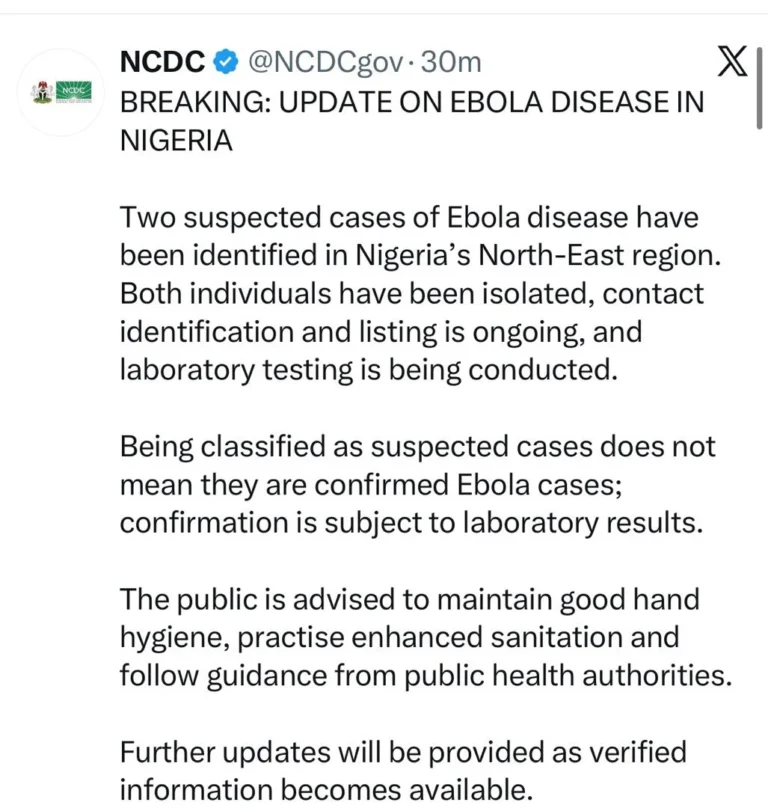
The Nigeria Centre for Disease Control and Prevention (NCDC) has officially alerted the public to the identification of two suspected cases of Ebola Virus Disease (EVD) in the North-East region of the country. The agency made the announcement via its official social media channels on October 31, 2026, triggering immediate public health surveillance protocols across the affected states. While the classification remains strictly in the "suspected" category, the NCDC has moved swiftly to isolate the individuals while laboratory diagnostic processes are underway to confirm or rule out the presence of the virus.
This development comes at a time when the Nigerian health sector remains hyper-vigilant regarding viral hemorrhagic fevers. The NCDC has confirmed that contact tracing and listing for the two individuals are currently ongoing, a standard operating procedure designed to create a "ring of protection" around potential transmission points. As of this afternoon, the agency emphasized that the public should remain calm but vigilant, noting that a suspected case is not a confirmed diagnosis, and that conclusive results will only be provided following rigorous molecular testing at national reference laboratories.
Historical Context and Nigeria’s Ebola Experience
To understand the gravity of the current alert, one must look back at the 2014 Ebola epidemic that threatened the stability of the West African sub-region. Nigeria’s response to the 2014 crisis is widely regarded as a global gold standard for epidemiological containment. On July 20, 2014, Patrick Sawyer, an official from the Liberian Ministry of Finance, arrived at the Murtala Muhammed International Airport in Lagos while symptomatic. Within weeks, the virus had claimed eight lives in Nigeria, including healthcare workers who treated the index case.
Through a massive, coordinated effort involving the federal government, state authorities, and international partners, Nigeria successfully tracked 894 contacts and managed to contain the outbreak within 93 days. The World Health Organization (WHO) officially declared Nigeria Ebola-free on October 20, 2014. Since that time, the NCDC has invested heavily in surveillance, diagnostic infrastructure, and the training of rapid response teams. The current situation in the North-East is being handled with the institutional memory gained from that 2014 victory, ensuring that if these cases are confirmed, the response will be immediate and localized.
Understanding Ebola Virus Disease (EVD)
Ebola Virus Disease is a severe, often fatal illness in humans caused by the Ebola virus. The virus is transmitted to people from wild animals and spreads in the human population through human-to-human transmission. The incubation period, or the time interval from infection with the virus to the onset of symptoms, is 2 to 21 days. Humans are not infectious until they develop symptoms, which typically include the sudden onset of fever, fatigue, muscle pain, headache, and sore throat. This is followed by vomiting, diarrhea, rash, symptoms of impaired kidney and liver function, and in some cases, both internal and external bleeding.
The mortality rate of EVD is historically high, ranging from 25% to 90% in past outbreaks. However, medical advancements over the past decade—including the development of monoclonal antibody treatments and effective vaccines—have significantly shifted the prognosis for those infected. Early supportive care, including rehydration with oral or intravenous fluids and treatment of specific symptoms, significantly improves survival rates.
The North-East Operational Landscape
The North-East region of Nigeria presents a unique set of challenges for public health surveillance. Years of conflict and displacement have impacted local healthcare infrastructure and created pockets of vulnerable populations with limited access to primary care. The NCDC’s surveillance network in this region relies heavily on community informants and health workers who are trained to identify symptoms of hemorrhagic fever.
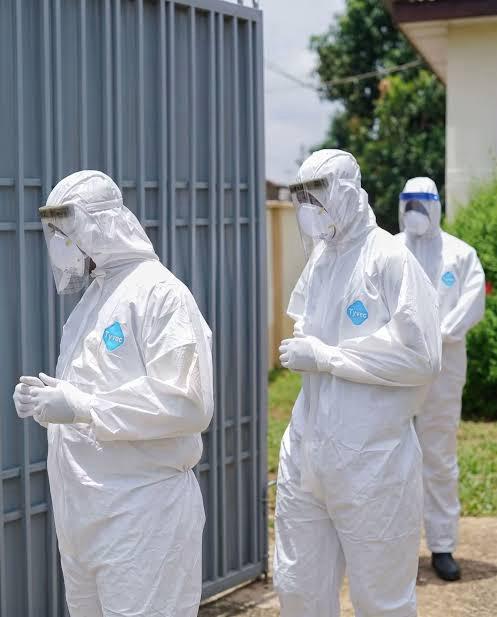
The current identification of these two suspected cases suggests that the surveillance systems are functioning as intended. By detecting individuals showing symptoms that align with the Ebola case definition, health officials can intervene before the virus has an opportunity to spread in crowded or underserved communities. Epidemiologists suggest that the success of this current containment effort will depend on the speed of laboratory verification and the ability of local health authorities to track all primary and secondary contacts of the two individuals.
Official Guidance and Public Health Measures
In its statement, the NCDC underscored the importance of community participation in preventing the spread of infectious diseases. The agency reiterated the fundamental pillars of hygiene:
- Hand Hygiene: Frequent washing of hands with soap and water or the use of alcohol-based hand sanitizers remains the most effective way to prevent transmission.
- Sanitation: Enhanced environmental cleaning, particularly in shared spaces, is essential.
- Reporting: The NCDC urged the public to report any individual presenting with unexplained high fever, bleeding, or symptoms associated with hemorrhagic fever to the nearest health facility immediately.
- Adherence to Protocols: Residents are advised to follow official guidance from the NCDC and the Federal Ministry of Health, rather than relying on unverified information circulating on social media platforms.
The agency has confirmed that it is providing updates to the public as verified information becomes available. This transparency is intended to mitigate panic while ensuring that the public remains informed about the necessary precautions.
Analytical Perspective: Implications for National Security
The emergence of a potential Ebola outbreak in Nigeria has implications that extend beyond clinical medicine; it touches upon economic stability and national security. The 2014 outbreak caused significant disruption to the aviation and hospitality industries, and a resurgence of the virus could potentially trigger travel restrictions and economic slowdowns.
From a geopolitical standpoint, the international community watches Nigeria closely due to its status as the most populous country in Africa. An uncontrolled outbreak would represent a significant public health failure, whereas a swift containment demonstrates regional leadership and institutional maturity. The current NCDC strategy appears to be one of "preemptive caution"—treating the two cases as potentially confirmed to ensure that all containment protocols are activated at the highest level of efficiency.
Chronology of the Current Alert
- October 31, 2026 (Early Morning): Preliminary symptoms were noted in two individuals within the North-East region. Local health facilities performed initial assessments.
- October 31, 2026 (Mid-Day): The cases were flagged as "suspected" based on the standard Ebola case definition. Isolation protocols were initiated immediately.
- October 31, 2026 (3:13 PM): The NCDC issued a public statement via their X handle, confirming the existence of the suspected cases and outlining the ongoing response.
- Ongoing: Laboratory samples have been secured and transported to the appropriate national diagnostic centers. Contact tracing teams are actively identifying anyone who may have interacted with the individuals during their symptomatic period.
Conclusion and Future Outlook
The coming days will be critical in determining the trajectory of this situation. If the laboratory tests return negative, it will be a testament to the efficacy of the current surveillance system in identifying and isolating illnesses that mimic Ebola. If the results are positive, the government is prepared to scale up its response, leveraging the experience of previous interventions.
The Nigerian government, through the NCDC, remains the sole authority for official updates on this matter. The public is advised to maintain a standard of vigilance, support the efforts of health workers, and prioritize factual, evidence-based reporting. The NCDC has reiterated its commitment to protecting the health of Nigerians and will continue to provide updates as soon as laboratory results are confirmed. For now, the situation is contained, the patients are isolated, and the robust public health machinery of the Nigerian state is in full motion to ensure that any potential threat is neutralized before it can pose a wider risk to the population.