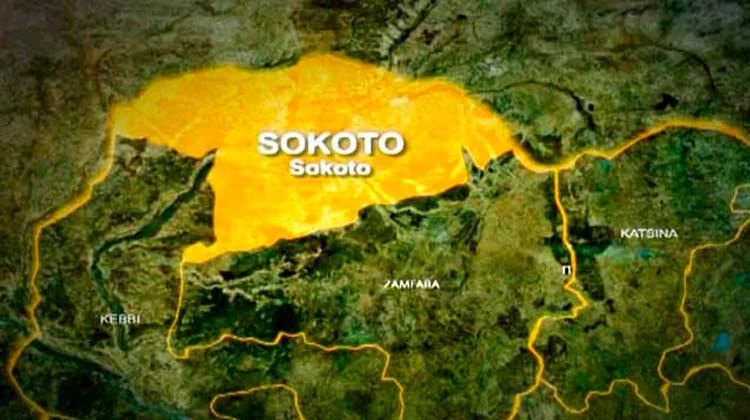
The Sokoto State Government has officially sealed the state secretariat of the African Democratic Congress (ADC) following a violent confrontation between party supporters and suspected miscreants. The decisive action, announced on Monday by the Sokoto State Commissioner for Lands and Housing, Nasiru Dantsoho, is aimed at preserving public order, safeguarding lives, and protecting property within the metropolis. According to state authorities, the sprawling property—located in a high-density commercial and political zone of the state capital—is currently shrouded in legal ambiguity concerning its true ownership.
Preliminary investigations conducted by the Ministry of Lands and Housing revealed that the disputed building originally belonged to the now-defunct Savannah Bank of Nigeria, an institution that suffered liquidation decades ago. State officials noted that official land registries and archives contain no documented evidence indicating that the title of the property was ever legally transferred to any private individual, corporate entity, or political organization following the bank’s collapse. Consequently, the state government has intervened to halt further hostilities while formally engaging the Nigeria Deposit Insurance Corporation (NDIC), the statutory liquidator and custodian of assets belonging to failed financial institutions in Nigeria, to ascertain the true administrative and legal status of the real estate.
The dramatic sealing of the opposition party’s office highlights the volatile intersection of property rights, regulatory oversight, and competitive party politics in northwestern Nigeria. As political realignments gather momentum ahead of future electoral cycles, the incident underscores the vulnerability of disputed commercial and corporate assets to political repurposing, often resulting in security flashpoints that demand swift administrative intervention.
Chronology of Events and Escalating Tensions
The events leading up to the government’s intervention unfolded over several weeks, characterized by rising local anxieties over the occupation of the contested building. The property, which had remained largely dormant for years following the winding down of Savannah Bank’s operations, recently became a beehive of political activity after it was purportedly leased or acquired by stakeholders of the African Democratic Congress to serve as their state headquarters.
The timeline of the crisis escalated rapidly in the days preceding the government directive:
Phase One: Initial Occupation and Retrofitting. ADC loyalists and party officials moved into the premises, commencing internal and external renovations to brand the structure with party colors, insignia, and signage. Local residents reportedly raised initial concerns regarding the sudden change of occupancy, given the building’s long-standing association with the liquidated financial institution.
Phase Two: The Confrontation. Tensions boiled over when a violent clash erupted outside the secretariat. Eyewitness accounts indicate that party supporters and a yet-unidentified group of individuals—described by authorities as suspected miscreants—engaged in a physical altercation. The fracas caused considerable panic in the neighborhood, disrupting vehicular traffic and resulting in minor injuries and property damage. The violence drew the immediate attention of state security architecture, prompting emergency deployments to restore calm.
Phase Three: Government Intervention and Verification. Prompted by the security breach, the Ministry of Lands and Housing launched an immediate documentary audit of the land title and Certificate of Occupancy associated with the property. The review confirmed the asset’s original registration under Savannah Bank.
Phase Four: Official Communication with NDIC. Recognizing the federal statutory jurisdiction over assets of liquidated banks, the Sokoto State Government dispatched formal inquiries to the Nigeria Deposit Insurance Corporation. As of press time, state authorities are awaiting a formal administrative response from the NDIC to clarify whether any lawful liquidation sale, lease authorization, or title transfer was ever executed regarding the property.
Phase Five: Enforcement of the Seal. Citing the imperative to prevent a recurrence of violence, Commissioner Dantsoho announced the immediate sealing of the premises. Security personnel were deployed to secure the perimeter, restricting access to all parties until the ownership dispute is conclusively resolved.
Regulatory Framework and the Role of the NDIC
The core of the Sokoto State dispute hinges on asset management protocols governing liquidated banks in Nigeria. Under the Nigerian banking and insurance legal framework, the Nigeria Deposit Insurance Corporation acts as the official liquidator for banks whose licenses have been revoked by the Central Bank of Nigeria (CBN). In this capacity, the NDIC assumes legal custody of all physical assets, real estate, liabilities, and debtor portfolios belonging to the defunct institution.
Real estate assets belonging to liquidated entities such as Savannah Bank are typically disposed of through transparent, regulated public auctions or formal lease agreements approved by the corporation’s management board, in alignment with statutory asset-disposal guidelines. Any acquisition, transfer, or occupation of such properties devoid of verifiable documentation from the NDIC constitutes a violation of federal receivership protocols.
State Commissioner Nasiru Dantsoho emphasized this regulatory reality during his media briefing, stating that the government’s actions are strictly grounded in due diligence.
"Following a review of the Certificate of Occupancy and other relevant documents, we discovered that this property belongs to the Savannah Bank, and that ownership has not changed as of today," Dantsoho declared. "We have written to the NDIC, the custodian of this building, to clarify its present ownership, but we are yet to receive a response."
The commissioner reiterated that the state government holds no proprietary interest in the property itself but is compelled to act as an impartial arbiter of public safety. By sealing the building, the state aims to freeze the status quo, preventing any party from establishing operational facts on the ground through self-help or intimidation.
Reactions and Political Implications
The closure of the ADC office has triggered diverse reactions across the political spectrum in Sokoto State, illuminating the delicate balance between maintaining law and order and preserving democratic spaces for opposition politics.
From the perspective of state authorities, the move is framed purely as an administrative and security imperative. Officials maintain that the state government has a constitutional obligation to protect citizens from politically motivated violence and to ensure that abandoned or disputed properties do not become epicenters of criminal turf wars. The government has issued a clear directive to anyone laying claim to the property to come forward with legitimate documentation.
"We urge anyone claiming ownership of the building to submit relevant documents to the ministry for verification and proper documentation," Dantsoho stated. He added that the property would be promptly handed over to whoever establishes legitimate, lawful ownership backed by verifiable statutory approvals. However, he maintained a firm posture regarding compliance, warning that the premises will remain under lock and key until the process is completed.
"Anyone attempting to forcefully gain access to the building despite the government’s action will face the full weight of the law," he cautioned.
Conversely, opposition circles and civil society observers have expressed cautious concern over the timing and broader implications of the government’s action. The sealing occurs against a backdrop of heightened political tension in Sokoto State, marked by recent allegations of friction between opposition actors and state-backed security formations. Critics argue that while the preservation of public peace is paramount, state-level interventions in property disputes involving opposition party offices can inadvertently feed perceptions of executive overreach or political censorship.
Political analysts note that opposition parties operating in sub-national jurisdictions frequently face logistical hurdles in securing administrative spaces due to historical patronage networks and the widespread distribution of commercial real estate tied to government or defunct corporate bodies. When such properties become entangled in protracted legal or regulatory limbo, opposition secretariats become acutely vulnerable to administrative disruptions.
Broader Impact on Sokoto’s Political Landscape
The Sokoto State ADC office controversy carries several broader implications for governance, rule of law, and political competition within the state:
First, it highlights the lingering legacy liabilities of Nigeria’s historical banking sector reforms. Numerous properties formerly owned by banks liquidated during past financial system consolidations remain legally orphaned or inadequately documented in state land registries, creating fertile ground for land grabbing, fraudulent sales, and protracted litigation.
Second, the incident tests the efficacy of inter-governmental coordination between state land ministries and federal regulatory bodies like the NDIC. Efficient resolution of such disputes relies heavily on rapid administrative responses from federal agencies to preempt local security escalations. Delays in communication between federal custodians and state land authorities can inadvertently exacerbate local political friction.
Third, the development underscores the imperative for political parties to conduct rigorous legal and title due diligence before committing financial and organizational resources to acquiring or leasing secretariat facilities. Relying on third-party assurances without verifying foundational titles with relevant statutory bodies exposes political organizations to sudden disruptions.
As Sokoto State awaits official clarification from the Nigeria Deposit Insurance Corporation, the sealed ADC secretariat stands as a physical manifestation of unresolved property rights colliding with the high-stakes arena of state politics. How the state government, the NDIC, and the opposition party navigate the subsequent verification phases will serve as a critical test of institutional transparency, adherence to the rule of law, and the preservation of democratic pluralism in the region.