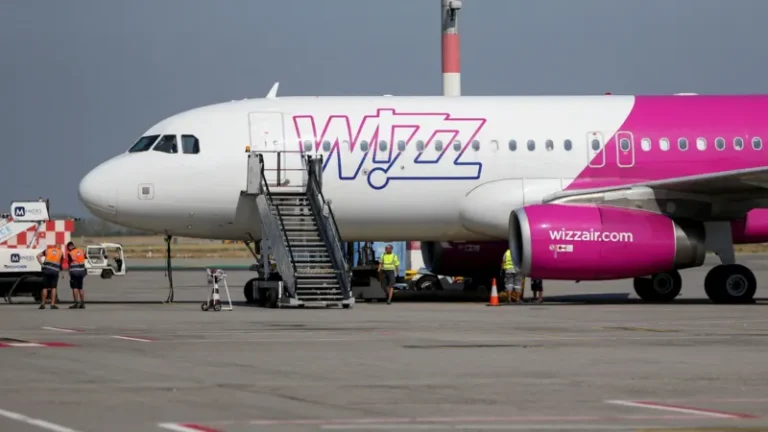
The aviation industry was put on high alert on Monday, November 2, 2026, when a Wizz Air commercial flight, operating from London Luton Airport to Sofia, Bulgaria, was forced to execute an emergency diversion due to a credible bomb threat received while the aircraft was in transit. The incident, which triggered a significant international security response involving Hungarian military assets, highlights the stringent protocols governing modern commercial aviation safety and the logistical complexities of mid-air security contingencies.
Chronology of the Emergency Diversion
According to flight telemetry data provided by Flightradar24, the aircraft—an Airbus A320-family jet—departed London Luton Airport on schedule, heading southeast toward the Bulgarian capital. The flight progressed uneventfully through European airspace until it reached the vicinity of Bosnia and Herzegovina. It was at this juncture, according to preliminary reports, that the flight crew received information regarding a potential security breach in the form of a bomb threat.
Upon receiving the threat, the flight crew immediately initiated emergency diversion protocols. The decision was made to land at the nearest suitable major hub capable of handling a high-security incident: Budapest Liszt Ferenc International Airport. The transition from the planned flight path to the diversion route occurred rapidly, with the aircraft altering its heading toward Hungary.
As the aircraft entered Hungarian airspace, the Hungarian Defence Ministry took swift action. Defence Minister Romulusz Ruszin-Szendi confirmed that a Hungarian Air Force JAS 39 Gripen fighter jet was scrambled to intercept and escort the commercial airliner. This measure is standard practice under NATO’s air policing protocols, ensuring that a compromised aircraft is monitored and directed safely to its designated landing zone. The jet escorted the Wizz Air flight until it touched down safely at Budapest at approximately 18:58 local time. Upon landing, the plane was directed to a remote, isolated stand—a standard safety procedure intended to minimize risk to airport infrastructure and other passengers.
Official Responses and Security Protocols
Wizz Air issued a formal statement shortly after the landing, confirming the diversion and the nature of the threat. The airline emphasized that the safety of passengers and crew remains the primary objective in all operations. "Wizz Air confirms that today’s London Luton–Sofia flight was diverted to Budapest following a bomb threat received during the flight," the carrier stated. The airline further noted that it is working in full cooperation with local and international law enforcement agencies to investigate the origin and legitimacy of the threat.
Hungarian authorities took charge of the situation immediately upon the aircraft coming to a halt. Local police, working in conjunction with airport security and emergency services, commenced a rigorous inspection of the aircraft. Passengers were deplaned in a controlled environment to allow for a thorough sweep of the cabin and the cargo hold, utilizing both specialized personnel and canine units.
The Hungarian Defence Minister provided updates via social media, noting that the escorting Gripen fighter jet successfully returned to its base in Kecskemét, central Hungary, once the aircraft was confirmed to be safely on the ground and under the supervision of law enforcement. As of late Monday evening, the airport authorities were conducting forensic analysis on the aircraft to ensure no explosive devices were present, while passengers were being provided with necessary support and alternate transit arrangements.
Aviation Security and the Threat Landscape
The incident on November 2, 2026, serves as a stark reminder of the persistent threats faced by the global aviation industry. Bomb threats, whether hoaxes or credible warnings, pose significant challenges to flight crews who must balance the immediate safety of passengers with the logistical requirements of an emergency landing.
Aviation experts note that when a threat is received in-flight, the flight crew evaluates the information based on internal security protocols. These protocols involve communication with air traffic control, intelligence agencies, and the airline’s operations center. Once a decision is made to divert, the primary challenge is finding an airport with the capability to manage the aircraft away from busy terminals. Budapest Liszt Ferenc International Airport, a key hub for Central European transit, is well-equipped for such contingencies, having designated secure zones for aircraft undergoing emergency security checks.
Statistically, while the vast majority of bomb threats against commercial flights are found to be hoaxes intended to disrupt operations, the aviation industry treats every such alert as a "worst-case scenario." The cost of such a diversion is substantial, encompassing fuel consumption, airport handling fees, passenger rebooking costs, and the operational loss of the aircraft while it is grounded for security sweeps.
Broader Implications for European Air Travel
The diversion of the Wizz Air flight carries implications that ripple across the European aviation network. Firstly, it underscores the effectiveness of the integrated European air defense system. The rapid response of the Hungarian Air Force demonstrates the high level of coordination between military and civil aviation authorities in the region.
Secondly, the incident brings into focus the psychological impact on travelers. The sudden shift from a routine flight to an emergency landing accompanied by military fighter jets is a traumatic event for passengers. Airline crisis management teams are now tasked with ensuring that those on board receive not only the logistical assistance required to reach their final destination but also the psychological support needed following such a high-stress security event.
Thirdly, this event will likely trigger a deeper investigation by both British and Hungarian authorities. Determining the source of the bomb threat is paramount. In recent years, international law enforcement agencies have intensified efforts to track down individuals responsible for issuing false security alerts, which are treated as serious criminal offenses. Such acts are often prosecuted under international aviation safety laws, which carry heavy penalties, including imprisonment and substantial financial restitution for the costs incurred by the airlines and airports.
Future Outlook and Technological Considerations
As aviation security continues to evolve, the industry is increasingly relying on advanced data analytics and communication systems to detect and mitigate threats before they escalate. Modern aircraft are equipped with sophisticated systems that allow for real-time communication with ground-based security centers. This ensures that when a threat is received, the information is processed with the highest degree of accuracy.
However, the human element remains a critical factor. The professionalism of the flight crew, who remained composed throughout the transition from London to Budapest, is the most important safeguard in the event of an in-flight crisis. Their adherence to established emergency procedures ensured that the situation remained under control, preventing panic and ensuring the safety of all individuals on board.
The incident also highlights the necessity for ongoing cooperation between low-cost carriers and government security agencies. As Wizz Air continues to expand its footprint across Europe, its ability to manage these complex security environments remains a testament to the rigorous training programs implemented by the airline. The cooperation with Hungarian authorities in this instance has been described as seamless, serving as a model for how nations should collaborate to maintain the safety of the skies.
Conclusion
The diversion of the London-to-Sofia Wizz Air flight on November 2, 2026, is a significant event that necessitates careful scrutiny. While the outcome was positive—with no injuries reported and the aircraft safely secured—the incident serves as a sobering reminder of the ongoing security challenges inherent in modern air travel. As the investigation into the source of the bomb threat proceeds, the aviation industry will continue to emphasize that safety protocols, while inconvenient, are the absolute bedrock of commercial aviation. For the passengers and crew involved, the day was one of unexpected peril, but for the international aviation community, it was a successful execution of security procedures designed to protect life above all else. The vigilance of the Hungarian Defence Forces and the efficiency of the Budapest airport ground crew were instrumental in resolving a potentially catastrophic situation with minimal disruption to the wider European transit network. As global travel demand continues to rise, the maintenance of such robust security measures will remain a non-negotiable priority for carriers and regulators alike.