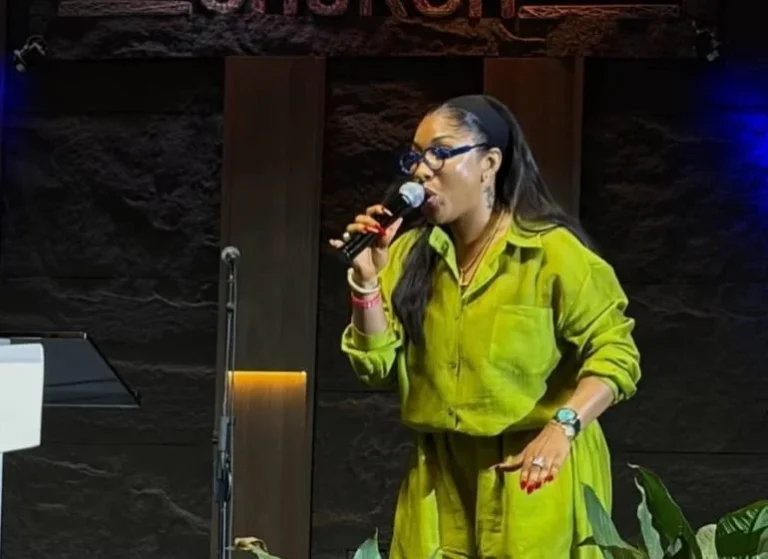
Nollywood actress and prominent public figure Tonto Dikeh has sparked widespread public discourse following a recent address at her newly established religious institution, the New Wine Prophetic Tabernacle (NWPT). During the service, which has since drawn significant attention across various digital platforms, the celebrated actress and entrepreneur directly challenged entrenched societal stereotypes surrounding wealth acquisition in Nigeria. Her remarks specifically targeted the prevalent cultural assumptions that automatically attribute male affluence to ritualistic practices and female success to transactional relationships with men.
The address, captured in a video clip that quickly circulated on the social media platform X (formerly Twitter), highlights a growing shift in Dikeh’s public profile as she transitions further into spiritual leadership. Speaking passionately to her congregation, the actress emphasized that financial success is frequently the product of relentless hard work, the monetization of natural talents, inherited advantages, and adherence to universal economic principles rather than illicit activities. Her comments have since ignited extensive commentary regarding societal cynicism, gender biases in wealth accumulation, and the evolving intersection of celebrity culture and religious leadership in contemporary Nigeria.
Background Context of New Wine Prophetic Tabernacle and Dikeh’s Spiritual Evolution
Tonto Dikeh’s recent foray into religious leadership represents a notable chapter in her multifaceted career. Best known for her extensive contributions to the Nigerian film industry—commonly referred to as Nollywood—Dikeh has spent over a decade maintaining a dominant presence in entertainment, media, and philanthropic circles. However, her transition into the spiritual sphere materialized visibly in August, when she officially unveiled the New Wine Prophetic Tabernacle (NWPT), describing the institution as a dedicated spiritual sanctuary designed for consecrated believers.
The development of the ministry progressed further in October, a milestone marked by the official laying of the foundation stone for the church’s permanent physical structure. Since the establishment of NWPT, Dikeh has increasingly utilized the platform to address not only traditional theological doctrines but also practical socioeconomic issues affecting her congregation and the broader Nigerian populace. Her recent sermon on wealth and societal judgment is part of a broader series of teachings focused on personal empowerment, financial literacy, spiritual discipline, and dismantling toxic cultural narratives. Observers note that this evolution reflects a concerted effort by the actress to redefine her public persona, moving from a purely entertainment-centric celebrity to a multifaceted voice of authority on social and spiritual matters.
The Mechanics of Wealth Creation According to Tonto Dikeh
During her address to the New Wine Prophetic Tabernacle congregation, Dikeh articulated a structured philosophy regarding how individuals can achieve financial independence and prosperity. Moving away from mystical explanations of wealth, she grounded her teachings in personal responsibility, capability enhancement, and economic alignment.
“There’s so much power in you to produce wealth, and yes, some of us are wealth. We don’t have wealth. We are the wealth,” Dikeh told her listeners, framing financial capability as an innate human potential rather than an external stroke of luck.
Expanding on this concept, the Nollywood star outlined a tripartite framework for achieving prosperity. First, she stressed the importance of self-discovery and internal capability. Second, she urged attendees to actively refine their talents and gifts, arguing that latent abilities hold little economic value until they are systematically developed and commercialized. Third, she pointed to what she termed the “universal system of prosperity,” suggesting that economic laws operate independently of moral standing and reward diligence, innovation, and strategic execution.
By emphasizing talent, skill refinement, and universal economic principles, Dikeh sought to demystify the process of wealth creation, encouraging her followers to look inward and focus on productivity rather than waiting for external windfalls or engaging in counterproductive envy.
Deconstructing Societal Cynicism and Wealth Stereotypes in Nigeria
A central focus of Dikeh’s sermon was a direct critique of the cultural cynicism that frequently shadows financial success in Nigeria. In a society where displays of wealth are often met with immediate skepticism, the actress condemned the automatic labeling of successful individuals as criminals, fraudsters, or ritualists.
“So when you see him [someone] driving a Lamborghini, you’re like, ‘Hmm, he’s a ritualist.’ Not every rich man is a ritualist,” Dikeh stated bluntly, challenging the cynicism that often trivializes genuine entrepreneurial efforts, corporate triumphs, and technological innovations within the country.
Furthermore, Dikeh addressed the persistent misogynistic tropes that undermine the financial achievements of women. She strongly criticized the assumption that financially independent women acquire their assets exclusively through male patronage or immoral conduct.
“Not every rich woman is sleeping with a man. Get it into your head,” she asserted. “Some people work hard earnestly and don’t even know God, because they discovered a gift in them and they did not let it sleep.”
Through these remarks, Dikeh highlighted a well-documented sociological phenomenon in developing economies: the deep-seated skepticism toward rapid upward mobility. By acknowledging that individuals can achieve immense financial success through hard work and talent—even outside strict religious frameworks—she introduced a pragmatic perspective that separates economic productivity from moral or spiritual perfectionism.
Inclusive Theology: Redefining the Boundaries of Divine Grace
In addition to addressing socioeconomic stereotypes, Dikeh used her platform at the New Wine Prophetic Tabernacle to challenge conventional religious exclusivity. Her theological remarks touched upon the universal nature of the divine, rebuking the notion that God’s grace, favor, or existence is restricted exclusively to self-identified religious believers.
“Who told you God is only for you as a believer? No. That’s why I laugh at all of you. And I said to God, I said, ‘I hope these people just understand that God is a God for everybody,’” she elaborated to her congregation.
Dikeh emphasized a theology of radical inclusivity, drawing parallels to foundational biblical narratives regarding divine pursuit and mercy. “The unbelievers and the believers alike. And none is more important. As a matter of fact, He is the one who will leave the ninety-nine and chase after the one.”
This perspective represents a departure from insular religious rhetoric, positioning the New Wine Prophetic Tabernacle as an institution open to broader philosophical and humanistic understandings of spirituality. Analysts of contemporary Nigerian religious movements note that such messages resonate strongly in urban centers, where pluralism and skepticism toward dogmatic religious gatekeeping are increasingly prevalent among younger demographics.
Broader Socioeconomic Implications and Public Reactions
Tonto Dikeh’s remarks at the New Wine Prophetic Tabernacle have generated extensive dialogue across mainstream media and digital networks, underscoring the significant influence of celebrity figures in shaping public discourse in Nigeria. The intervention comes at a time when discussions surrounding wealth generation, economic hardship, and systemic corruption occupy a central place in the national consciousness.
Sociological and economic analysts point out that Dikeh’s critique touches upon a vital psychological barrier in entrepreneurial development: the fear of success and the societal backlash associated with wealth display. In environments where sudden wealth is frequently criminalized in the court of public opinion, aspiring entrepreneurs may face undue psychological pressure. By validating hard work, talent, and universal economic laws, Dikeh’s message provides a counter-narrative that encourages productivity while denouncing the glorification of poverty or the automatic vilification of success.
Moreover, her defense of financially independent women addresses a critical gender equity issue. In patriarchal structures, successful women often encounter systemic skepticism that attributes their professional milestones to compromised morals rather than competence, strategic vision, or professional endurance. Dikeh’s explicit rejection of these tropes has been widely praised by women’s advocacy groups and gender equality commentators as a necessary pushback against internalized misogyny.
Timeline of Key Events Leading to the Address
The recent discourse surrounding Tonto Dikeh follows a carefully documented timeline of personal, professional, and spiritual milestones over the past year:
- August: Tonto Dikeh officially unveiled the New Wine Prophetic Tabernacle (NWPT), defining it as a spiritual home for consecrated believers and marking her formal entry into institutional religious leadership.
- October: The Nollywood actress and ministry founder laid the physical foundation for the permanent building of the New Wine Prophetic Tabernacle, signaling long-term institutional commitment to the ministry.
- Recent Weeks: A video recording of Dikeh addressing her congregation at NWPT circulated widely on digital platforms, particularly on X, capturing her controversial yet widely discussed comments on wealth stereotypes, talent development, and divine inclusivity.
- Ongoing: Public reactions continue to unfold across social media, blending debates on celebrity-led ministries, gender biases in wealth acquisition, and the cultural psychology of money in Nigeria.
Fact-Based Analysis of the Discourse
The convergence of celebrity status and religious ministry in Nigeria is not unprecedented; several notable figures from the entertainment and media industries have historically transitioned into spiritual leadership roles. However, Dikeh’s approach—characterized by candid social commentary, the dismantling of patriarchal narratives, and an inclusive theological stance—differentiates her platform from conventional ecclesiastical models.
From an analytical standpoint, Dikeh’s messaging performs a dual function. Economically, it reinforces the narrative that national development relies on innovation, skill acquisition, and productivity rather than fatalism or cynicism. Culturally, it confronts the toxic elements of social surveillance that often accompany wealth accumulation in developing societies. While debates persist regarding the monetization of celebrity influence within the religious sector, Dikeh’s recent statements have undeniably repositioned her as a formidable voice capable of steering national conversations toward accountability, equity, and progressive mindset shifts.
As the New Wine Prophetic Tabernacle continues to develop its physical infrastructure and expand its congregation, observations indicate that Tonto Dikeh will remain a central figure in the intersection of Nigerian pop culture, socioeconomic critique, and spiritual reform. Her ability to leverage her platform to address systemic cultural biases ensures that her transition from the silver screen to the pulpit will continue to command significant public and analytical interest.