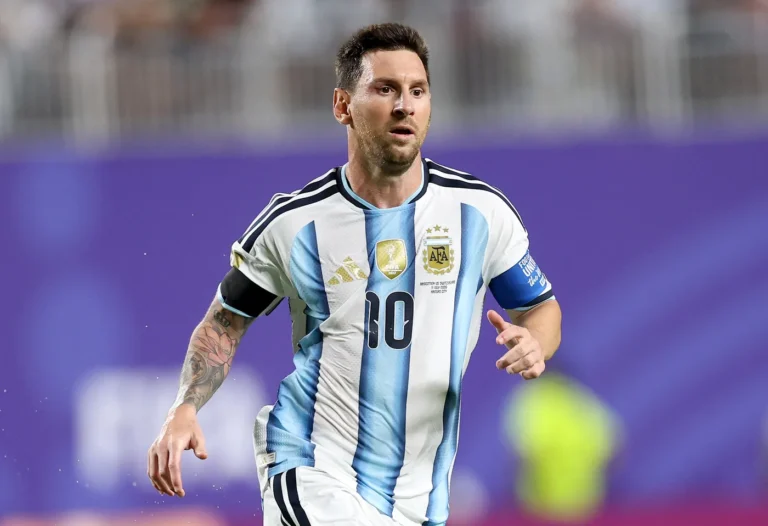
The pursuit of excellence in professional sports often demands an all-consuming focus on physical conditioning, tactical awareness, and match-day performance, frequently leaving little room for the academic or linguistic pursuits that define a well-rounded education. For Lionel Messi, the eight-time Ballon d’Or winner widely considered the greatest footballer of his generation, this narrow focus has left a lingering sense of professional and personal shortcoming. In a candid appearance on the Miro de Atrás podcast, the Argentine icon revealed that his failure to learn English during his youth remains one of his most significant personal regrets, highlighting a disconnect between his unparalleled mastery on the pitch and his capabilities in the global linguistic landscape.
A Candid Reflection on Missed Opportunities
During the interview, Messi reflected on his younger years, acknowledging that he possessed both the time and the cognitive capacity to acquire a second language but ultimately chose to prioritize his footballing development to the exclusion of academic enrichment. "I didn’t do it, and I regret it a lot," Messi admitted, speaking with a level of vulnerability that rarely surfaces in the highly curated world of elite sports PR. The admission serves as a poignant reminder that even those who reach the pinnacle of human achievement are subject to the same regrets regarding missed developmental opportunities as any other individual.
For decades, Messi has navigated a career that moved him from the youth academies of Rosario, Argentina, to the global stage in Barcelona, Paris, and now Miami. Throughout this trajectory, he has worked with teammates, coaches, and staff from virtually every continent. Yet, despite his professional success, the language barrier has consistently persisted, necessitating the use of translators and limiting his ability to communicate directly with an international audience.
The Chronology of a Global Career and the Language Barrier
The timeline of Messi’s career provides context as to why this regret has become more pronounced in recent years. Born in 1987 in Rosario, Argentina, Messi’s early life was almost entirely dedicated to Newell’s Old Boys before his high-profile move to FC Barcelona in 2001 at age 13. During his formative years in Catalonia, his primary linguistic focus was mastering Spanish and Catalan, the latter being essential for integration into the club’s youth academy, La Masia.
Between 2004 and 2021, Messi’s tenure at FC Barcelona saw him transcend the sport. However, his interactions with the media and international sponsors remained largely conducted in Spanish. It was not until his 2021 move to Paris Saint-Germain (PSG) that the necessity of a broader linguistic repertoire became apparent. Operating in a locker room filled with players from Brazil, Italy, France, and Spain, the nuances of communication were vital for team cohesion.
The current chapter of his career—his tenure with Inter Miami CF in Major League Soccer (MLS)—has arguably brought the English language issue to the forefront. Living in the United States, a country where English is the primary language of commerce, media, and daily social interaction, Messi is now immersed in an environment where his inability to speak the language represents a tangible hurdle to total assimilation.
The Socio-Economic Data of Athlete Education
The intersection of professional sports and education is a subject of significant academic inquiry. Research from organizations such as the FIFPRO (the worldwide representative organization for professional footballers) suggests that a high percentage of elite athletes enter professional environments with significant gaps in their formal education. The "career transition" problem is well-documented: athletes who focus exclusively on sport often struggle to navigate life after retirement because they lack the transferable skills, such as fluency in international languages, required for corporate, broadcasting, or coaching roles.
According to data regarding the professional development of elite footballers, approximately 65% of players in major European leagues report that they do not possess proficiency in a language other than their native tongue or the language of their host country. In a globalized economy, this lack of linguistic versatility is not merely a social inconvenience; it is a financial one. Athletes with high levels of linguistic competence are statistically more likely to secure lucrative endorsement deals, international media contracts, and post-retirement management positions. Messi’s admission, while personal, sheds light on an systemic issue within youth sports academies that prioritize immediate physical output over long-term cognitive and linguistic utility.
Analytical Perspectives: The Cost of Communication Barriers
From a communication standpoint, the implications of Messi’s limited English are twofold. First, there is the aspect of brand management. As a global icon, Messi’s reach is hindered when his messages must be mediated through an interpreter. In the digital age, where direct-to-fan engagement via social media is the currency of influence, the ability to communicate authentically in English would allow Messi to engage directly with millions of fans in Asia, North America, and Northern Europe.
Second, there is the tactical and leadership implication. While Messi’s on-field communication is largely non-verbal—manifesting through vision, spatial awareness, and body language—there are moments in team sports where clear, immediate verbal instruction is required. Coaches and former teammates have noted that while Messi’s leadership style is often quiet and lead-by-example, a deeper mastery of English could have allowed him to take a more vocal role in international dressing rooms.
However, it is important to note that Messi’s success has remained unaffected by this limitation. His trophy cabinet, containing eight Ballon d’Or awards, four UEFA Champions League titles, and a FIFA World Cup, serves as empirical evidence that linguistic barriers do not impede technical excellence. Analysts suggest that Messi’s reliance on his primary language has allowed him to maintain a sense of "cultural groundedness," which has been central to his persona as a relatable, humble figure despite his god-like status in the world of sports.
Responses and The Lessons for Future Generations
The reaction to Messi’s comments has been largely sympathetic. Sports educators and youth coaches have utilized his statement as a "teachable moment." By acknowledging his own regret, Messi has inadvertently provided a blueprint for how young athletes should view their development. The consensus among sports psychologists is that athletes should treat their education with the same discipline as their training regimens.
"It is a paradox of the modern athlete," says Dr. Elena Rossi, a sports sociology researcher. "They are global celebrities who operate in local bubbles. Messi’s honesty encourages a shift in the culture of youth sports. If the greatest player of all time regrets not learning a language, it sends a powerful message to a 14-year-old in an academy that the classroom is as important as the training pitch."
There is no indication that Messi intends to stop his professional journey anytime soon, but his comments suggest a shift in his personal priorities. Whether he chooses to dedicate time to learning English now remains to be seen. Some argue that at this stage in his career, the mental energy required to master a new language might be better spent on his ongoing performance on the field. Others suggest that learning even a conversational level of English would greatly enrich his life in Miami and his potential future in international football management or broadcasting.
The Broader Implications for Global Sports Culture
Messi’s reflection on his missed educational opportunities serves as a broader commentary on the culture of elite athletics. In an era where players are scouted as early as age 10 or 11, the pressure to "specialize" can lead to a narrowing of horizons. The professionalization of youth sports, while creating higher levels of skill, often comes at the expense of a well-rounded upbringing.
The legacy of Lionel Messi will undoubtedly be defined by his goals, his assists, and his titles. Yet, by choosing to share his regret regarding the English language, he has added a layer of human complexity to his narrative. He has moved beyond the image of a flawless footballing machine to reveal an individual who, like many others, looks back on his younger self and identifies paths not taken.
Ultimately, Messi’s story is a reminder that success is multidimensional. While his professional achievements are absolute and untouchable, his personal growth continues. For the next generation of footballing stars, the lesson is clear: the mastery of the game is temporary, but the acquisition of knowledge—including the ability to bridge linguistic divides—is an investment that pays dividends long after the final whistle blows. As Messi continues to navigate his final years in the sport, his reflection remains a poignant look at the trade-offs inherent in the life of a global superstar, proving that even at the pinnacle of human achievement, there is always more to learn.