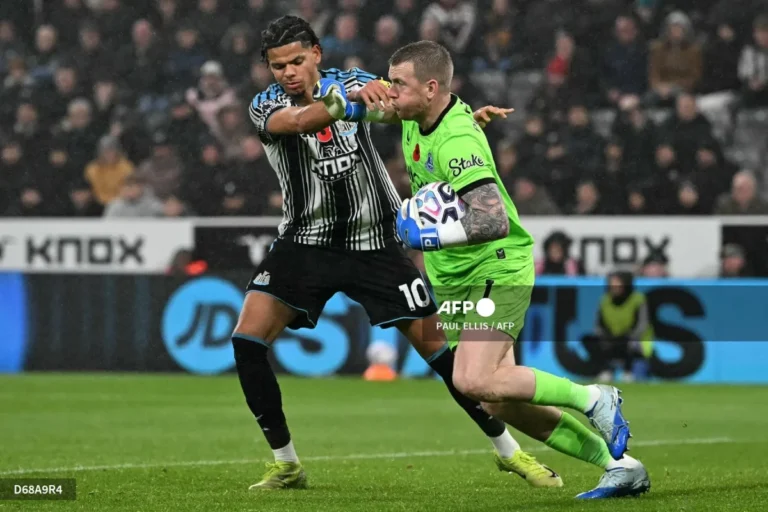
The modern landscape of the English Premier League is characterized by relentless scrutiny, microscopic financial oversight, and an unforgiving demand for immediate results. On a rain-swept Monday evening in the northeast of England, the stark reality of this environment claimed another narrative casualty as Everton traveled to St James Park and secured a hard-fought 1-0 victory against Newcastle United. The defining moment of the fixture arrived just four minutes into the second half, when French forward Thierno Barry capitalized on defensive frailties to net his eighth goal of the campaign. The strike not only propelled the Toffees up to seventh place in the league standings but also plunged their hosts into a deepening sporting crisis, leaving Newcastle languishing in 13th position and intensifying the pressure on first-year manager Matthias Jaissle.
For a club backed by the immense financial power of Saudi Arabia’s Public Investment Fund, the current trajectory is a source of acute frustration among supporters and board members alike. The defeat compounded a miserable run of form that has seen the Magpies lose four of their past five matches across all competitions, tasting victory just twice in their last seven outings. As the final whistle blew, echoing through the cold Tyneside air, it was met by a chorus of vehement boos—a soundtrack that has become grimly familiar during a tumultuous transition season that follows the surprise departure of long-serving manager Eddie Howe during the preceding summer.
Chronology of the Match and Tactical Breakdown
The encounter began with a brief flurry of optimism for the home supporters. Buoyed by the atmospheric cauldron of St James Park, Newcastle sought to establish early dominance. Winger Harvey Barnes carved out the game’s first notable opening, driving a low shot narrowly past the upright, before Brazilian midfielder Joelinton tried his luck from 25 yards out, sending his effort just over Jordan Pickford’s crossbar. However, these sporadic flashes of intent quickly evaporated, devolving into a scrappy, disjointed affair defined more by perspiration than tactical inspiration.
Both midfields wrestled for control through a scoreless first half that offered precious little in terms of aesthetic quality or clear-cut opportunities. The deadlock was finally broken in the 49th minute through a sequence that encapsulated Newcastle’s defensive vulnerabilities. Tyrique George found space within the penalty area to unleash a low strike that lacked optimal power. Newcastle’s stand-in goalkeeper, Lukas Hornicek, could only palm the ball directly into the danger zone, where Barry was on hand to apply a straightforward finish from close range. The goal triggered a lengthy VAR review regarding a potential offside infraction, creating palpable tension inside the stadium before the officials ultimately validated the strike.
Trailing by a goal, Jaissle’s side attempted to mount a response, though their efforts were repeatedly thwarted by a resolute Everton defensive block. Swiss central defender Fabian Schar squandered a golden opportunity to restore parity when he blazed an effort wide of the target from a promising position inside the box. Moments later, Swedish forward Anthony Elanga came agonizingly close to equalizing, seeing his close-range effort clip the outside of the post and roll agonizingly along the goalline before the Everton defense scrambled the ball clear to safety.
Despite dominating possession in the latter stages, Newcastle’s attacking output remained astonishingly blunt. It took the hosts an alarming 86 minutes to register their first official shot on target, a routine claim by England international Jordan Pickford from a speculative effort by Yoane Wissa. Even as stoppage time unfolded, Wissa found himself denied once more by Pickford, who commanded his penalty area with authority. The evening’s frustrations culminated in disciplinary chaos during the dying seconds of the match, when midfielder Jacob Ramsey received two yellow cards within the span of 60 seconds, culminating in a red card for a crude, late challenge on Harrison Armstrong. Ramsey’s dismissal served as a fittingly chaotic punctuation mark to another miserable evening for the home side.
Broader Context and Historical Anomalies
The defeat reinforces a bizarre and concerning statistical trend for Newcastle United: their inability to secure results on the opening night of the traditional weekly work cycle. Historically and statistically, the Magpies have now suffered defeat in 22 of their last 33 Premier League fixtures played on a Monday. This recurring vulnerability has begun to drain the patience of the fanbase, many of whom were seen streaming toward the exits of St James Park well before the referee signaled the end of the match.
The timing of the fixture added an additional layer of psychological weight. The two clubs had met just five days prior in the fourth round of the League Cup, a match that also ended in a victory for Sean Dyche’s well-organized Everton side by a 3-1 scoreline. Winning back-to-back fixtures against the same opponent within a single week demonstrates a tactical clarity that Everton have managed to forge despite their own internal turbulence. For the Toffees, this result snaps a two-match league losing streak that featured consecutive defeats at the hands of traditional heavyweights Arsenal and Chelsea. Furthermore, it marks Everton’s first away league victory since February 28, a statistic that underscores their historical struggles on opposition turf.
The Jack Grealish Conundrum
While Everton’s collective defensive resilience and clinical finishing ultimately secured the three points, the build-up to the match was dominated by discussions surrounding high-profile absentee Jack Grealish. The on-loan Manchester City winger was omitted from the matchday squad for the second consecutive fixture following what the club formally described as a "breach of club discipline."
Reports indicate that Grealish skipped a crucial training session ahead of the initial League Cup encounter against Newcastle last week. Known throughout his career for a vibrant personality both on and off the pitch, the playmaker’s latest disciplinary infraction has tested the patience of the Everton technical staff. While club officials officially stated that Grealish was simply "not match fit" for the return journey to Tyneside, his continued absence highlights the delicate disciplinary tightrope managers must walk when integrating exceptionally talented, yet occasionally mercurial, modern footballers into a cohesive squad. Nevertheless, Everton’s professional execution at St James Park proved that the collective unit can absorb high-profile absences without sacrificing functional efficiency.
Management under the Microscope: The Plight of Matthias Jaissle
For Matthias Jaissle, the immediate future is fraught with peril. Transitioning from Red Bull Salzburg and Saudi Pro League side Al-Ahli to the high-stakes ecosystem of the English Premier League represents one of the steepest learning curves in modern professional sport. Inheriting a squad molded by Eddie Howe—a manager who successfully connected with the cultural identity of the region and built a competitive, high-intensity playing style—always carried inherent risks. Jaissle’s attempts to implement his own tactical philosophy have thus far yielded an inconsistent product characterized by a lack of defensive solidity and an increasingly blunt attacking vanguard.
The psychological toll of consecutive home defeats, compounded by audible supporter unrest at both the interval and the final whistle, places the German tactician under intense scrutiny from the club’s hierarchy. In modern football, the financial investments made by ownership groups dictate a zero-tolerance policy toward sustained stagnation. With the pressure mounting daily, Jaissle faces a defining fixture this coming weekend as Newcastle prepares to travel south to face fellow strugglers Fulham at Craven Cottage. Anything less than a comprehensive victory in the capital will inevitably accelerate speculation regarding his long-term tenure in the northeast.
Tactical and Financial Implications for the Campaign
As the Premier League campaign approaches its demanding winter phase, the trajectories of both clubs offer a fascinating study in contrast. For Everton, ascending to seventh place validates the pragmatic, industrious approach instilled by their coaching staff. Despite enduring waves of financial restructuring, points deductions in previous cycles, and personnel disruptions, the Merseyside club continues to demonstrate a resilient capacity to grind out results in hostile environments. Thierno Barry’s emergence as a reliable focal point in attack—now boasting eight goals for the season—provides a vital offensive outlet that compensates for periods of sustained defensive pressure.
Conversely, Newcastle’s descent into 13th place serves as a cautionary tale regarding the complexities of squad evolution. The substantial capital injected by their ownership group has raised external expectations to elite levels, yet the club’s current on-field output mirrors that of a mid-table side struggling for identity and confidence. The upcoming fixtures will test not only the tactical acumen of the coaching staff but also the mental fortitude of a squad that appears increasingly brittle under the weight of expectation. As the winter weather closes in across English football stadiums, the margin for error for clubs harboring European ambitions—or simply attempting to stabilize their domestic campaigns—grows vanishingly thin.