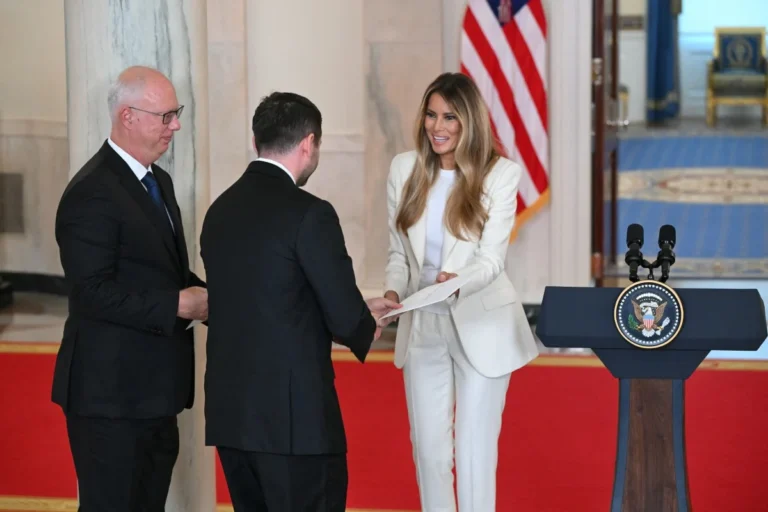
In an unprecedented display of humanitarian diplomacy, United States First Lady Melania Trump hosted high-level delegations from Russia and Ukraine at the White House on Thursday, November 5, 2026. The meeting, which marks a significant departure from traditional administrative foreign policy, focused on codifying a more permanent ceasefire following the relative success of a localized six-day truce in the embattled Ukrainian city of Oleshky. As the conflict, now entering its fifth year, continues to weigh heavily on global geopolitical stability, the First Lady’s intervention signals a potential pivot in the approach of the Trump administration toward the resolution of hostilities in Eastern Europe.
During the proceedings, Melania Trump presented personal, hand-delivered letters addressed to Russian President Vladimir Putin and Ukrainian President Volodymyr Zelensky. These missives serve as an appeal for the warring parties to transition from temporary tactical pauses to a structured framework for de-escalation. “Now we must use the courage we brought to Oleshky to find common ground through a shared concern for the suffering of innocent people,” the First Lady stated. “Together, we can create something more enduring than a temporary ceasefire.”
Chronology of the Oleshky Initiative
The seeds of this week’s White House gathering were sown in October 2025, when the First Lady first revealed the establishment of a clandestine communication channel with Moscow. The primary objective at that time was the reunification of children displaced or separated from their families during the intensity of the invasion. This humanitarian focus eventually evolved into the Oleshky ceasefire agreement, which became the longest-standing pause in combat operations since the full-scale invasion commenced in February 2022.
The timeline of recent diplomatic efforts is as follows:
- October 2025: Melania Trump announces the creation of a secret communication channel to address the humanitarian crisis involving displaced children.
- October 2026: The Oleshky ceasefire is established, allowing for the first major humanitarian corridor of the year, enabling civilians to choose between evacuation to Ukrainian-controlled territory or Russia.
- November 5, 2026: The White House hosts Russian envoy Kirill Dmitriev and Ukrainian representative David Arakhamia to formalize the next steps of the peace process.
- Upcoming, mid-November 2026: Trilateral talks are scheduled in Abu Dhabi, involving high-level representatives from the U.S., Russia, and Ukraine.
Humanitarian Impact and Behind-the-Scenes Cooperation
The Oleshky truce was not merely a military decision but a logistical success that facilitated the demining of critical infrastructure and the evacuation of trapped residents. Central to this success was the unlikely partnership between Russia’s human rights ombudsman, Yana Lantratova, and her Ukrainian counterpart, Dmytro Lubinets. Throughout the ceasefire, the two officials remained on the ground in the war-ravaged town, jointly overseeing the delivery of medical aid and the orderly departure of civilians.
This cooperation has been lauded as a rare success in a conflict defined by entrenched animosity. Russian envoy Kirill Dmitriev, speaking on behalf of President Putin, acknowledged the First Lady’s "distinguished humanitarian role." The acknowledgment is significant, as it marks one of the few instances in which Kremlin officials have publicly praised a member of the American executive branch for their diplomatic mediation.
In a reciprocal gesture of diplomatic recognition, the Ukrainian government announced that President Zelensky has awarded the First Lady the Order of Princess Olga, First Class—a prestigious national honor. The decree, published on the official Ukrainian presidential website, recognizes her efforts in bridging the gap between the two nations to secure the safety of non-combatants.
Strategic Context and Regional Implications
While the humanitarian achievements are significant, the broader strategic landscape remains fraught with complexity. President Donald Trump, who took office in January 2025, campaigned on a pledge to conclude the conflict within his first 24 hours in office. While that ambitious timeline proved elusive due to the multifaceted nature of the conflict and the emergence of parallel crises—notably the conflict in Iran—the administration’s focus has recently shifted back to the European theater.

Analysts suggest that the upcoming trilateral talks in Abu Dhabi will serve as a litmus test for the viability of a long-term peace agreement. The participation of U.S. envoys Steve Witkoff and Jared Kushner, who recently held an intensive 90-minute discussion with President Zelensky, indicates a renewed push by Washington to finalize a settlement.
However, the rapprochement between the Trump and Putin administrations has prompted skepticism among some European allies. Concerns remain that an American-led peace deal could prioritize stability at the expense of Ukrainian territorial integrity. Despite these fears, the current administration maintains that the "Oleshky model"—focusing on humanitarian pauses as a precursor to political dialogue—is the most pragmatic path forward.
Fact-Based Analysis: The "Spark in the Darkness"
The effectiveness of this diplomacy hinges on whether the Oleshky ceasefire can be scaled. Historically, local truces in this conflict have often collapsed due to military mistrust or the failure of commanders on the ground to adhere to central directives. By involving high-level human rights officials from both sides, the First Lady’s initiative attempts to build institutional trust where political trust is absent.
Data from the region indicates that the displacement crisis remains the most volatile element of the war. With millions still living as refugees or internally displaced persons, the focus on child reunification and civilian safety provides a neutral ground for negotiation. If the Abu Dhabi talks succeed, they could provide a framework for a "frozen conflict" scenario, which would end active kinetic warfare while deferring the resolution of contested sovereignty to long-term international arbitration.
International and Domestic Reactions
The international community has reacted with cautious optimism. European leaders, who have long called for a diplomatic solution, are watching the Abu Dhabi talks closely, hoping that the involvement of U.S. presidential envoys will provide the necessary weight to enforce any eventual agreement. Conversely, some domestic critics of the administration have questioned the reliance on "secret channels," arguing that such diplomacy lacks the transparency required for democratic accountability.
Despite these criticisms, the tangible results—such as the safe passage of civilians and the ongoing efforts to reunite separated children—have provided a narrative of progress that the White House is eager to leverage. The First Lady’s growing diplomatic profile has positioned her as a key architect of the administration’s humanitarian policy, effectively softening the edges of the President’s more aggressive, "deal-maker" approach.
The Road Ahead
As the world looks toward the Abu Dhabi summit, the legacy of the Oleshky ceasefire will be determined by its sustainability. The White House meeting on Thursday demonstrated that even after years of brutal conflict, there exists a functional capacity for communication between Kyiv and Moscow.
Whether this communication can transcend humanitarian relief to address the core territorial and security demands of both nations remains the central question of the next chapter of the war. For now, the administration has successfully moved the needle from active, unceasing combat toward a precarious, but nonetheless functional, diplomatic dialogue. The "spark in the darkness," as the First Lady described it, is currently the only point of light in an otherwise bleak landscape, representing the most significant opportunity for a formal end to the hostilities since the conflict began in 2022.
The upcoming days will likely see an intensification of back-channel communications. With the U.S. firmly positioned as the broker, the pressure on both President Putin and President Zelensky to make concessions is higher than at any point since the inauguration of the current U.S. administration. The world waits to see if this "enduring ceasefire" can be transformed into a lasting peace, or if it will be another temporary reprieve in a conflict that has fundamentally altered the 21st-century global order.