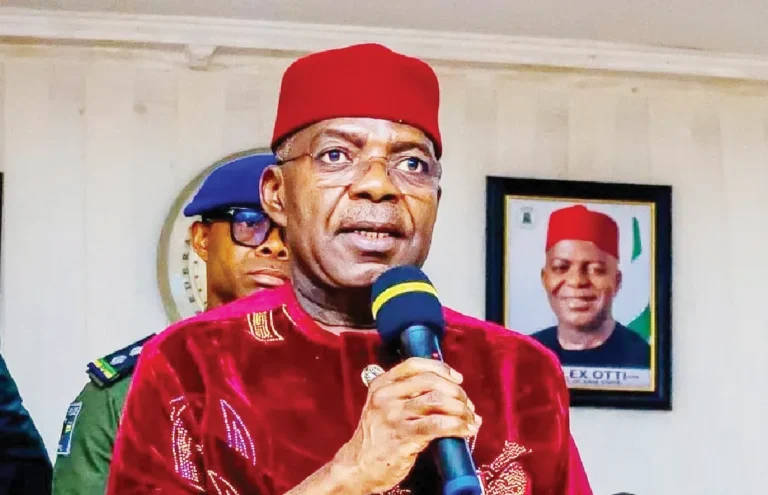
Abia State Governor Alex Otti has officially announced that his administration has activated comprehensive precautionary health protocols across the state to safeguard residents against potential outbreaks of Ebola. While confirming that there are currently zero reported cases of the virus within the state’s borders, Governor Otti emphasized that the government is operating under a proactive framework to ensure the health security of the populace. The disclosure was made during his highly anticipated monthly media chat held in Umuahia, where he provided updates on key governance milestones, public health initiatives, and the state’s strategic approach to sustainable transportation.
Strengthening Public Health Infrastructure
A cornerstone of the state’s current health preparedness strategy is the deliberate designation and renovation of the Mother and Child Hospital in Umuahia. According to the Governor, this facility has been repurposed as a dedicated isolation center. The decision to renovate and repurpose an existing facility underscores a cost-effective approach to emergency management, allowing the state to respond rapidly to potential public health crises without the need for extensive new construction.
"We have activated all necessary protocols," Governor Otti stated during the briefing. "We have set up an isolation center at the Mother and Child Hospital in Umuahia, which has recently undergone significant renovations. We have made the strategic decision not to open this specific facility for general public use at this time, keeping it ready as a specialized isolation center should the need arise. We are not resting on our oars; while there is no cause for public alarm or panic, being ready is a fundamental duty of government."
Public health experts have lauded this preemptive approach, noting that the Ebola virus remains a high-consequence pathogen that requires robust surveillance and rapid response capabilities. By designating a facility before a crisis occurs, the Abia State government aims to eliminate the logistical delays that often exacerbate health emergencies.
Advancing Vision Care: The Eye Health Management Bureau
Beyond emergency preparedness, Governor Otti highlighted the remarkable progress achieved by the Abia State Eye Health Management Bureau. The initiative, which seeks to address the high prevalence of visual impairment in the region, has seen significant engagement from the public. Data presented during the media chat revealed that 31,000 residents have undergone comprehensive eye screenings since the program’s inception.
Of this cohort, 1,811 patients have successfully undergone surgical interventions. Notably, 304 of these procedures were specialized cataract surgeries provided free of charge to vulnerable citizens. This initiative is part of a broader healthcare reform agenda aimed at democratizing access to medical services that were previously prohibitively expensive for the average citizen.
The infrastructure behind this initiative is equally ambitious. The state has currently operationalized 25 eye centers distributed across its 17 local government areas, ensuring that specialized ophthalmic care is no longer centralized in the state capital. Recognizing the growing demand, Governor Otti announced the approval of four additional centers, which will bring the total to 29. This expansion is designed to reduce the travel burden on residents in rural communities, effectively bridging the gap between urban and rural healthcare delivery.
Strategic Shifts in Public Transportation: The Electric Vehicle Initiative
During the media engagement, Governor Otti clarified the state’s stance on the Federal Government’s push for Compressed Natural Gas (CNG)-powered buses. While the federal initiative seeks to transition the national transport sector away from expensive petrol and diesel, Abia State has chosen to pivot toward electric vehicle (EV) technology for its public transport fleet.

The Governor provided a detailed explanation for this strategic divergence, noting that while the state remains open to the economic benefits of CNG, it views electric mobility as a more sustainable, long-term solution. "We are not doing CNG for our public transport," the Governor explained. "We are opting for electric vehicles. We have held discussions with several private sector entities interested in setting up refilling stations for CNG within the state. We are not opposed to the technology, and it will likely serve other commercial purposes, but for our public transportation system, we are committed to the electric route."
The rationale behind this decision lies in the technological trajectory of the global automotive industry. While both CNG and petrol engines rely on internal combustion, electric vehicles offer a cleaner, more efficient energy profile. By investing in EVs, the administration hopes to position Abia as a hub for green energy adoption in Nigeria. The Governor acknowledged that this transition requires a specialized maintenance ecosystem, but expressed confidence that the long-term operational savings and environmental benefits outweigh the initial infrastructural challenges.
Reviewing the Administration’s Performance
The monthly media chat served as an open forum for accountability, with Governor Otti reviewing his administration’s progress across several critical sectors. Since assuming office, the administration has placed a heavy emphasis on infrastructure development, particularly the rehabilitation of road networks to facilitate commerce and agriculture.
Road Infrastructure and Connectivity
The state has undertaken an aggressive road construction program aimed at connecting major industrial and agricultural clusters. By improving the road network, the administration aims to lower the cost of logistics for local businesses and improve the ease of doing business. The Governor reiterated his commitment to completing ongoing projects before the end of the fiscal year, noting that road connectivity remains the primary catalyst for economic development in the state.
Power and Utility Reforms
Recognizing that energy costs are a significant barrier to industrial growth, the administration has also focused on improving the power sector. Through collaborations with distribution companies and investment in rural electrification, the state is working to stabilize power supply for small and medium-sized enterprises (SMEs). The Governor emphasized that these utility reforms are not merely about power delivery but are part of an integrated plan to turn Abia into an industrial powerhouse in the South-East region.
Broader Implications and Future Outlook
The proactive stance taken by Governor Otti’s administration reflects a modern approach to governance that balances immediate crisis management with long-term strategic investment. The decision to prioritize electric public transport, for instance, signals a departure from traditional policy-making, indicating an attempt to future-proof the state’s infrastructure against the volatility of the global oil market.
Furthermore, the expansion of the eye health centers represents a data-driven approach to social services. By tracking screening numbers and surgical outcomes, the government can better allocate resources to areas of highest need. This methodology of using performance indicators to drive policy decisions is becoming a hallmark of the current administration.
As the state moves forward, the focus is expected to remain on the sustainability of these health and transport initiatives. The collaboration with private sector firms to establish CNG stations for commercial use suggests that the government is not rigidly ideological but rather pragmatic—adopting technologies based on their specific application.
Conclusion
Governor Alex Otti’s latest media engagement has provided a clear roadmap of his administration’s priorities. By addressing public health fears with concrete, actionable measures, demonstrating tangible success in specialized healthcare, and articulating a clear vision for sustainable transport, the government continues to solidify its focus on citizen-centric development. As the state monitors the health landscape and prepares for the rollout of its electric transport fleet, the administration remains positioned to continue its trajectory of reform, signaling a period of significant structural and social evolution for the people of Abia State.