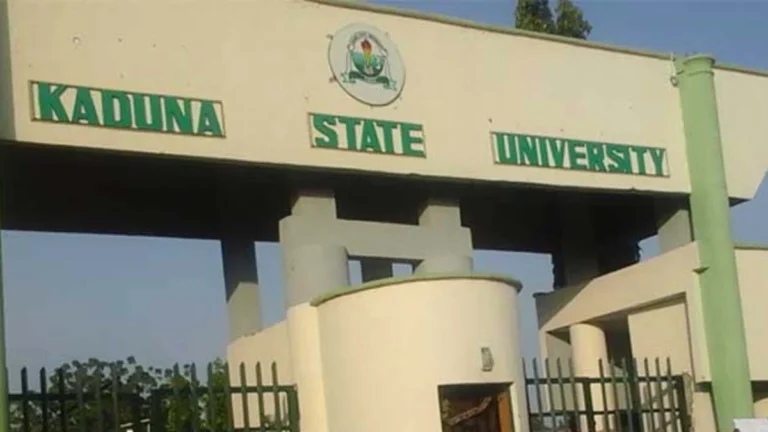
Academic activities at Kaduna State University (KASU) are set to resume in full swing following the decision of the institution’s chapter of the Academic Staff Union of Universities (ASUU) to suspend its industrial action. The suspension follows a critical breakthrough in negotiations between the state government, the university’s governing council, and the academic union. The breakthrough was anchored on the definitive approval by Kaduna State Governor, Senator Uba Sani, to fully implement the 2025 Federal Government of Nigeria (FGN)/ASUU agreement, alongside a concrete framework for the immediate settlement of accumulated salary arrears spanning nine months.
The announcement of the strike suspension was formalized through an official joint statement released in Kaduna on Thursday night. The document was duly endorsed by the Chairman of ASUU-KASU, Comrade Abubakar Abdullahi, and the Secretary, Comrade Silas Amos Bakut. According to the union executives, the decision to halt the industrial action was reached unanimously by the congress of the branch during an emergency meeting held on Thursday, September 17, 2026. After a comprehensive appraisal of the concessions made by both the state government and the university management, the union resolved to accept the terms of the settlement, paving the way for academic normalcy to return to the campus effective from 12:01 a.m. on Friday, September 18, 2026.
Background Context of the KASU Industrial Dispute
The industrial dispute that culminated in the recent strike action stems from long-standing grievances regarding staff welfare, salary structures, and the delayed domestication and implementation of nationally negotiated agreements within state-owned tertiary institutions. While federal universities operate directly under federal budgetary allocations and centralized agreements, state-owned universities like KASU often require distinct political and administrative buy-ins from their respective state governors to domesticate agreements reached between the federal government and ASUU.
Over the past several years, academic staff across various state universities have frequently faced disparities in remuneration, delayed promotions, and the non-implementation of approved salary reviews. The agitation at KASU gained momentum as academic staff pressed for the full adoption of the 2025 FGN/ASUU agreement, which serves as a benchmark for competitive remuneration, robust funding models, and improved working conditions within the Nigerian university system. The accumulation of the nine-month salary arrears—covering the period from January to September 2027—exacerbated financial pressures on lecturers, ultimately leading to the declaration of the strike action that has now been successfully resolved.
Chronology of Key Events Leading to the Resolution
The pathway to the resolution of the KASU crisis reflects a structured process of engagement, negotiation, and administrative compromise between the state authorities and the academic union.
Initial Escalation and Grievances: Tensions had been brewing within the university community over the delayed implementation of the national agreement and the backlog of unpaid arrears. Despite initial informal engagements, the widening gap between the union’s demands and the administration’s fiscal planning necessitated a formal industrial dispute.
The Congress Deliberation: Following weeks of behind-the-scenes consultations, the leadership of ASUU-KASU convened a crucial congress on Thursday, September 17, 2026. The primary agenda was to review the formal offers and financial commitments presented by the Kaduna State Government and the KASU Governing Council.
Intervention and Approvals: Crucially, the breakthrough was made possible by the direct intervention of Governor Uba Sani, who approved the financial outlay required to clear the nine-month arrears. Concurrently, the University Governing Council and management ratified the implementation framework, ensuring that the union’s core demands were met.
Suspension of Action: Satisfied with the concrete guarantees provided by the state administration, the congress voted unanimously to suspend the strike. The suspension order took effect immediately at 12:01 a.m. on Friday, September 18, 2026, signaling the end of the disruption and clearing the path for students to return to their lecture halls.
Union Commendation and Appraisal of Industrial Relations
In their official statement, the leadership of ASUU-KASU did not merely announce the end of the strike; they also took deliberate steps to commend the state government and university management for the mature and civil manner in which the dispute was managed. The union expressed profound appreciation to Governor Uba Sani, noting that his swift executive approval demonstrates a genuine commitment to prioritizing education and ensuring that KASU remains a leading institution of higher learning in Nigeria.
The union specifically highlighted the role played by the Government Negotiation Team, praising their dedication, diligence, and prompt attention to the complex issues table during the discussions. Similar commendations were extended to the management of Kaduna State University for providing transparent administrative documentation, necessary data, and operational support that expedited the resolution process for both negotiating parties.
In a departure from the adversarial dynamics that frequently characterize labor disputes in Nigeria’s public sector, ASUU-KASU placed strong emphasis on the absence of coercion or intimidation throughout the duration of the crisis. The union noted with satisfaction that neither the organization nor its individual members were subjected to threats, harassment, or punitive administrative measures by either the state government or the university management.
Furthermore, the union praised the authorities for respecting established institutional and internal procedures, allowing the academic body to both commence and suspend its industrial action through due process. This peaceful adherence to constructive engagement has been widely interpreted by labor analysts as a positive milestone in modern Nigerian industrial relations, setting a cooperative precedent for future labor-management interactions in state-owned tertiary institutions.
Implications and Broader Impact on Kaduna State University
The amicable resolution of the KASU ASUU strike carries profound implications for the academic calendar, student population, and the general administrative stability of the institution.
Restoration of Academic Stability: The immediate consequence of the suspension is the uninterrupted resumption of academic activities. For students and parents who bear the psychological and financial toll of prolonged academic disruptions, the swift resolution prevents what could have been a debilitating setback to the academic calendar.
Boost to Staff Morale: With the governor’s approval of the 2025 FGN/ASUU agreement and the imminent disbursement of the nine-month arrears, academic staff morale is expected to experience a significant upward surge. Financial security and improved welfare packages are critical components in retaining high-caliber academic talent and curbing brain drain within the university system.
Enhanced Institutional Reputation: The peaceful resolution of the dispute without resort to victimization or prolonged legal and industrial battles enhances KASU’s reputation as an institution governed by mutual respect and progressive dialogue. This harmonious environment makes the university more attractive for prospective students, researchers, and academic partners alike.
As KASU transitions back to regular operations, stakeholders across the board remain optimistic that the collaborative spirit demonstrated during this negotiation phase will serve as a enduring foundation for sustained educational development and industrial peace in Kaduna State.