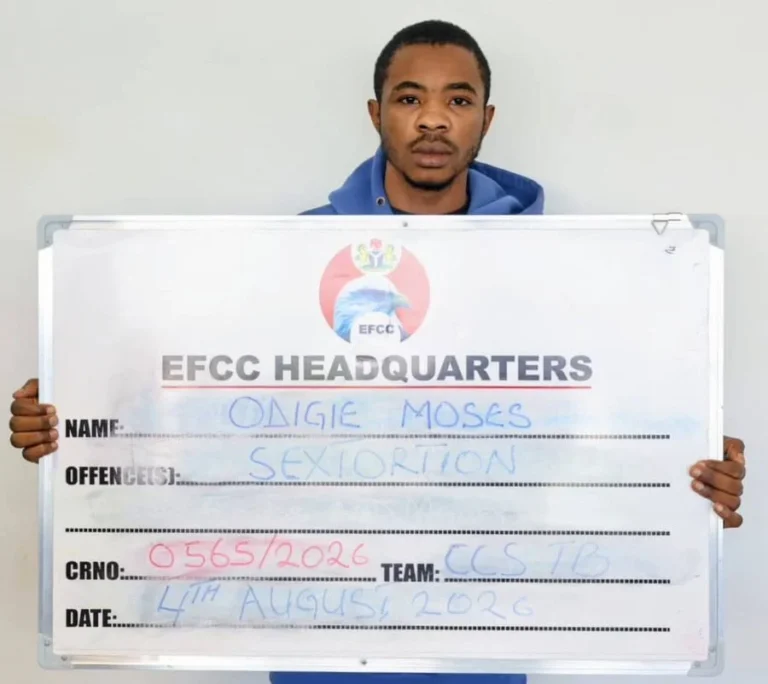
The administration of justice in Nigeria’s cybercrime landscape reached a significant milestone on Tuesday, September 8, 2026, when a Federal High Court sitting in Abuja delivered a decisive verdict against a transnational internet fraudster. Justice C.N. Nwabulu presided over the case, handing down a one-year prison sentence to Solomon Odigie Moses, a fraudulent spiritualist who preyed upon an overseas national under the guise of offering divine intervention. Moses, who also operated under the alias "Dr. Solomon," was prosecuted by the Economic and Financial Crimes Commission following a detailed investigation that unraveled a web of online impersonation, financial laundering, and malicious sextortion.
The presiding judge found Moses guilty of a one-count charge bordering on cheating and criminal impersonation. Alongside the custodial sentence, the court provided an option of a N300,000 fine and mandated the full restitution of the $1,100 proceeds of the crime to the victim, facilitated through the anti-graft agency. This ruling underscores the judiciary’s ongoing response to the evolution of cyber-enabled financial crimes in West Africa, where perpetrators increasingly exploit digital platforms to target vulnerable individuals across international borders.
Chronology of the Crime: From TikTok Deception to International Extortion
The sequence of events that led to the conviction of Solomon Moses highlights the calculated and predatory nature of modern digital romance and spiritual scams. The operation began on the popular short-form video hosting service, TikTok, where Moses established a fictitious profile portraying himself as an enlightened spiritual leader and healer capable of resolving personal and metaphysical afflictions.
The digital net cast by the convict eventually ensnared Sharon Kaur, an Indian national seeking spiritual guidance and intervention. Operating from thousands of miles away, Kaur engaged with the fake persona, trusting the fraudulent assurances offered by the defendant. According to court filings and EFCC investigative reports, Moses leveraged psychological manipulation to extract funds from the victim, initially demanding and receiving $1,100 under the pretext of conducting specialized spiritual prayers and rituals on her behalf.
The financial transaction itself reflected the sophisticated methods employed by contemporary internet fraudsters. Moses received the funds via the Zelle digital payments network, successfully laundering the foreign currency before routing the naira equivalent into his domestic bank account in Nigeria. However, the exploitation did not end with financial extortion.
In a severe escalation of the offense, the convict manipulated the victim into participating in a naked spiritual bath. Without Kaur’s knowledge or consent, Moses covertly recorded the proceedings live. Armed with this intimate footage, the fraudulent spiritualist transitioned from mere financial deception to outright sextortion and blackmail. He threatened to release the compromising video to the public and transmit it to the victim’s social circles unless she met further financial demands. Driven by fear and coercion, Kaur succumbed to the pressure, transferring an additional $1,100 to prevent the dissemination of the explicit recording.
Investigation, Arrest, and Legal Proceedings
The breakthrough in the case came when the victim, or representatives acting on her behalf, formally escalated the matter to the Economic and Financial Crimes Commission. Operating through its cybercrime division, the anti-graft agency launched a comprehensive intelligence-gathering operation to track down the digital footprint of the suspect.
Investigators traced the fraudulent transactions, IP addresses, and financial accounts linked to the alias "Dr. Solomon," eventually pinpointing his physical location in Ekpoma, Edo State. A coordinated tactical operation led to the apprehension of Moses in Edo State, after which he was transferred to Abuja to face the full weight of the law.
During the arraignment before Justice C.N. Nwabulu, the prosecution counsel, Maryam Hayatudeen, presented the formal charge against the defendant. The charge sheet stated: “That you Solomon Odigie Moses (A.K.A DR SOLOMON) sometimes in 2026 in Abuja, within the jurisdiction of this Honourable Court did fraudulently impersonate a spiritual leader named Dr. Solomon on a fictitious Tiktok account and obtained the sum of $1100 (One Thousand One Hundred Dollars) from an Indian lady by name Sharon Kaur, for the purpose of spiritual prayer and assistance, thereby committing an offence contrary to Section 321 of the Penal Code Act (Abuja) LLFN, 1990 and punishable under Section 322 of the same Act.”

Faced with overwhelming digital and financial evidence compiled by the EFCC, Moses abandoned any pretense of innocence and entered a plea of "guilty" to the charge. Consequently, prosecution counsel Hayatudeen urged the court to convict the defendant summarily based on his unequivocal admission of guilt and the weight of the evidence presented. Justice Nwabulu accepted the plea, leading to the subsequent sentencing, the imposition of the fine option, and the mandatory order for the restitution of the $1,100 to the victim.
Broader Data and Context on Cyber-Enabled Financial Crime in Nigeria
The conviction of Solomon Moses is part of a much broader, relentless campaign by Nigerian law enforcement agencies to combat the multi-billion-dollar global industry of cybercrime. Over the past decade, the Economic and Financial Crimes Commission, alongside sister agencies like the Independent Corrupt Practices and Other Related Offences Commission and the Nigeria Police Force, has significantly ramped up intelligence and enforcement operations targeting internet fraudsters, commonly referred locally as "Yahoo Boys."
Data released by anti-corruption watchdogs and financial intelligence units indicate a shifting trend in cybercrime modalities. While traditional business email compromise and simple romance scams historically dominated the landscape, perpetrators have increasingly diversified into specialized niches, including cryptocurrency fraud, fake investment schemes, and spiritual extortion or sextortion. The use of global social media platforms such as TikTok, Instagram, Facebook, and Telegram has democratized access to international victims, allowing localized fraudsters in semi-urban centers like Ekpoma, Ibadan, Lagos, and Port Harcourt to target individuals across North America, Europe, and Asia.
International Dimensions and Cross-Border Collaboration
The case of Sharon Kaur highlights the crucial transnational dimension of modern financial crimes. Cybercriminals frequently operate under the assumption that geographical distance and jurisdictional boundaries will shield them from prosecution. However, increased bilateral and multilateral intelligence-sharing between Nigerian authorities and international law enforcement bodies—including Interpol, the United States Federal Bureau of Investigation, and various cybercrime units across Asia—has closed the loop on many cross-border syndicates.
Victims residing abroad are increasingly finding viable avenues for redress through direct engagement with Nigerian anti-corruption institutions. The EFCC has established dedicated channels for receiving international petitions, allowing victims from diverse cultural and geographical backgrounds to seek justice. The successful repatriation and restitution of funds in cases like Moses’s serve to demonstrate a growing commitment by Nigerian authorities to ensure that international victims are not left uncompensated.
Implications for Social Media Regulation and Digital Literacy
Beyond the courtroom drama, the case of the fake spiritualist casts a harsh spotlight on the systemic vulnerabilities inherent in global social media ecosystems. Platforms like TikTok, which rely heavily on algorithmic content distribution and pseudonymity, frequently struggle to vet accounts claiming specialized, esoteric, or medical expertise. Fraudsters easily establish authoritative online personas, utilizing purchased engagement, stock imagery, and deceptive video content to cultivate an aura of credibility.
Cybersecurity experts and digital rights advocates have repeatedly called for stricter platform accountability, urging technology companies to implement more robust verification protocols for accounts purporting to offer spiritual, financial, or psychological counseling. Without proactive moderation and swift takedown mechanisms, bad actors will continue to exploit the emotional and psychological vulnerabilities of internet users worldwide.
Furthermore, the incident emphasizes the critical need for heightened digital literacy and public enlightenment campaigns. Law enforcement agencies across the globe continually reiterate that spiritual healing, divine intervention, and supernatural solutions cannot be legitimately transacted or commodified over social media applications. The EFCC has consistently used public advisories to warn citizens and international internet users against engaging with unverified online personas promising miraculous breakthroughs, urging anyone targeted by sextortion or digital fraud to immediately preserve evidence and report the activities to the appropriate authorities rather than succumbing to blackmail.