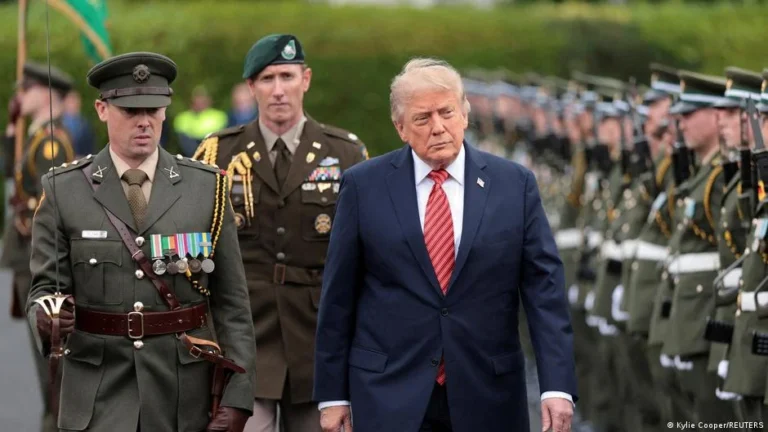
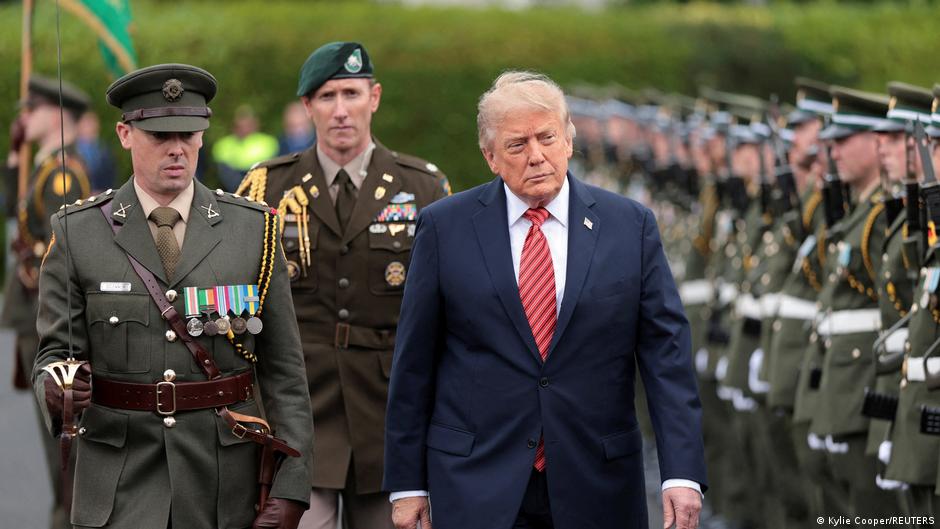
During a high-profile diplomatic visit to Dublin, United States President Donald Trump openly expressed his desire to see a united Ireland, marking a significant departure from the traditional neutrality held by his predecessors regarding the constitutional status of Northern Ireland. The president, who arrived in Ireland primarily to attend the Irish Open golf tournament held at his own Atlantic coast property, utilized the margins of the event to conduct formal discussions with Irish Taoiseach Micheál Martin. While the visit was framed around recreation and bilateral trade, Mr. Trump’s remarks on Irish unification have ignited immediate debate in both Dublin and London.
The president’s comments followed a bilateral meeting at Farmleigh House in Dublin’s Phoenix Park. When prompted by reporters on the potential for a unified island, Mr. Trump stated that he would "love to see it unified," describing such a prospect as a "fantastic thing." He acknowledged the sensitivity of the issue, noting that the United Kingdom would naturally have a significant role in any such determination, yet he remained characteristically optimistic about the inevitability of the process.
Historical Context and the Delicate Balance of Northern Ireland
The question of Irish unification is rooted in the complex history of the partition of the island in 1921. For decades, the region was defined by the "Troubles," a period of intense sectarian violence that claimed over 3,500 lives. The 1998 Good Friday Agreement (Belfast Agreement) served as the cornerstone for peace, establishing a framework that maintains Northern Ireland as part of the United Kingdom while providing a mechanism for a border poll—a referendum on unification—should it become apparent that a majority of the people of Northern Ireland wish to leave the UK and join the Republic of Ireland.
Historically, US presidents have maintained a scrupulous stance of neutrality, often acting as honest brokers to ensure the stability of the peace process. By openly favoring a specific constitutional outcome, President Trump has effectively broken with decades of diplomatic precedent. Analysts suggest this move could complicate the delicate power-sharing arrangements currently in place at Stormont, where the political landscape remains fragile and deeply divided between unionist and nationalist factions.
Official Reactions and Political Ramifications
The British government was quick to issue a response following the president’s remarks. A spokesperson for Prime Minister Andy Burnham noted that while the United Kingdom values its "special relationship" with the United States, the constitutional status of Northern Ireland is a matter for the people of Northern Ireland to decide. The statement emphasized that there is currently no evidence of majority public support for a border poll, and the British government remains committed to the principle of consent as enshrined in the Good Friday Agreement.
In Dublin, the political reaction was more muted but equally cautious. Taoiseach Micheál Martin’s office characterized the discussions as constructive and focused on trade and economic cooperation, avoiding any direct endorsement of the president’s specific rhetoric on unification. Observers note that while many in the Republic of Ireland hold the aspiration of a united island as a long-term goal, the government is wary of any external interference that could destabilize the current cross-border economic integration.
Escalating Conflict in the Middle East: The Iran Campaign
Beyond the Irish question, President Trump utilized his media availability to address the ongoing military conflict with Iran, which commenced on February 28. Defending the necessity of the campaign, the president characterized the military intervention as a preemptive strike aimed at preventing Iran from acquiring nuclear capabilities. He claimed that intelligence assessments indicated Iran was mere weeks away from weaponization, which, in his view, would have posed an existential threat to Israel, the Middle East, and potentially European cities.
The war has had profound global economic consequences, most notably a surge in oil prices that has affected domestic fuel costs in the United States and global markets. President Trump remained optimistic, predicting that the conflict would conclude "very soon," at which point he expects energy prices to "come tumbling down." Despite this confidence, the conflict remains a source of domestic contention. Many American voters, citing campaign promises to avoid "forever wars," have expressed skepticism regarding the duration and scope of the military commitment.
Trade Tensions with Canada: A Shift in North American Relations
The final pillar of the president’s commentary involved the ongoing trade friction with Canada. The relationship between Washington and Ottawa has been strained by a series of import bans and retaliatory tariffs, particularly affecting the agricultural sector. President Trump insisted that Canada is under significant pressure to negotiate, suggesting that a resolution could be reached in the near term.

The president’s rhetoric focused heavily on the agricultural imbalance, specifically regarding Canadian tariffs on US dairy and poultry products. "Canada has to treat our farmers better," he remarked, reiterating that the current trade environment is untenable for American producers. Economists warn that while a quick deal may be politically advantageous for the White House, the interconnected nature of the US-Canadian supply chain means that prolonged trade disputes could have lasting inflationary effects on consumer goods in both nations.
Chronology of Recent Diplomatic Engagements
- February 28: The United States officially commences military operations against Iranian targets, citing intelligence on nuclear proliferation.
- March – August: Escalating trade tariffs are imposed between the United States and Canada, leading to a breakdown in several bilateral trade committees.
- September 10: President Trump arrives in Ireland for the Irish Open, signaling a mix of private business interests and state-level diplomacy.
- September 12: Formal meeting between President Trump and Taoiseach Micheál Martin at Farmleigh House.
- September 12 (Afternoon): President Trump publicly supports Irish unification, triggering a prompt clarification from the British Prime Minister’s office.
Implications for Global Diplomacy
The president’s weekend in Ireland serves as a microcosm of the current American foreign policy strategy: a mix of direct, often unconventional interventions and a focus on bilateral economic leverage. The endorsement of a united Ireland is perhaps the most significant departure from traditional US foreign policy seen in years. While supporters of the president might view this as a refreshing, "straight-talking" approach to international affairs, critics and career diplomats argue that such comments risk alienating key allies and undermining the stability of long-standing peace agreements.
Furthermore, the dual pressure of an active military campaign in the Middle East and a trade conflict with a primary neighbor like Canada suggests that the White House is juggling multiple high-stakes issues simultaneously. The coming weeks will be critical as the administration attempts to turn these public declarations into tangible policy successes. Whether the optimism expressed by the president regarding the Iran conflict and Canadian trade relations proves accurate or overly ambitious remains to be seen. For now, the global community is left to navigate the implications of a US foreign policy that increasingly prioritizes immediate, declarative outcomes over the slower, more traditional channels of quiet diplomacy.