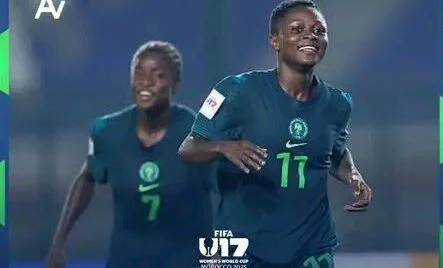
The Nigerian U-17 women’s national team, the Flamingos, has etched its name into the annals of football history by securing a place in the final of the 2026 FIFA U-17 Women’s World Cup. In a pulsating semi-final encounter staged in Morocco, the West African side dismantled a formidable Brazilian outfit with a 3-1 scoreline. The victory was defined by a commanding second-half display, spearheaded by the remarkable individual brilliance of Awawu Bashiru, whose brace cemented her status as one of the tournament’s standout talents and earned her the coveted Player of the Match award.
This historic milestone marks the first time Nigeria has reached the final of the FIFA U-17 Women’s World Cup, a competition where the nation has previously struggled to navigate past the quarter-final or semi-final hurdles. By overcoming Brazil—a nation with deep-rooted tactical pedigree in youth football—the Flamingos have sent a clear message to the global football community about the rapid development and competitive nature of Nigerian women’s football.
A Masterclass in Tactical Execution
From the opening whistle, the match was characterized by high-intensity pressing and tactical discipline. The Flamingos approached the contest with a game plan centered on neutralizing Brazil’s technical proficiency in midfield while exploiting the gaps behind the South American defensive line. Awawu Bashiru operated as the primary orchestrator of this strategy. Acting as the focal point of the Nigerian attack, her movement off the ball forced the Brazilian backline to retreat deeper than they were comfortable with, creating the necessary space for the Nigerian midfield to dictate the tempo of the game.
The first half remained a cagey affair, with both sides testing the waters and prioritizing defensive shape. However, the equilibrium was broken in the 71st minute. Following sustained pressure from the Flamingos, Bashiru found the breakthrough, finishing a well-constructed team move that left the Brazilian goalkeeper stranded. The goal acted as a catalyst, shifting the momentum entirely in favor of Nigeria.
The Decisive Final Stretch
While Brazil attempted to claw their way back into the match, the Nigerian defensive unit remained resolute. The Flamingos utilized a counter-attacking strategy that proved devastating in the final quarter of the match. In the 80th minute, Oluebube Umejiaku showcased vision and composure, threading a precise pass into the path of Bashiru. With the poise of a veteran striker, Bashiru converted the opportunity to secure her brace and extend Nigeria’s lead to 3-1.
This second goal effectively extinguished any hopes of a Brazilian comeback. Despite a late flurry of activity from the South American side, the Nigerian defense, supported by disciplined wing-backs, successfully managed the remaining minutes of regulation and stoppage time to confirm their place in the championship decider.
The Road to the Final: A Chronology of Success
The journey to this semi-final victory was not merely a stroke of luck but the result of a rigorous campaign. The 2026 FIFA U-17 Women’s World Cup in Morocco has seen the Flamingos grow in confidence with each passing fixture.
- Group Stage Dominance: Nigeria began the tournament with a series of disciplined performances, focusing on defensive solidity and clinical finishing.
- Quarter-final Resilience: The path to the semi-finals required the team to overcome significant pressure in the knockout stages, where they demonstrated the ability to win under duress.
- The Semi-final Breakthrough: The 3-1 win over Brazil represents the culmination of this development, as the team balanced physical tenacity with technical intelligence.
The significance of this run cannot be overstated. For the Nigerian Football Federation (NFF) and the technical crew, this tournament serves as a validation of the investment in grassroots scouting and the structured development of youth talent.

Statistical Context and Tactical Analysis
The statistical breakdown of the semi-final highlights the efficiency of the Nigerian squad. Despite Brazil enjoying higher possession metrics in the opening exchanges, the Flamingos proved significantly more dangerous in the final third. Nigeria registered more shots on target than their opponents, demonstrating a high conversion rate—a trait that has been missing in previous iterations of the U-17 national team.
Awawu Bashiru’s performance metrics during the match underscored her role as the engine of the team. Beyond her two goals, her heat map showed extensive coverage across the attacking third, confirming her role as a hybrid forward who drops deep to link play before transitioning into a predatory striker inside the box. This tactical flexibility made her nearly impossible for the Brazilian defenders to track, as she constantly rotated positions with Umejiaku and the wider forwards.
Official Reactions and Stakeholder Perspectives
While formal statements from the coaching staff are currently being collated, the atmosphere in the Nigerian camp is one of focused determination. Technical officials have lauded the discipline shown by the players, noting that the victory was a result of meticulous preparation and a deep understanding of the opposition’s weaknesses.
For the Brazilian side, the defeat serves as a sobering reminder of the parity in global youth football. Brazilian coaching staff noted in post-match discussions the difficulty of containing the physical pace and verticality of the Nigerian attack, admitting that the Flamingos deserved the victory due to their superior clinical nature in front of goal.
Implications for the Future of Nigerian Women’s Football
The advancement to the FIFA U-17 Women’s World Cup final holds profound implications for the sport in Nigeria. Firstly, it provides a massive platform for the current squad members to secure professional contracts with major clubs in Europe and North America. The exposure gained during a World Cup final is unparalleled, and scouts from across the globe have undoubtedly noted the performances of players like Bashiru and Umejiaku.
Secondly, this achievement serves as a catalyst for increased investment and interest in women’s football within the country. The "Flamingos effect" is likely to inspire a new generation of young girls to pursue football, potentially expanding the talent pool for the senior national team, the Super Falcons. The success in Morocco proves that when youth development is prioritized and backed by tactical acumen, Nigerian teams can compete with, and defeat, the traditional powerhouses of world football.
Looking Ahead to the Final
As the Flamingos prepare for the final, the focus will shift toward recovery and tactical adjustments. The team has shown that they are capable of adapting to different styles of play, a quality that will be essential in the championship match. Whether they face a European or Asian opponent, the confidence garnered from dismantling a giant like Brazil will be the foundation of their preparation.
The Nigerian public and the broader football community now look toward the final with a sense of anticipation. Regardless of the outcome of the final match, the Flamingos have already secured a place in history. They have proven that they are not merely participants in the global game, but contenders for the highest honors in youth football.
The performance of Awawu Bashiru and her teammates has ensured that the 2026 FIFA U-17 Women’s World Cup will be remembered as the tournament where a new generation of Nigerian talent announced itself on the world stage. As the team prepares for the final showdown, they carry the hopes and expectations of a nation that is increasingly recognizing the potential and the achievements of its female athletes. The path to the trophy is clear, and for the Flamingos, the final represents the ultimate opportunity to cement their legacy as one of the most successful youth teams in the history of the sport.