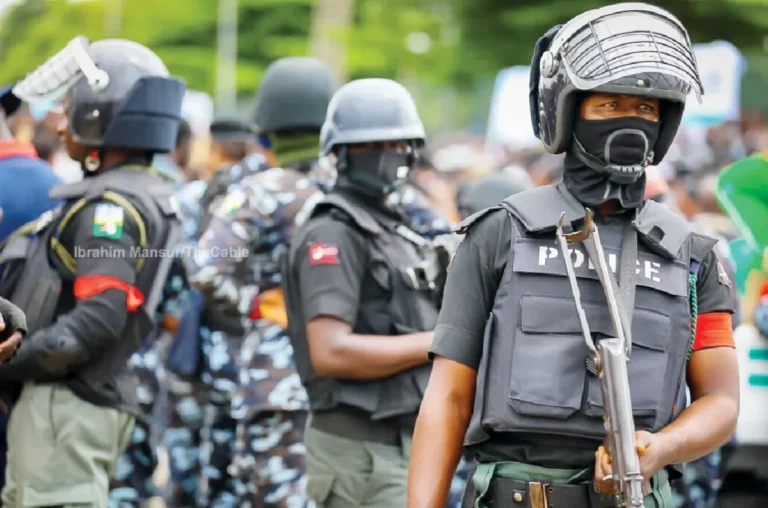
The persistent insecurity plaguing Nigeria’s northwest region claimed more lives on Sunday, as suspected bandits ambushed a police convoy travelling from Sokoto State to Zamfara State, leaving at least five officers feared dead. The security operatives, who were moving in a convoy of three vehicles on a special tactical assignment, ran into a deadly blockade mounted by heavily armed non-state actors. The attack has once again underscored the extreme hazards security personnel face as they navigate volatile transit corridors across the region.
According to reliable accounts gathered by correspondents, the assault occurred suddenly as the convoy traversed a notorious stretch known for bandit ambushes. While the advance vehicles managed to press forward during the initial onslaught, the gunmen concentrated their ferocious firepower on the rear vehicle, sealing the fate of the occupants inside. Graphic footage that subsequently emerged on social media platforms revealed the grim aftermath of the ambush, displaying the bloodied interior of the targeted vehicle and personal belongings of the slain personnel scattered across the blood-soaked terrain.
Chronology of the Ambush
The deployment began in the early hours of Sunday as part of a routine rotational movement of tactical personnel. Security commands frequently move operatives between Sokoto, Zamfara, and Kebbi states under the Zone 10 jurisdiction to reinforce vulnerable frontline formations battling bandit syndicates.
The convoy, consisting of three vehicles transporting operatives assigned to special duties in Zamfara State, departed from Sokoto without early indications of peril. However, as the vehicles approached a forested transit choke point—terrain frequently exploited by criminal networks for hit-and-run operations—the armed elements struck.
According to a surviving operative who spoke under the condition of anonymity, the attack was swift and coordinated. The bandits initiated the engagement by unleashing a hail of automatic gunfire directly targeting the third vehicle bringing up the rear of the convoy.
"We were travelling in three vehicles when they suddenly opened fire on the third vehicle behind us," the surviving officer recounted. "Five of our members were killed in the process."
The sheer volume of gunfire overwhelmed the targeted vehicle, cutting off any immediate opportunity for tactical withdrawal or counter-offensive from the rear guard. By the time the front vehicles maneuvered to secure the area and assess the situation, the assailants had already retreated into the dense surrounding forestry, leaving behind a scene of devastation.
Escalating Threat Matrix in the Northwest
This latest tragedy is not an isolated incident but rather part of a wider, deeply concerning pattern of violence directed against state security apparatuses in Nigeria’s northwest. Zamfara, Sokoto, Katsina, and Kaduna states have remained epicentres of violent criminality characterized by cattle rustling, mass kidnappings, and coordinated ambushes orchestrated by heavily armed gangs colloquially referred to as bandits.
These criminal organizations operate primarily out of extensive forest reserves, such as the infamous Sububu and Kuyanbana forests, which provide natural sanctuaries and evade standard ground offensives. Over the past decade, these groups have evolved from loose affiliations of rustlers into well-equipped insurgent-style factions possessing sophisticated weaponry, communication gadgets, and localized intelligence networks.
Security forces traversing federal and state highways within these zones increasingly find themselves outgunned or ambushed by adversaries intimately familiar with the terrain. Convoys carrying personnel on transfer, special duty, or operational logistics have frequently been prioritized as high-value targets by criminal factions aiming to demoralize law enforcement agencies and demonstrate tactical dominance.
Official Silence and Institutional Response
As of Monday, the official machinery of the Nigeria Police Force was still compiling comprehensive operational reports regarding the incident. Attempts by journalists to obtain a formal statement from the Police Zone 10 headquarters—which oversees Sokoto, Kebbi, and Zamfara states—proved abortive. The Zonal Police Public Relations Officer, Assistant Superintendent of Police Abdallah Faruku, could not be reached via telephone, and text inquiries remained unanswered at the time of filing this report.
In standard operational protocols, when law enforcement casualties occur during inter-state deployments, the respective state commands typically coordinate with Force Headquarters in Abuja to verify casualties, notify grieving families, and initiate discreet tactical sweeps to hunt down the perpetrators. Security analysts anticipate that a joint operation involving the military and mobile police squadrons will likely be launched to comb the vicinity of the ambush site in search of the fleeing bandits.
Broader Security Implications
The killing of five security personnel in a single transit ambush carries profound implications for the ongoing counter-insurgency and internal security operations in northwestern Nigeria.
First, it highlights the severe logistical vulnerabilities associated with troop movements across high-risk corridors. While tactical deployments are necessary to plug security deficits in frontline communities, the failure to secure transit routes leaves elite personnel exposed to asymmetric warfare tactics. Military and police planners may now face renewed pressure to mandate aerial reconnaissance, armoured personnel carrier (APC) escorts, and real-time intelligence surveillance for all inter-state personnel movements within the region.
Second, the psychological impact on the rank and file cannot be overstated. Security operatives already contending with harsh operational conditions, inadequate hazard allowances, and operational fatigue are further demoralized when colleagues are brutally targeted while answering official duty calls. Maintaining troop morale remains a critical challenge for the police hierarchy as casualties mount in the protracted campaign against non-state actors.
Finally, the incident underscores the urgent need for a paradigm shift in how security architecture is managed in the northwest. Traditional reactive deployments and convoy transits are increasingly proving insufficient against agile criminal syndicates capable of mass mobilization and coordinated ambush tactics. Experts continue to advocate for enhanced intelligence-led pre-emptive strikes, sustained bombardment of forest enclaves, and greater deployment of drone technology to secure federal highways before troop movements occur.
As investigations continue and families await official confirmation regarding their loved ones, the nation is once again left to mourn the supreme sacrifice paid by law enforcement officers on the frontline of Nigeria’s complex internal security crisis.