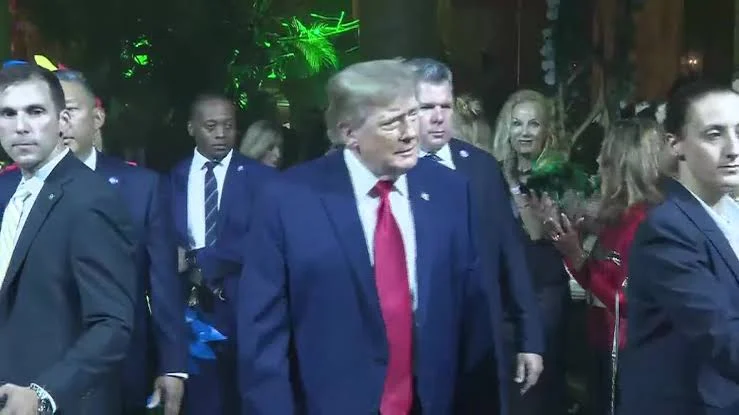
The annual Halloween celebration at the Mar-a-Lago club in Palm Beach, Florida, took a characteristic turn this past Saturday as President Donald Trump arrived at the festivities opting for his customary professional attire rather than a traditional costume. Addressing the gathered crowd and members of the press, the President quipped that his lack of preparation time necessitated the decision to attend the jungle-themed gala as himself. This event, which has become a staple of the President’s social calendar, saw hundreds of guests in elaborate costumes, contrasting sharply with the President’s decision to maintain his signature navy blue suit and red tie ensemble.
The Atmosphere at Mar-a-Lago
The ballroom at Mar-a-Lago, often referred to as the "Winter White House," was transformed for the occasion with elaborate jungle-themed decor, including lush foliage, simulated wildlife, and dim, atmospheric lighting. Guests at the event—many of whom are high-profile donors, political allies, and socialites—had reportedly spent considerable time and resources on their costumes, with some attendees dedicating hours to professional hair, makeup, and intricate prosthetic work.
In a brief interaction with reporters on the sidelines of the party, President Trump acknowledged the disparity between his own minimalist approach and the elaborate nature of the guests’ outfits. "I didn’t have time to get… people spent a lot of time and money," he remarked. "Rich people. They spent nine hours getting ready. I had 10 minutes, so I came as Donald Trump." The comment, delivered with his trademark candid delivery, was met with laughter from those in proximity and quickly circulated through social media channels as a lighthearted moment during a high-stakes political season.
Chronology of the Evening
The evening began as guests arrived at the historic estate, which has served as a central hub for the President’s personal and political gatherings since the 1980s. By 8:00 p.m., the ballroom was at capacity. Security protocols were, as expected, rigorous, with Secret Service agents managing the entry points as guests processed through the club’s ornate lobby.
Following the arrival of the President and his immediate party, the event transitioned into a private social function. While media access was restricted to the arrival and brief photo opportunities, internal reports suggest the evening followed the tradition of previous years, featuring a seated dinner, music, and a display of seasonal decorations. The President spent the duration of the event engaging with attendees, marking a rare moment of social reprieve during an administration characterized by a relentless policy agenda.
Historical Context of Presidential Halloween Celebrations
Halloween at the White House—or in this case, the President’s primary residence—is a tradition that has evolved significantly over the decades. While the White House traditionally hosts a trick-or-treat event for military families and local school children on the South Lawn, the Mar-a-Lago gathering is distinct in its nature. It serves primarily as a networking event for the President’s inner circle, blending social festivities with political relationship-building.
Historically, presidents have varied in their participation in Halloween. While some have opted for formal costumes, others, like President Trump, have preferred to maintain their public persona. This decision reinforces the President’s brand of authenticity, which he often emphasizes in his interactions with the public. By refusing to wear a mask or a character costume, he remains consistent with the image of the "unfiltered" leader that has defined his political career.
Economic and Social Implications of High-Profile Galas
The event at Mar-a-Lago also serves as a barometer for the social circles surrounding the administration. The mention of "rich people" spending nine hours on their costumes speaks to the exclusive nature of the club’s membership. Mar-a-Lago, a National Historic Landmark, has seen its membership fees and prestige climb significantly during the Trump presidency. Such events are often cited by political analysts as crucial for campaign fundraising, where the lines between social networking and political lobbying frequently blur.
From a sociological perspective, the "jungle-themed" party reflects a broader cultural interest in escapism among the political elite. In an era of intense political polarization, these events provide a necessary venue for coalition building outside of the formal environment of Washington, D.C. The fact that the President chose to address the media in a jocular fashion suggests a calculated attempt to soften his image and engage with the public on a more relatable, human level.
Analysis of Public Perception and Media Coverage
The coverage of the event, particularly the viral nature of the President’s comments, underscores the ongoing fascination with his personal life. By frame-shifting the narrative from "the President attended a party" to "the President dressed as himself," the administration successfully garnered positive media attention that focused on his personality rather than contentious policy debates.
Fact-based analysis of the President’s rhetoric reveals a recurring theme: the juxtaposition of the "everyman" against the "establishment." Even when surrounded by the opulence of Mar-a-Lago, his insistence that he "didn’t have time" and therefore appeared as himself serves to reinforce his narrative as a busy, no-nonsense executive who is fundamentally different from the "elite" guests he hosts. This framing is a cornerstone of his communication strategy, ensuring that even during social events, the political brand remains front and center.
Official Responses and Future Outlook
While no official press release was issued by the White House regarding the Halloween event, aides familiar with the evening noted that the President was in high spirits. Representatives for the Mar-a-Lago club declined to comment on the specific guest list or the logistics of the event, citing privacy concerns for members.
Looking ahead, the focus for the administration remains on the final months of the year, with the holiday season typically signaling a pivot toward year-end legislative goals and strategic planning for the upcoming fiscal year. The Mar-a-Lago party represents the final major social engagement before the intensity of the winter legislative session.
Broader Political Impact
The event, while seemingly trivial in the grand scheme of national governance, highlights the intersection of celebrity culture and political power. In the modern media landscape, the ability to generate a viral moment—even a seemingly off-the-cuff remark about a Halloween costume—is a valuable tool. By controlling the narrative of his appearance, the President ensures that he remains the focal point of the news cycle, regardless of the venue.
As the administration continues to navigate complex domestic and international challenges, these moments of levity are frequently used to contrast with the gravity of the work being performed in the Oval Office. Whether or not this strategy effectively influences public perception remains a subject of ongoing debate among political strategists. However, the success of the evening in generating engagement—measured by the volume of social media traffic and subsequent reporting—demonstrates that the President’s approach to public relations remains as potent as ever.
In conclusion, the Halloween party at Mar-a-Lago served as both a social milestone for the President’s supporters and a masterclass in personal branding. By appearing as himself, President Trump reinforced his status as a singular figure in American politics, one who operates by his own rules and defies the conventional expectations of his office. As the event concluded, the images of the President in his signature suit served as a reminder that in the theater of politics, the most effective costume is often the person themselves.