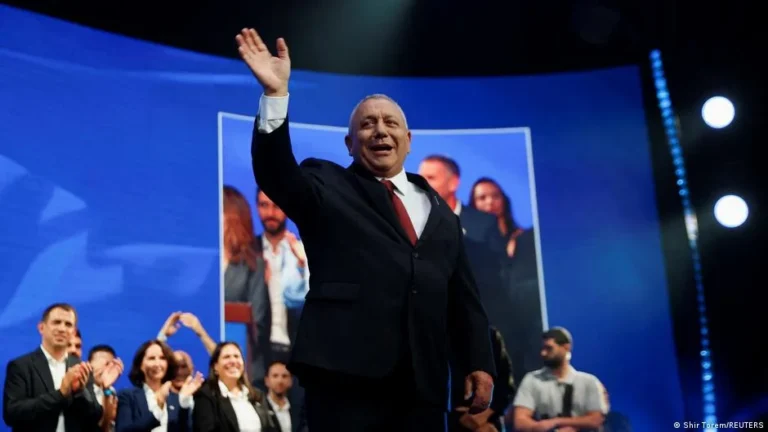
The announcement, delivered by the President’s office on Saturday evening, signals the commencement of a high-stakes period of coalition negotiations that could potentially end the era of Benjamin Netanyahu’s dominance in Israeli governance. Gadi Eisenkot, a former Chief of General Staff of the Israel Defense Forces and the current leader of the centrist Yashar party, has been formally invited to the President’s residence to accept the mandate, setting the stage for a dramatic shift in the nation’s political landscape.
This development follows the inconclusive results of the October 2026 national elections, which saw a fractured parliament and a razor-thin margin between competing ideological blocs. While Netanyahu’s right-wing camp secured 53 seats—emerging as the largest single bloc—it failed to reach the 61-seat threshold required for an absolute majority in the 120-seat Knesset. Conversely, the anti-Netanyahu alliance led by Eisenkot commanded 48 seats. The decision to grant Eisenkot the first opportunity to form a government is a strategic gamble, predicated on the surprising consolidation of support from Israel’s Arab parties, which hold 19 seats in the new parliament.
The Chronology of the 2026 Election Cycle
The path to this political impasse began in late 2025, when the previous government coalition collapsed under the weight of internal disputes regarding fiscal policy and judicial reform. The October 2026 election was characterized by an unprecedented level of voter engagement and a deep polarization of the Israeli electorate.
- October 20, 2026: Election Day saw high turnout across both urban and rural districts. Early exit polls immediately indicated that neither the Netanyahu-led right-wing coalition nor the opposition bloc would secure a clear path to 61 seats.
- October 23, 2026: Final vote tallies were confirmed. Netanyahu’s Likud-led camp reached 53 seats, while Eisenkot’s bloc trailed with 48. The Arab parties, acting as a pivotal bloc, secured a historic 19 seats.
- October 27, 2026: Consultations began at the President’s residence. Leaders from all parties were summoned to recommend their preferred candidate for Prime Minister.
- October 31, 2026: Arab majority lists officially announced their support for Gadi Eisenkot, providing the necessary momentum for the President to break the deadlock and offer the mandate to the opposition leader.
Shifting Alliances and the Role of Arab Parties
The inclusion of Arab parties in the political calculus is perhaps the most significant element of this election cycle. Historically, Israeli governments have operated under an informal "cordon sanitaire" regarding Arab parties, which have rarely been formal members of a ruling coalition. The only significant exception in recent history was the 2021–2022 coalition led by Naftali Bennett and Yair Lapid, which included the Ra’am party.
Political analysts suggest that the decision of the Arab parties to back Eisenkot represents a tactical shift. By recommending a former military leader, these parties are signaling a pragmatic desire to exert influence on policy—specifically regarding domestic infrastructure, crime prevention in Arab communities, and economic development—rather than remaining in permanent opposition.
However, this reliance remains highly contentious. Opponents of such a coalition argue that the national security agenda of the state, particularly concerning the Israeli-Palestinian conflict, requires a government that is not beholden to parties with divergent views on the Zionist character of the state. Eisenkot, whose background is firmly rooted in the military establishment, is viewed by some as a compromise candidate who can bridge these gaps, though he faces intense pressure from both the far-right and within his own centrist camp to clarify how he will reconcile these conflicting interests.
Data-Driven Analysis of the Parliamentary Math
The composition of the current Knesset represents one of the most complex legislative puzzles in Israel’s history. With 120 seats, a functioning government requires a minimum of 61.
- The Netanyahu Bloc (53 seats): Consisting of the Likud party, religious-nationalist factions, and ultra-Orthodox parties. While this bloc is ideologically cohesive on many issues, it remains short of the majority, and Netanyahu’s refusal to engage with Arab parties has left him with no clear path to bridge the gap.
- The Eisenkot Bloc (48 seats): A centrist and liberal coalition focused on economic stability and institutional reform.
- The Arab Parties (19 seats): Acting as the "kingmaker," this group’s support for Eisenkot is conditional and likely tied to specific budget allocations and policy guarantees.
The remaining seats are held by independent members or smaller factions that have yet to pledge their allegiance to either side, making every single vote critical during the upcoming 28-day negotiation window.
Official Reactions and Public Sentiment
The reaction from the political establishment has been as divided as the electorate itself. A spokesperson for Benjamin Netanyahu described the President’s decision as "a disregard for the will of the voters," noting that Netanyahu’s camp remains the largest in the parliament. They argued that any government formed with the support of Arab parties would be inherently unstable and against the spirit of the election results.
Conversely, supporters of the Eisenkot mandate point to the necessity of change. "The public voted for a new direction," a senior member of the Yashar party stated. "We are committed to building a broad-based government that serves all citizens of Israel, regardless of their background. Our goal is to move past the era of polarization."
President Herzog, in his formal statement, emphasized the need for national unity. He urged all parties to engage in "good-faith negotiations" to prevent the nation from slipping into a cycle of perpetual elections.
The Path Forward: Implications and Risks
Gadi Eisenkot now faces the arduous task of drafting a coalition agreement. Under Israeli law, he has 28 days to present a government to the Knesset for a vote of confidence. If he fails, President Herzog holds the constitutional authority to grant a 14-day extension. If that also fails, the mandate could pass to another candidate—likely Netanyahu—or the country could face the prospect of its sixth general election in four years.
The implications of an Eisenkot government would be profound. Economically, the country is facing inflationary pressures and a housing crisis that requires legislative stability to address. Diplomatically, the transition would be closely watched by international allies, particularly in Washington and Brussels, who are keen to see how a new administration handles regional security challenges.
Furthermore, the integration of Arab parties into the governing structure—or even their role as an external support bloc—would mark a permanent evolution in the Israeli democratic process. It challenges the traditional definition of the "Zionist consensus" and forces a public debate on what it means to be a modern, inclusive state.
For the time being, the eyes of the nation are fixed on the President’s residence. The next month of negotiations will likely determine not only the next Prime Minister but also the long-term trajectory of Israeli policy. Whether Eisenkot can navigate the treacherous waters of coalition-building—balancing the demands of his secular, centrist allies with the requirements of the Arab parties and the potential for defections from the right—remains the central question of the hour. The stability of the Knesset, and indeed the future of the Israeli government, rests on his ability to forge a common purpose out of a deeply fractured political landscape.