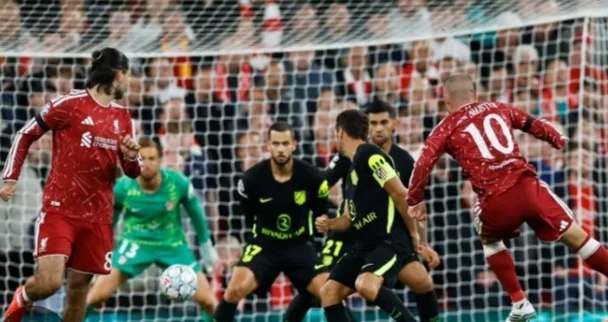
The iconic floodlights of Anfield bore witness to another classic European night as Liverpool commenced their latest UEFA Champions League campaign with a hard-fought, character-defining 2-1 victory over Spanish heavyweights Atletico Madrid. In a match that encapsulated the relentless drama, tactical chess, and high-octane intensity synonymous with elite continental football, the English side was forced to dig deep after conceding an early opener. Diego Simeone’s resilient Atletico outfit initially stunned the home crowd, but a resolute tactical adjustment and moments of individual brilliance from Dominik Szoboszlai and Alexis Mac Allister turned the fixture on its head.
The victory serves not only as an ideal opening three points in the newly formatted league phase of Europe’s premier club competition but also as a testament to the squad depth and mental fortitude of Arne Slot’s side. As the final whistle blew, sealing a tense evening where both goalkeepers were forced into critical interventions, Anfield erupted in relief and jubilation, cognizant that overcoming a side of Atletico’s tactical pedigree requires more than just technical skill—it demands resilience under extreme pressure.
Main Facts and Match Overview
The fixture unfolded against a backdrop of immense tactical anticipation, pitting two of Europe’s most tactically distinct managers against one another. Liverpool, playing on their famous home turf, dominated possession for large stretches, registering high territory metrics and forcing Atletico into heavy defensive blocks. However, the visitors from Madrid lived up to their reputation for defensive organization and clinical counter-attacking football, striking first through midfielder Marcos Llorente.
Despite trailing at the midway point of the first half, Liverpool’s offensive persistence bore fruit just before the interval through Szoboszlai’s precise finish. The momentum carried seamlessly into the second half, with Argentine World Cup winner Mac Allister capitalizing on a loose ball to smash home his milestone 20th goal for the club. While Liverpool thought they had extended their lead late in the game through Jeremie Frimpong—only for the effort to be rightly chalked off for offside—they successfully navigated a nervy period of stoppage time to secure the 2-1 scoreline.
The match statistics underscored a fiercely contested encounter. Liverpool edged the possession statistics with roughly 58% of the ball, while Atletico’s defensive block restricted the home side to five shots on target from a total of sixteen attempts. Alisson Becker and Jan Oblak both delivered masterclasses in goalkeeping, ensuring the scoreline remained within touching distance until the very last second.
Chronological Breakdown of Events
The narrative of the match can be mapped through a series of high-stakes momentum shifts that tested both managers’ tactical resolve.
First-Half Momentum and the Early Shock
The opening fifteen minutes were characterized by a cagey feeling-out process, but it was Atletico Madrid who steadily found their rhythm by exploiting spaces in Liverpool’s defensive transitions. The visiting side took a deserved lead in the 17th minute. Julian Alvarez orchestrated the breakthrough with a precise, visionary pass through the middle of the pitch. Marcos Llorente timed his run to perfection, accelerating away from Liverpool left-back Milos Kerkez before executing a sublime left-footed chip over the on-rushing Alisson Becker, sending the traveling contingent into raptures.
Atletico capitalized on their psychological advantage, maintaining their defensive shape while threatening on the break. In the 27th minute, Alvarez came dangerously close to doubling the lead, unleashing a fierce effort that required a sharp, reflex save from Alisson to keep Liverpool within striking distance.
The Equalizer Before the Break
As the first half drew to a close, Liverpool ratcheted up the pressure, pinning Atletico deep into their own defensive third. The equalizer in the 40th minute stemmed from sustained pressure initiated by Kerkez, who atoned for his earlier defensive lapse by driving the play forward. Bradley Barcola unleashed a powerful strike that Atletico goalkeeper Jan Oblak could only parry. Liverpool maintained their composure inside a crowded penalty area, and defender Ronald Araujo cleverly flicked the loose ball into the path of Dominik Szoboszlai. The Hungary international displayed exceptional technical control, taking a touch before rifling a clinical right-footed shot into the bottom-left corner, restoring parity at 1-1 just moments before the referee blew for half-time.
Mac Allister’s Milestone Strike
Buoyed by the psychological boost of the late equalizer, Liverpool emerged from the tunnel for the second half with palpable urgency. The turnaround was completed mere minutes after the restart, in the 50th minute. Alexander Isak, working tirelessly up front, inadvertently nudged the ball into the path of Alexis Mac Allister near the edge of the Atletico penalty area. The Argentine midfielder showed immense composure, making no mistake as he struck a venomous left-footed shot past a stranded Oblak, nestling the ball neatly into the bottom-left corner. The strike marked a significant personal milestone for Mac Allister, representing his 20th goal since joining the Merseyside club.
Late Drama and Defensive Heroics
With the score at 2-1, the game opened up significantly. Atletico pushed forward in search of an equalizer, with Alvarez testing Alisson once again from distance, though the Brazilian goalkeeper gathered comfortably. At the other end, Liverpool sought to put the game to bed. Isak found himself with a gilt-edged opportunity from roughly ten yards out, only for Atletico substitute Robin Le Normand to throw his body in front of the ball, executing a desperate and vital goal-saving block.
As the clock ticked into the final ten minutes, Diego Simeone’s side threw caution to the wind. Defender Hancko headed narrowly over the bar from a tight angle following a corner kick in the 85th minute, and in the 89th minute, Alisson was called into action once more to deny a dangerous effort from Munoz.
Deep into stoppage time, Anfield briefly celebrated what appeared to be the insurance goal when Jeremie Frimpong bundled the ball over the line from close range. However, a lengthy VAR review and assistant referee consultation confirmed that Frimpong had strayed into an offside position, chalking off the effort and keeping Atletico’s faint hopes alive. Despite a frantic final wave of pressure from the Spanish visitors, Liverpool’s backline held firm to claim all three points.
Supporting Data and Historical Context
This fixture added another chapter to the rich and occasionally volatile European history between English and Spanish clubs, and specifically Liverpool’s modern engagements in the UEFA Champions League.
Historically, encounters between Liverpool and Atletico Madrid have been defined by razor-thin margins and tactical chess matches. Most notably, their Round of 16 clashes in the 2019-20 season saw Atletico eliminate Liverpool at Anfield in extra time, a memory that still lingers faintly in the collective consciousness of the Anfield faithful. This fixture, therefore, carried minor undertones of sporting redemption, even if the primary objective remained securing an optimal start to the newly structured league phase.
From a statistical standpoint, Dominik Szoboszlai’s performance underlined his growing importance as Liverpool’s creative engine in the middle of the pitch. His goal was his third in all competitions this season, highlighting his improved efficiency from deep and secondary-scoring positions. Meanwhile, Alexis Mac Allister’s milestone 20th goal reinforces his reputation as one of the most reliable and tactically intelligent box-to-box midfielders in European football today.
Jan Oblak, despite conceding twice, turned in a typically heroic performance with six saves, further cementing his status as one of the defining goalkeepers of his generation. For Liverpool, Alisson’s three crucial saves preserved the lead during Atletico’s heaviest spells of pressure in the second half, proving once again why the Brazilian remains indispensable between the posts.
Post-Match Analysis and Tactical Implications
Analyzing the structural flow of the match provides valuable insight into the trajectories of both clubs as the 2024-25 European season gathers pace.
For Liverpool, the victory validates the tactical evolution overseen by Arne Slot. Falling behind against a defensive titan like Atletico Madrid historically caused Liverpool’s previous iterations under Jurgen Klopp to occasionally over-commit and fall susceptible to devastating counter-attacks. Here, however, Liverpool demonstrated admirable tactical patience. By maintaining positional discipline, keeping circulation rapid, and utilizing the width provided by their full-backs and wide forwards, they eventually unpicked one of the stubbornest defensive low blocks in world football.
The integration of summer acquisitions and squad rotation also yielded positive indicators. The defensive stability provided by Araujo in critical moments, combined with the tireless pressing of Isak and the creative output of the midfield trio, suggests Liverpool possesses the squad depth necessary to navigate the arduous dual demands of domestic Premier League title pursuits and a grueling Champions League campaign.
For Atletico Madrid, the defeat, while disappointing, offers plenty of encouraging structural takeaways. Simeone’s side executed their game plan effectively for the first hour, demonstrating that their transition play and defensive organization can trouble elite opponents away from home. However, the inability to sustain defensive concentration across the entirety of ninety minutes proved their undoing. In the new Champions League league phase format—where goal difference and every single point hold monumental weight in determining qualification and seeding for the knockout rounds—such momentary lapses can prove costly.
Broader Impact on the Champions League Campaign
The revamped format of the UEFA Champions League, featuring a single expansive league table rather than traditional four-team groups, places an unprecedented premium on early victories. With teams playing eight different opponents in the opening phase, accumulating maximum points from home fixtures is non-negotiable for clubs with aspirations of direct qualification to the Round of 16.
By securing three points against a Pot 1 or Pot 2 caliber opponent like Atletico Madrid, Liverpool has established a formidable foundation. It relieves early pressure heading into a demanding sequence of fixtures across Europe, allowing the coaching staff to manage player workloads and tactical adaptations with greater flexibility.
Conversely, Atletico Madrid faces an immediate imperative to rectify their defensive frailties in upcoming matches. In a table where goal differentials will likely dictate qualification fates on the final matchday of the league phase, dropping points from a winning position away from home represents a significant setback.
As the European nights continue to unfold under the autumn chill, Liverpool’s resilient opening-night victory sends a resounding message to the rest of the continent: Anfield remains one of the most hostile fortresses in world football, and this Liverpool side possesses the tactical maturity, technical brilliance, and psychological steel to challenge for the ultimate prize once again.