The Nigerian Navy has intensified its ongoing crackdown on maritime criminality and economic sabotage in the Niger Delta region, scoring a significant operational victory by uncovering approximately 182,000 litres of a substance suspected to be stolen crude oil. The illicit petroleum products were found concealed within a network of dugout pits situated deep inside the treacherous terrain of Bethel Creeks in Rivers State. This latest intervention underscores the unrelenting efforts of the nation’s maritime security architecture to safeguard critical national assets, protect vital revenue streams, and dismantle the complex logistical infrastructure underpinning widespread crude oil theft.
The timely discovery was executed by personnel attached to the Forward Operating Base (FOB) Bonny. Operating on the heels of credible intelligence and actionable tips regarding suspicious, nocturnal activities in the remote swamplands, naval operatives swooped on the location on Tuesday. The operation highlights the increasing efficacy of intelligence-led policing and surveillance within Nigeria’s volatile coastal corridors, where economic saboteurs frequently attempt to exploit the challenging topography to carry out illicit bunkering operations.
Main Facts of the Operation
According to official operational summaries released in Abuja on Tuesday by the Director of Naval Information, Captain Abiodun Folorunsho, the raid resulted in the severe disruption of a major illegal storage and transfer syndicate operating within the Bethel Creeks axis.
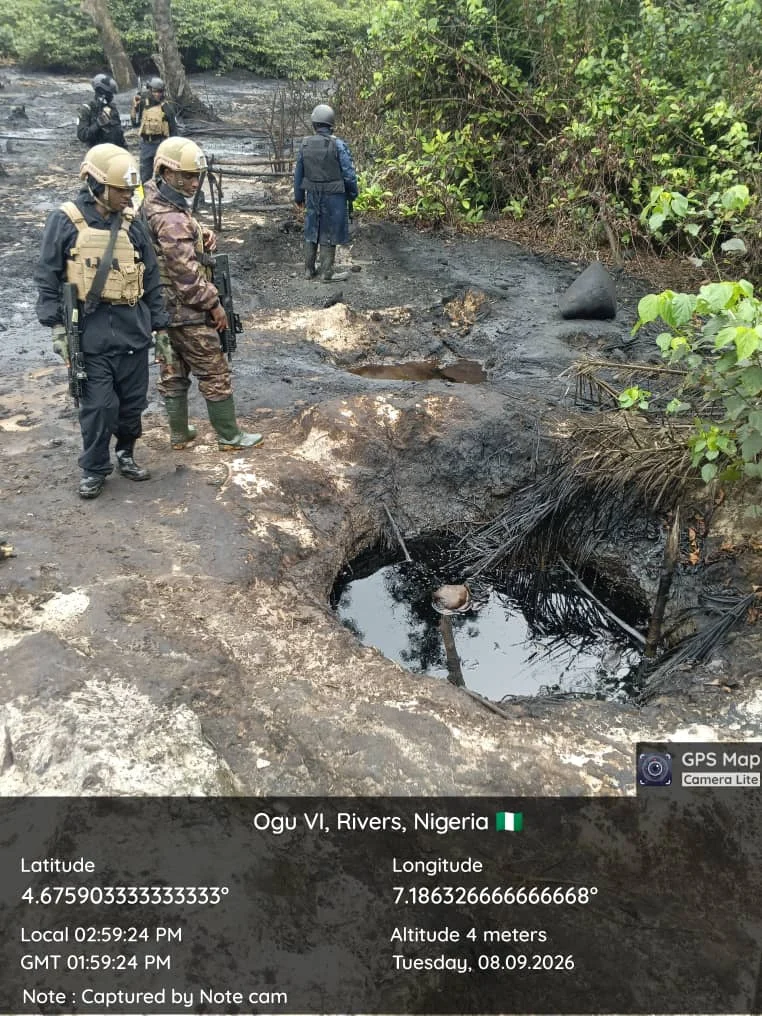
Upon combing the targeted area, naval personnel discovered a total of eight large dugout pits meticulously carved into the swampy terrain. A thorough assessment of these subterranean reservoirs revealed that five were heavily laden with the suspected stolen crude oil, containing an estimated volume of 182,000 litres. The remaining three pits were found empty, indicating that they were either recently emptied, undergoing preparation for fresh storage, or reserved as contingency holding facilities by the perpetrators.
In addition to the hydrocarbon reserves, the raiding team uncovered an intricate network of flexible hoses and pumping equipment. These clandestine conduits are typically deployed by oil thieves to siphon crude oil directly from compromised pipelines or to transfer the viscous substance from barges and wooden boats into land-based holding pits before subsequent movement to illegal refining sites. In accordance with standard operating procedures and existing regulatory frameworks, the naval personnel disabled the infrastructure, rendering the transfer lines inoperable and neutralizing the immediate threat posed by the storage facility.
Captain Folorunsho emphasized that the operation represents a critical blow to the operational capacity of oil theft syndicates in Rivers State. By systematically dismantling the storage hubs, the navy is actively starving these criminal networks of the essential logistical components required to sustain large-scale industrial theft and illegal refining operations.
Chronology of Recent Naval Operations in the Region
The raid at Bethel Creeks does not occur in a vacuum; rather, it is part of an aggressive, sustained campaign by the Nigerian Navy to sweep the maritime domain clean of economic saboteurs. A chronological review of recent military engagements in the area illustrates a pattern of escalating pressure on illegal bunkering networks, particularly within the area of responsibility covered by FOB Bonny.
Just two weeks prior to the Bethel Creeks raid, specifically on September 8, FOB Bonny operatives successfully executed a high-impact operation targeting newly activated illegal refining sites around Aworkiri. That intelligence-driven raid led to the recovery of approximately 87,000 litres of suspected stolen crude oil. During the Aworkiri operation, naval personnel exposed 19 dugout pits along with extensive associated infrastructure, laying bare the sheer scale of the syndicates’ attempts to establish entrenched facilities for the illegal storage and handling of petroleum products.
The proximity of these two major busts—merely a fortnight apart—illustrates both the resilience of the criminal elements and the unwavering, proactive stance of the naval forces. Rather than reacting solely to historical intelligence, the navy has adopted a dynamic posture characterized by continuous reconnaissance, post-operation monitoring, and follow-up patrols designed to prevent criminal groups from regrouping or reoccupying abandoned sites.
Military strategists note that the rapid succession of these discoveries points to a broader tactical shift. In the past, military interventions often ended with the immediate destruction of illegal sites, leaving a vacuum that criminals would quickly exploit to rebuild their infrastructure. Today, the Nigerian Navy’s updated operational doctrine emphasizes sustained area denial, continuous surveillance, and post-disruption monitoring to ensure that illicit actors cannot easily re-establish their networks once dismantled.
Supporting Data and the Macro-Context of Crude Oil Theft
To fully appreciate the significance of the 182,000-litre seizure at Bethel Creeks, it is necessary to examine the broader macroeconomic and security context surrounding crude oil theft in Nigeria. For decades, the Niger Delta—a sprawling labyrinth of creeks, rivulets, and mangrove swamps—has grappled with the endemic challenge of petroleum product diversion.
Crude oil theft, locally referred to as "bunkering," takes multiple forms, ranging from sophisticated hot-tapping of high-pressure trunk lines to rudimentary scooping from flow stations. The stolen crude is either routed to artisanal, makeshift refineries scattered across the creeks to produce substandard diesel, kerosene, and gasoline for local consumption, or transported via barges to waiting vessels on the high seas for international black-market export.
The financial toll of these illicit activities on the Nigerian state has been staggering. According to various economic and regulatory reports, Nigeria loses hundreds of thousands of barrels of crude oil daily to theft and vandalism. This hemorrhaging of national resources has historically depressed government revenue, constrained foreign exchange earnings, forced national budget adjustments, and severely impacted the ability of the federation to fund critical infrastructure and social services.
Furthermore, the environmental devastation associated with illegal refining and crude oil storage in dugout pits is catastrophic. The unmitigated spillage of hydrocarbons into fragile mangrove ecosystems destroys aquatic life, poisons local water tables, ruins local fishing and farming livelihoods, and contributes significantly to regional air pollution, infamously known locally as "soot." Consequently, every litre of stolen crude intercepted by the navy—such as the 182,000 litres recovered at Bethel Creeks—represents not only a financial victory for the national treasury but also a vital ecological defense for the Niger Delta environment.
Official Responses and Strategic Directives
The leadership of the Nigerian Navy, under the auspices of the Naval Headquarters in Abuja, has repeatedly reaffirmed its zero-tolerance policy toward maritime crime. Through official communications and public briefings, the service has maintained that safeguarding the nation’s economic lifeblood remains its foremost constitutional mandate.
Reacting to the Bethel Creeks operation, security analysts and military observers have praised the professionalism and responsiveness of the personnel attached to FOB Bonny. The ability to act swiftly on intelligence and execute complex swamp operations without collateral damage or officer casualties reflects a high standard of tactical readiness and specialized training.
Captain Abiodun Folorunsho, speaking on behalf of the naval hierarchy, reiterated the service’s unwavering resolve. He noted that the successive discoveries at Aworkiri and Bethel Creeks highlight an expanding operational focus aimed systematically at denying criminal operators the storage and transfer infrastructure required to sustain their illicit trade.
"The service is unyielding in its determination to prevent illicit activities from becoming re-established after previous disruptions," Folorunsho stated in his operational report. He added that these targeted interventions severely constrain the availability of crude oil and supporting infrastructure for illegal exploitation within the region, thereby choking off the supply chains that feed the black market.
While the navy continues to record tactical successes on the waterways, defense experts emphasize that addressing the root causes of crude oil theft requires a multi-dimensional approach. This includes enhanced inter-agency collaboration between the navy, the Nigerian Army, the Department of State Services (DSS), the Nigeria Security and Civil Defence Corps (NSCDC), and private security contractors. Additionally, intelligence-sharing mechanisms, community engagement with coastal populations, and the prosecution of apprehended suspects are viewed as critical components necessary to ensure deterrence.
Broader Impact and Economic Implications
The interception of 182,000 litres of suspected stolen crude oil carries profound implications for the Nigerian energy sector and the wider economy. At a time when the federal government is aggressively striving to boost national crude oil production quotas to meet targets set by the Organization of the Petroleum Exporting Countries (OPEC) and stabilize foreign reserves, security on the oil-producing corridors is paramount.
When production is disrupted by pipeline vandalism and theft, international oil companies (IOCs) and indigenous operators frequently declare force majeure, leading to steep declines in national output. By aggressively neutralizing illegal storage facilities, clamping down on unauthorized transfer hoses, and dismantling makeshift refining networks, the Nigerian Navy directly contributes to creating a more secure operating environment for legitimate energy investments.
Moreover, the psychological impact on criminal syndicates cannot be overstated. Repeated losses of large volumes of product—such as the combined 269,000 litres recovered in the recent operations at Aworkiri and Bethel Creeks—create severe financial strains for the financiers and kingpins behind these networks. The high cost of procuring equipment, deploying labor, and subsequently losing entire inventories to military raids significantly reduces the profit margins of illegal bunkering, making the enterprise increasingly risky and less financially viable.
As the Nigerian Navy sustains its operational momentum across the deltaic waterways, the message to economic saboteurs is unequivocal: the maritime domain is being actively reclaimed, and the infrastructure of crude oil theft will continue to face systematic dismantling. For the communities of the Niger Delta and the broader Nigerian populace, these aggressive naval patrols offer a glimmer of hope that the nation’s vital natural resources can be effectively protected from ruthless exploitation.