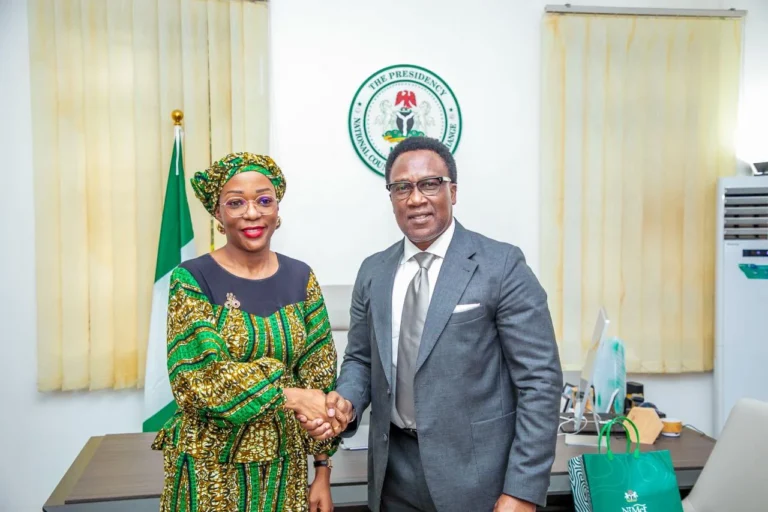
The Nigerian Meteorological Agency (NiMet) and the National Council on Climate Change (NCCC) have reached a landmark agreement to solidify their partnership through a formal Memorandum of Understanding (MoU) aimed at enhancing climate services, data management, and national resilience. This strategic alignment was announced following a high-level courtesy visit by the Director-General and Chief Executive Officer of NiMet, Professor Charles Anosike, to the Director-General of the NCCC Secretariat, Dr. Tenioye Majekodunmi. The meeting, held at the NCCC headquarters, marks a pivotal moment in Nigeria’s efforts to streamline its climate response and leverage scientific data for sustainable development.
During the deliberations, both heads of agency emphasized that the proposed MoU would serve as a framework for sustained collaboration in critical areas, including the co-development of climate projections, the strengthening of early warning systems, and the standardization of meteorological data across the federation. Professor Anosike highlighted that NiMet, as the primary custodian of Nigeria’s historical meteorological records, possesses over a century of atmospheric data that is indispensable for assessing climate risks and creating evidence-based policies. The synergy between the two organizations is expected to bridge the gap between scientific research and policy implementation, ensuring that Nigeria’s climate actions are rooted in localized, high-resolution data.
Strengthening the Foundations of Climate Data and Research
The core of the partnership revolves around the optimization of climate data management. Professor Anosike explained that NiMet’s repository of long-term meteorological records provides the necessary baseline for analyzing climate trends and developing reliable future projections. In an era where climate volatility poses a significant threat to national security and economic stability, the ability to interpret historical data to predict future patterns is vital. The collaboration will focus on "downscaling" global climate models—a process that translates broad international climate data into practical, localized advisories that are relevant to specific Nigerian communities and economic sectors.
By standardizing climate data, NiMet and the NCCC aim to provide a "single source of truth" for policymakers. This prevents the fragmentation of information and ensures that different government ministries, departments, and agencies (MDAs) are working from the same scientific foundation. The joint research initiatives planned under the MoU will specifically target climate-sensitive sectors such as agriculture, water resources, aviation, and disaster risk management.
Unlocking International Climate Finance
One of the most significant aspects of the NiMet-NCCC collaboration is its potential to unlock international climate funding. Professor Anosike underscored that quality meteorological and climate data are absolute prerequisites for accessing global funds, such as the Green Climate Fund (GCF) and the Adaptation Fund. International donors and investors require rigorous, data-backed evidence of climate vulnerability and the projected impact of proposed interventions before committing resources.
"Quality meteorological and climate data is a prerequisite for accessing international climate finance," Anosike stated. He further noted that by joining forces, NiMet and the NCCC can develop more robust joint funding proposals. These proposals will focus on climate resilience, the expansion of early warning infrastructure, and the modernization of climate-monitoring hardware. With a unified front, Nigeria is better positioned to compete for the billions of dollars available globally for climate adaptation and mitigation, which are essential for meeting the nation’s obligations under the Paris Agreement.
Chronology of Institutional Collaboration
The move toward a formal MoU is the culmination of a series of strategic engagements between the two agencies over the past two years.
- August 2024: NiMet and the NCCC held preliminary talks where they resolved to deepen cooperation on climate action. During this meeting, NiMet first highlighted its role as the guardian of over 100 years of data, emphasizing how this asset could support the United Nations’ "Early Warnings for All" initiative.
- March 2026: In a parallel effort to decentralize climate knowledge, NiMet signed a significant MoU with the University of Agriculture and Environmental Sciences. This partnership was designed to bolster localized weather observations and support climate-smart agriculture, providing a template for how NiMet intends to work with academic and regulatory bodies like the NCCC.
- Late 2026: Following internal reviews and the appointment of new leadership at the NCCC, both agencies fast-tracked the drafting of a comprehensive framework to address the escalating threats of flooding, desertification, and heatwaves.
- The Recent Visit: The meeting between Professor Anosike and Dr. Majekodunmi on Tuesday served as the final consultative step before the official signing of the MoU, which is expected to take place in the coming weeks.
The Role of the NCCC in Nigeria’s Climate Governance
The National Council on Climate Change, established under the Climate Change Act of 2021, is the lead body tasked with coordinating Nigeria’s climate change mitigation and adaptation efforts. Under the leadership of Dr. Tenioye Majekodunmi, the NCCC has been working to operationalize Nigeria’s Net Zero target by 2060.

Responding to the NiMet delegation, Dr. Majekodunmi commended the agency for its consistent delivery of weather information and its proactive approach to climate services. He noted that the NCCC’s mandate to implement the National Climate Change Action Plan cannot be achieved in isolation. The integration of NiMet’s technical expertise into the NCCC’s policy framework is seen as a "force multiplier" that will enhance the effectiveness of Nigeria’s climate governance.
Implications for Agriculture and Food Security
The collaboration holds profound implications for Nigeria’s agricultural sector, which remains the backbone of the economy and a primary employer of labor. Smallholder farmers are particularly vulnerable to the shifting patterns of the rainy season, increased frequency of droughts, and sudden flooding.
Through the MoU, NiMet and the NCCC plan to improve the dissemination of "Climate-Smart" advisories. By downscaling climate projections, the agencies can provide farmers with specific planting windows and crop recommendations based on predicted rainfall patterns in their immediate localities. This evidence-based approach is critical for reducing post-harvest losses and ensuring national food security in the face of a changing climate.
Enhancing Early Warning Systems for All
The partnership is also a direct response to the United Nations Secretary-General’s call for "Early Warnings for All" by 2027. This global initiative aims to ensure that every person on Earth is protected by early warning systems against increasingly extreme weather and climate events.
In Nigeria, where flash floods in 2022 and 2024 caused significant loss of life and property, the need for a robust early warning system is urgent. The NiMet-NCCC alliance will focus on the "last mile" of communication—ensuring that a weather alert generated by NiMet is translated into actionable policy or emergency response by the NCCC and relevant disaster management agencies. This involves not only the technology to detect storms but also the institutional framework to move people out of harm’s way before disaster strikes.
A Data-Driven Future for Nigeria’s Climate Policy
The transition toward a data-driven climate policy represents a shift in Nigeria’s administrative culture. Historically, climate action in many developing nations has been reactive, responding to disasters after they occur. The NiMet-NCCC partnership signals a move toward a proactive, anticipatory model.
By analyzing the 100-year data set held by NiMet, the NCCC can identify long-term trends, such as the gradual southward shift of the Sahara Desert or the rising sea levels along the Atlantic coast. This allows for long-term urban planning and the construction of resilient infrastructure that can withstand the climate realities of the next 50 years.
Conclusion and Path Forward
As the world prepares for future COP (Conference of the Parties) summits, the unified stance of NiMet and the NCCC will strengthen Nigeria’s diplomatic position. A country that can demonstrate a clear, science-based understanding of its climate challenges and a coordinated institutional response is more likely to lead regional climate discussions and attract green investments.
The forthcoming signing of the Memorandum of Understanding is more than a bureaucratic formality; it is a commitment to protecting the lives and livelihoods of over 200 million Nigerians. By combining NiMet’s scientific rigor with the NCCC’s policy mandate, Nigeria is taking a significant step toward a climate-resilient future. The focus on data management, early warning systems, and international finance ensures that the nation is not just surviving climate change, but actively adapting and thriving in a changing global environment.