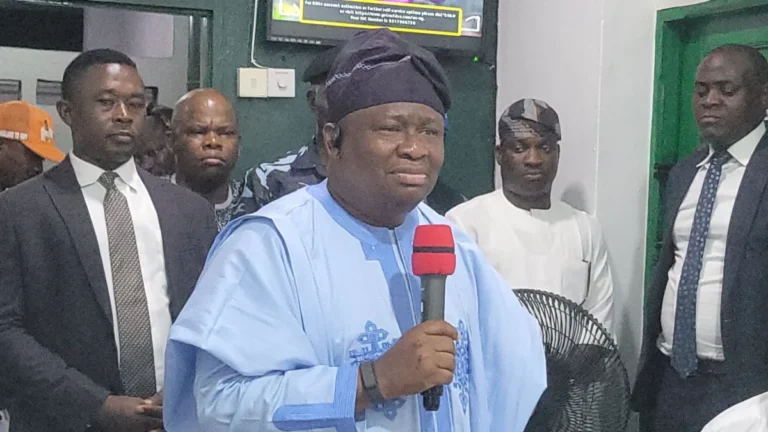
The political landscape of Ogun State shifted into a higher gear this week as the All Progressives Congress (APC) governorship candidate and current Senator representing Ogun West, Solomon Adeola, officially signaled his intent to prioritize youth development and economic empowerment. During a highly charged mega-rally held at the Otunba Dipo Dina International Stadium in Ijebu-Ode, Senator Adeola, popularly known by his moniker Yayi, laid out a vision for the state that centers on harnessing the demographic dividend of Nigeria’s younger generation. The event, which drew thousands of supporters, was not merely a campaign stop but a strategic mobilization effort that underscored the party’s ambition to maintain its dominance in the South-West geopolitical zone ahead of the 2027 general elections.
The Ijebu-Ode Mobilization: A Strategic Display of Power
The rally, organized by the Yayi Progressives Movement (YPM), served as the launchpad for a statewide campaign strategy. The scale of the event—attended by a coalition of artisans, market associations, local government chairmen, and various youth organizations from the nine local government areas of the Ogun East Senatorial District—demonstrated the formidable grassroots machinery currently being deployed by the APC.
Senator Adeola, addressing the sea of supporters, emphasized that his commitment to the youth is not a mere campaign slogan but a core pillar of his prospective administration. "Our commitment to empowering the youth and helping them to succeed while also contributing their much-needed quota to the development of our dear state and the country at large will never be brushed aside," Adeola declared. His speech focused on the dual necessity of personal success for young people and their integration into the broader economic growth strategy of Ogun State.
The highlight of the event was the formal inauguration of over 1,100 Artisan Ambassadors. These individuals, drawn from diverse vocational fields including tailoring, automotive mechanics, carpentry, and hairdressing, are intended to act as the primary interface between the YPM and the grassroots economy. By formally organizing these groups, the APC is signaling a move to capture the informal sector, which constitutes a significant portion of Ogun State’s workforce and is critical to electoral success in the state’s densely populated urban centers.
Chronology of the Political Mobilization
The road to the 2027 elections has already begun to take shape, with the APC implementing a structured approach to engagement. Following the recent meeting between Senator Adeola and the Inter-Party Advisory Council (IPAC) in Abeokuta, the party has moved rapidly to consolidate its base.
- Early September 2026: Initial consultations with local party stakeholders and IPAC members to ensure alignment on gubernatorial objectives.
- Mid-September 2026: Announcement of the Yayi Progressives Movement’s regional tour, starting with the Ogun East Senatorial District.
- September 21, 2026: A solidarity walk conducted by thousands of youths in Ijebu-Ode, setting the tone for the main rally.
- September 22, 2026: The official Ogun East Mega Rally at the Otunba Dipo Dina International Stadium, featuring the inauguration of the 1,100 Artisan Ambassadors.
- Future Outlook (Q4 2026 – 2027): Planned similar rallies for the Ogun Central and Ogun West senatorial districts, aimed at saturating the state with the party’s message before the formal campaign period.
Supporting Context and Economic Implications
The emphasis on youth empowerment is particularly relevant given the socio-economic climate in Ogun State. As an industrial hub bordering Lagos, Ogun serves as a critical manufacturing center. However, the state faces the dual challenge of balancing rapid industrialization with the need to reduce unemployment among a growing youth population.
Current data suggests that youth unemployment remains a critical policy issue across Nigeria. By focusing on vocational training and the formalization of artisan guilds, the APC’s strategy aims to bridge the gap between education and employment. According to economic analysts, mobilizing artisans is a high-yield political strategy; these individuals possess high social capital within their local communities, making them effective conduits for political messaging.
Furthermore, the involvement of Governor Dapo Abiodun at the rally added significant weight to the event. The governor’s presence was a clear message of party unity—a factor often cited by analysts as a prerequisite for APC success in Ogun. With the governor throwing his full weight behind the legislative and executive candidates of the party, the APC is aiming for a clean sweep of the electoral map in 2027.
Official Responses and Party Strategy
Governor Abiodun’s address during the rally was direct and focused on the party’s performance metrics for the upcoming election. His call for a "united electoral front" was underscored by the ambitious goal of securing two million votes for President Bola Tinubu.
"We have promised our President two million votes, and not a single vote must be lost," Governor Abiodun stated. "After all, there is no opposition in Ogun State."
This rhetoric reflects a broader strategy of "electoral consolidation." By framing the party as the sole viable path for governance in the state, the APC is attempting to suppress the growth of opposition parties before they can gain momentum. The governor’s insistence that votes be secured from the presidential level down to the state legislative level highlights the party’s focus on maintaining legislative control, which is necessary to pass the state budget and implement the policies proposed by the governorship candidate.
Broader Impact: The 2027 Political Landscape
The political implications of these developments are significant for both the APC and its potential challengers. First, the early start of the YPM movement forces other political actors in the state to accelerate their own mobilization efforts, likely leading to a highly competitive, if not volatile, political environment in the months leading up to the polls.
Second, by focusing on "artisan ambassadors," the APC is signaling a shift toward identity-based political mobilization that transcends traditional party structures. If this model proves successful in Ogun East, it is expected to be replicated in the industrial corridors of Ogun Central and the agricultural belts of Ogun West.
Finally, the focus on youth, while a standard feature of modern campaigning, is here linked to a tangible promise of economic participation. The ability of the APC to deliver on these promises—or to provide a credible roadmap for them—will likely determine the level of youth turnout in the 2027 election.
As the state moves closer to the general election, the focus will likely shift from broad mobilization to the specifics of policy implementation. Senator Adeola’s supporters argue that his experience at the federal legislative level provides him with the necessary contacts and policy acumen to transform these campaign pledges into reality. Conversely, observers note that the success of these initiatives will depend heavily on the state’s fiscal capacity to support vocational and youth-focused programs amidst ongoing inflationary pressures.
In conclusion, the Ijebu-Ode rally marks a critical juncture in the Ogun State political calendar. With the APC leadership projecting total unity and the Yayi Progressives Movement expanding its grassroots footprint, the party has effectively set the pace for the next electoral cycle. Whether this strategy translates into the anticipated electoral mandate will depend on the party’s ability to maintain its current momentum and effectively address the pressing economic concerns of the Ogun electorate. As the movement prepares for its upcoming rallies in the remaining senatorial districts, all eyes will remain on how the APC balances its internal party dynamics with the high expectations of the voters it seeks to mobilize.