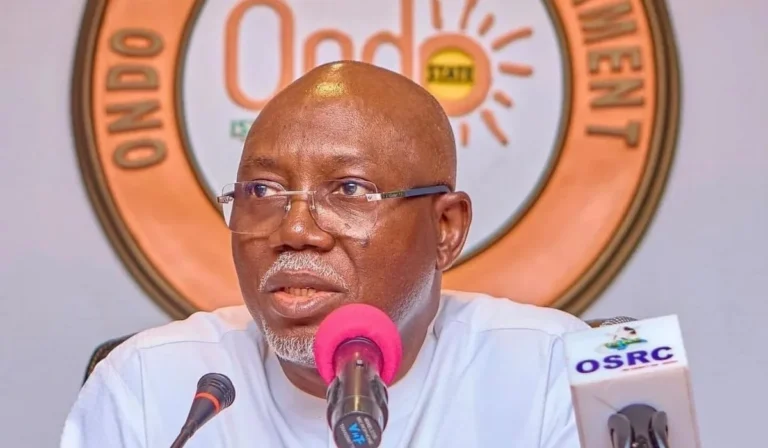
In a strategic move to bolster human capital development and mitigate the escalating costs of tertiary education, the Ondo State Government, under the leadership of Governor Lucky Aiyedatiwa, has officially inaugurated the 2026 bursary, scholarship, and financial assistance programme. During a formal ceremony held at the Cocoa Conference Centre in the Governor’s Office, Alagbaka, Akure, on Tuesday, the administration committed N400 million to support 13,360 students of Ondo State origin currently enrolled in various tertiary institutions across Nigeria. This intervention is part of a broader educational reform package designed to ensure that socio-economic barriers do not hinder the academic pursuits of the state’s youth.
The selection process for the 13,360 beneficiaries reflects a tiered approach to support. The breakdown includes 11,907 bursary recipients, 614 scholarship beneficiaries, 239 students currently attending the Nigerian Law School, 500 medical students undergoing intensive clinical training, and 100 students living with physical disabilities. By targeting specific cohorts, particularly those in high-cost professional fields like medicine and law, the administration aims to stabilize the academic progression of students who are most vulnerable to financial attrition.
A Strategic Vision for Educational Infrastructure
Governor Aiyedatiwa framed the disbursement not merely as a social welfare gesture but as a cornerstone of the state’s long-term economic development strategy. Emphasizing the theme of the 2026 Budget of Economic Consolidation, the Governor noted that the government has prioritized the rehabilitation and construction of 500 basic schools across the state. This infrastructure drive is complemented by the integration of technology in classrooms, exemplified by the commencement of a Digital Literacy Programme, which involves the distribution of digital tablets to students in 50 public secondary schools.
The state’s vision for education extends to the expansion of its tertiary landscape. Governor Aiyedatiwa provided updates on the transition of Rufus Giwa Polytechnic, Owo, into the proposed University of Agriculture, Science and Technology, Owo (UNASTO). This transformation is intended to align academic research with the state’s agricultural potential, creating a pipeline of skilled graduates capable of driving the state’s industrialization. Furthermore, the administration confirmed the impending take-off of a College of Nursing at Igbokoda and a College of Education at Aboto, initiatives aimed at decentralizing higher education and improving access for students in the coastal regions of the state.
Digital Innovation in Student Support
A significant development emerging from the event was the announcement by the Senior Special Assistant to the Governor on Scholarship, Samad Orijeminiyi, regarding the move toward a fully digitized scholarship management system. Working in collaboration with the State Information Technology Agency (SITA), the government is developing a dedicated mobile application designed to function as a central digital registry for all indigenes studying in tertiary institutions.
This transition from traditional, manual application methods to a digital database is expected to revolutionize how the state manages educational support. According to government officials, the platform will serve three primary functions: identity verification, data-driven policy planning, and fraud reduction. By centralizing student profiles, the government can better track academic performance, identify areas of need, and reduce the administrative overhead associated with manual documentation. Furthermore, officials suggested that this transparent, data-rich platform could serve as a catalyst for private sector collaboration, allowing corporate entities to align their Corporate Social Responsibility (CSR) efforts with verified student needs.
Financial Breakdown and Welfare Commitments
The financial support structure is tiered based on academic performance and specific professional needs. According to the Permanent Secretary of the Ondo State Scholarship Board, Mrs. Funsho Tunji-Omoniyi, scholarship beneficiaries who maintain a minimum Cumulative Grade Point Average (CGPA) of 4.0 on a five-point scale—or 3.0 on a four-point scale—are entitled to a grant of N100,000. Bursary recipients are set to receive N20,000, while Law School and medical students in clinical training receive N100,000. Physically challenged students receive a specialized grant of N75,000.
Beyond the direct student grants, the Commissioner for Education, Science and Technology, Prof. Igbekele Ajibefun, highlighted other substantial financial injections into the education sector. These include the release of N633.918 million to cover the 2026 West African Senior School Certificate Examination (WASSCE) registration fees for students in public secondary schools. Additionally, the administration has moved to address long-standing industrial relations issues by approving the implementation of the Federal Government’s agreement regarding new salary structures for university staff. To facilitate this, the government has increased subventions to state-owned tertiary institutions, ensuring that the new wage scales can be paid without compromising the quality of instruction or institutional maintenance.
Compassion and Institutional Continuity
A poignant moment during the event occurred when Governor Aiyedatiwa authorized a special scholarship for the child of the late Comrade Mary Ogunga, a student leader who passed away in July while preparing for her final Bar examinations. The Governor further directed that the child be enrolled in the bursary scheme immediately, despite not yet reaching the tertiary level of education. This gesture was widely viewed as a reflection of the administration’s commitment to the student community and a tribute to the legacy of grassroots leadership.
Comrade Temitope Alade, the Global President of the National Association of Ondo State Students, lauded the initiative. Representing the student body, he characterized the Governor’s actions as "fatherly" and impactful, noting that the timely release of funds would provide a vital safety net for thousands of families currently grappling with the inflationary pressures affecting the Nigerian economy.
Broader Implications for Ondo State
The timing of this intervention is critical. With inflation impacting the cost of living, transport, and academic materials, the N400 million bursary serves as a necessary buffer to prevent a rise in dropout rates. However, the success of this programme will depend on the sustainability of the digital registry and the efficient distribution of funds.
Economists and educational stakeholders have observed that Ondo State’s approach—balancing infrastructure development, digital literacy, and direct financial aid—is a multifaceted strategy that addresses both the immediate needs of students and the long-term structural requirements of the state’s economy. By moving to transform Rufus Giwa Polytechnic into a specialized university, the government is signaling a shift toward specialized technical education, which is widely regarded as a requirement for modern economic growth.
Furthermore, the commitment to paying WASSCE fees for all public school students is a significant intervention in secondary education, ensuring that students from lower-income backgrounds have an equal opportunity to pursue higher education. By removing the initial barrier of examination fees, the government is effectively expanding the pool of potential university entrants for future years.
As the administration continues to implement the 2026 Budget of Economic Consolidation, the focus will likely remain on the execution of these capital projects. The integration of the proposed digital registry will be the primary metric for measuring the efficiency of this administration’s educational policy. If successful, the platform could serve as a model for other states in Nigeria seeking to modernize their scholarship boards and foster closer relationships between the public sector, academic institutions, and the student population.
The event concluded with a charge from the Governor to the students: to view the financial support as a responsibility rather than a mere entitlement. By maintaining academic excellence and discipline, the beneficiaries are expected to contribute back to the state’s development, completing a cycle of investment that the Governor hopes will define his tenure as a period of significant educational renaissance in Ondo State.