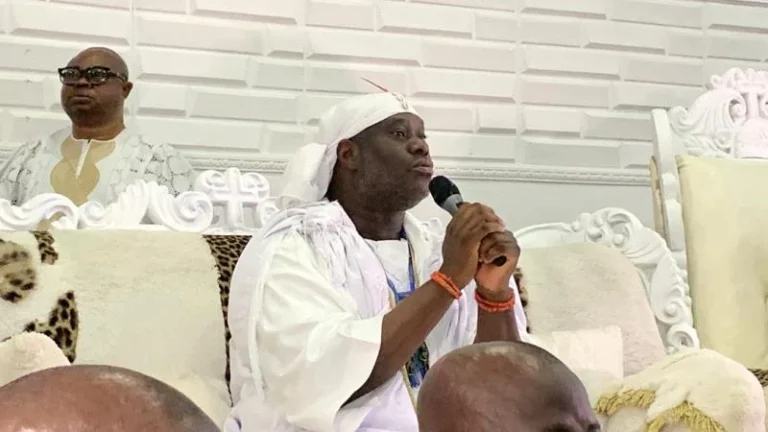
The revered monarch of the Yoruba kingdom, His Imperial Majesty, the Ooni of Ife, Oba Adeyeye Enitan Ogunwusi, Ojaja II, has issued a profound appeal to all political parties, their respective candidates, and their enthusiastic supporters, urging them to unequivocally renounce violence, avert any form of bloodshed, and exercise unwavering patience as the crucial August 15 Governorship election in Osun State draws nigh. This significant plea underscores the Ooni’s steadfast commitment to fostering a climate of peace and stability within his domain and across the broader state, particularly during periods of intense political activity.
The royal admonition was delivered during a pivotal visit by key figures of the African Democratic Congress (ADC) to the Ooni’s Palace on Tuesday. Among the distinguished delegation were Rauf Aregbesola, the National Secretary of the party, and Najeem Salaam, the party’s gubernatorial candidate for the upcoming election, alongside other prominent leaders of the ADC. The Ooni, a spiritual leader whose influence extends far beyond the confines of Ile-Ife, chose this occasion to articulate his vision for a democratic process devoid of rancor and marked by decorum.
Due to prior engagements, Oba Adeyeye Ogunwusi was represented by a high-ranking traditional dignitary, the Lowa Adimula of Ifeland, Oba Adekola Adeyeye. The details of this important encounter and the Ooni’s comprehensive message were subsequently disseminated through an official statement. This statement, issued on Tuesday by Sodiq Lawal, the Senior Media Officer at the Ooni’s Palace, on behalf of Moses Olafare, the Director of Media and Public Affairs, served to amplify the monarch’s call for tranquility and his unwavering dedication to the promotion of peaceful coexistence, a cornerstone of his reign, irrespective of the intricate tapestry of political affiliations that characterize the state’s democratic landscape.
The Royal Appeal for Tranquility: A Call for Democratic Civility
The core of the Ooni’s message resonated with a deep concern for the sanctity of human life and the preservation of communal harmony. He reiterated his unwavering commitment to promoting peaceful coexistence, emphasizing that political contests should never degenerate into avenues for division or conflict. His appeal was not merely a ceremonial utterance but a profound invocation of the Yoruba ethos of ‘Omoluabi’ – a philosophy embodying virtues such as respect, honor, and good character. By stressing the need for politicians and their adherents to "shun violence, avoid bloodshed and remain patient," the Ooni sought to steer the political discourse towards constructive engagement rather than destructive confrontation.
"Elections should not divide our people or cost anyone his or her life," the Ooni cautioned through his representative. This statement serves as a stark reminder of the often-volatile nature of elections in certain parts of Nigeria, where political rivalries can sometimes escalate into physical altercations, regrettably leading to loss of life and property. The Ooni’s intervention, therefore, carries significant weight, acting as a moral compass for all stakeholders involved in the electoral process. He further implored, "Let the campaigns be peaceful, while the electorate freely exercise their democratic rights," advocating for an environment where citizens can participate in the democratic process without fear or intimidation, thereby upholding the fundamental tenets of free and fair elections.
Significance of the August 15 Osun Governorship Election
The August 15 Governorship election in Osun State is a pivotal event in the state’s political calendar, holding profound implications for its future trajectory. Osun State, situated in the heart of the Yoruba Southwest, is known for its rich cultural heritage, strong traditional institutions, and a politically engaged populace. The outcome of this election will determine the leadership that steers the state for the next four years, impacting various sectors including education, infrastructure, healthcare, and economic development.
The political landscape of Osun State is often dynamic and highly contested, with various parties vying for control. The Independent National Electoral Commission (INEC) plays a crucial role in ensuring the credibility and transparency of the electoral process, from voter registration to the tabulation of results. Public appeals for peace from influential figures like the Ooni are essential in mitigating potential tensions, especially in a state where political contests can be fiercely competitive. Historically, electoral violence, though not always widespread, has been a concern in certain areas of Nigeria, making such pre-emptive calls for calm critically important for safeguarding the democratic process and ensuring citizen participation without hindrance. The Ooni’s statement aims to foster an atmosphere of civility, allowing for robust debate on policy issues rather than focusing on personality attacks or incitement to violence.
The Sacred Heart of Yoruba Heritage: Ile-Ife’s Development Imperative
Beyond the immediate call for peaceful elections, the Ooni also articulated a powerful message concerning the development of Ile-Ife, which he passionately described as "the spiritual and historical cradle of the Yoruba race." He stressed the imperative for successive governments and political leaders to accord Ile-Ife "the level of attention and development befitting its historical significance." This plea highlights a broader concern about regional development and the recognition of historical and cultural centers within Nigeria.
The Ooni elaborated on Ile-Ife’s unique position, asserting, "Ile-Ife remains the source and ancestral home of the Yoruba people. Politics in modern Nigeria has a rich history that also has strong roots in Ile-Ife." He drew a direct historical link to the late Ooni Adesoji Aderemi, who served with distinction as the Governor of the old Western Region. His remarkable contributions, the Ooni noted, were felt not only within Ile-Ife but resonated throughout Yorubaland and indeed, across Nigeria. This historical reference serves to underscore Ile-Ife’s foundational role in Nigeria’s political evolution.
However, the Ooni lamented a perceived disparity in development, stating, "Since he left office, Ile-Ife has not experienced the level of development that befits its status as the cradle of the Yoruba race." To contextualize this observation, he drew compelling parallels with other significant cultural and historical centers in Nigeria. "The Hausa people regard Sokoto as their source, and today Sokoto continues to enjoy significant development," he observed. Similarly, he pointed out, "The Igbo people hold Enugu in high esteem as one of their historic centres, and its growth is evident." These comparisons are not merely anecdotal but serve to illustrate a perceived imbalance in governmental attention and investment. The Ooni’s implicit argument is that if other major ethnic groups ensure the development of their ancestral homes, the Yoruba, who acknowledge Ile-Ife as their source, must "collectively ensure that this ancient city receives the attention and development it deserves." This call transcends mere sentiment; it is an advocacy for strategic investment in a site of immense cultural, historical, and potentially economic importance, recognizing that such development would benefit not just Ile-Ife but also serve as a source of pride and progress for the entire Yoruba nation.
Traditional Rulers as Custodians of Peace and Progress
The Ooni’s multifaceted appeal underscores the enduring and significant role of traditional rulers in contemporary Nigerian society. Despite the formal structure of modern democratic governance, traditional institutions, led by figures like the Ooni, retain immense influence over their communities. They are seen as custodians of culture, tradition, and community values, and their pronouncements often carry moral authority that transcends political divides.
In a nation as diverse and complex as Nigeria, traditional rulers frequently act as crucial intermediaries between the government and the populace. Their calls for peace during elections are not merely symbolic; they can significantly impact public behavior, helping to de-escalate tensions and foster a more responsible political culture. Furthermore, their advocacy for regional development, as seen in the Ooni’s plea for Ile-Ife, highlights their role as champions for the welfare and progress of their domains. They often possess an intimate understanding of local needs and aspirations, making them vital voices in the national development discourse. The Ooni’s appeal, therefore, serves as a powerful reminder of the symbiotic relationship between traditional authority and the democratic process, where both can contribute to stability and progress.
The African Democratic Congress’s Campaign Launch and Historical Context
The visit by the African Democratic Congress (ADC) delegation to the Ooni’s Palace was not merely a courtesy call but marked the official commencement of their governorship campaign in Osun State. Rauf Aregbesola, the National Secretary of the ADC, articulated the party’s rationale for choosing Ile-Ife as the auspicious starting point for their electoral journey. He explained that this decision was made "in recognition of the city’s cultural and historical importance to the Yoruba race." This strategic choice underscores the deep reverence many Yoruba politicians hold for Ile-Ife as the spiritual and ancestral heartland.
Aregbesola’s statement provided valuable historical context to the ADC’s relationship with Ile-Ife and the Ooni’s Palace. He recounted, "Ile-Ife remains our source. It has been about eight years since we last came here for this purpose." This reference points to a previous electoral cycle, indicating a long-standing tradition within their political camp. He further elaborated on a past campaign, stating, "We came with the candidate of our former political party, and although the people of Ife stood solidly with us, God did not permit that opportunity to be fully utilised." This candid reflection suggests a history of strong support from the Ife populace, even if previous electoral outcomes did not align with their aspirations.
The National Secretary emphasized the consistent nature of their approach, asserting, "Our tradition has always been to begin our political campaigns in Ile-Ife because we believe this is our source." This tradition, he noted, dates back almost two decades: "Since 2004, we have consistently visited the palace to seek royal blessings before embarking on major political activities, and we are here today to continue that tradition." This chronological detail highlights the deep-rooted cultural practice of seeking spiritual and ancestral endorsement from traditional rulers before embarking on significant public endeavors, especially in the political arena. For the ADC, initiating their campaign from Ile-Ife, with the Ooni’s blessing, is not just a political strategy but a culturally resonant act, designed to connect with the Yoruba heritage and secure a sense of legitimacy and divine favor from the source of their ancestry.
Historical Precedents: Ooni Adesoji Aderemi’s Legacy
The Ooni’s poignant reference to his predecessor, Oba Adesoji Aderemi, who served as Governor of the old Western Region, provides crucial historical depth to the discussion of Ile-Ife’s political significance. Ooni Adesoji Aderemi’s tenure as Governor from 1960 to 1962 was a landmark period, representing a unique convergence of traditional authority and modern political governance. His role as both a paramount traditional ruler and a key political figure demonstrated the profound respect and influence traditional institutions once commanded in the nascent Nigerian state.
His "remarkable contributions" were indeed far-reaching, encompassing administrative reforms, infrastructure development, and the fostering of regional unity. The Ooni’s lament that "since he left office, Ile-Ife has not experienced the level of development that befits its status" underscores a perceived decline in the strategic prioritization of the ancestral city by subsequent governments. This historical context serves as a powerful argument for renewed attention to Ile-Ife, not merely out of sentimentality, but as a recognition of its foundational role in the political and cultural tapestry of Nigeria. It suggests that investing in Ile-Ife is akin to honoring a vital part of the nation’s heritage and leveraging its historical weight for contemporary progress. The legacy of Ooni Adesoji Aderemi continues to be a benchmark for what is possible when traditional wisdom and modern governance converge for collective advancement.
Broader Implications for Democratic Process and National Cohesion
The Ooni’s intervention carries broader implications for the democratic process in Nigeria and the ongoing quest for national cohesion. In a country where ethnic and religious identities often intersect with political affiliations, the voice of a revered traditional ruler, particularly one whose authority transcends specific political parties, can be a potent force for stability. His appeal for peace during elections is not confined to Osun State alone but serves as a template for responsible political conduct across the nation.
Electoral violence, often fueled by desperation, misinformation, and the exploitation of youth, poses a significant threat to the integrity of democratic institutions. Such violence deters voters, particularly women and vulnerable populations, from participating, thereby undermining the legitimacy of election outcomes. By explicitly condemning bloodshed and advocating for patience, the Ooni aims to foster an environment where democratic rights can be exercised freely and safely. This contributes to building public trust in the electoral system, which is crucial for democratic consolidation. Furthermore, his emphasis on Ile-Ife’s development as a reflection of national commitment to cultural heritage speaks to the need for inclusive development that respects and uplifts all regions, thereby strengthening the bonds of national unity.
Ensuring Credible Elections: A Collective Responsibility
Ensuring credible and peaceful elections, as advocated by the Ooni, is a collective responsibility that extends beyond political parties and candidates. The Independent National Electoral Commission (INEC) bears the primary constitutional mandate to conduct elections, and its impartiality and efficiency are paramount. Security agencies are tasked with maintaining law and order, protecting electoral officials and materials, and ensuring the safety of voters without undue interference. Civil society organizations and election observers play a crucial role in monitoring the process, advocating for reforms, and reporting irregularities, thereby enhancing transparency and accountability.
However, the ultimate success of a peaceful election rests with the electorate itself. Informed and responsible voting, coupled with a refusal to be swayed by incitement or material inducements, is fundamental to a healthy democracy. The Ooni’s appeal serves as a powerful reminder to every citizen that their role is not just to cast a vote, but to actively uphold the values of peace, patience, and respect for the democratic process. By collectively embracing these principles, Osun State can set an example for other regions, demonstrating that vigorous political contestation can coexist with civility and harmony, thereby strengthening Nigeria’s democratic fabric.
The Path Forward: Sustaining Peace and Development
As the August 15 Governorship election approaches, the Ooni of Ife’s dual appeal for peace and development resonates deeply within Osun State and beyond. His call to shun violence and embrace patience is a critical reminder of the fragility of peace and the imperative of safeguarding human lives during political contests. This royal counsel, steeped in traditional wisdom and moral authority, aims to guide political actors towards a more responsible and constructive engagement with the democratic process.
Concurrently, his passionate advocacy for the development of Ile-Ife serves as a potent reminder of the need to address historical imbalances and invest strategically in centers of cultural and historical significance. Such investments are not merely about infrastructure but about recognizing and honoring the foundational heritage of a people, fostering pride, and unlocking economic potential that can benefit broader communities. The Ooni’s vision points towards a future where political competition is conducted with civility, and where the rich cultural tapestry of Nigeria is celebrated and nurtured through equitable development. The successful implementation of these calls will not only ensure a credible and peaceful election in Osun State but will also contribute significantly to the broader national agenda of unity, stability, and sustainable progress.