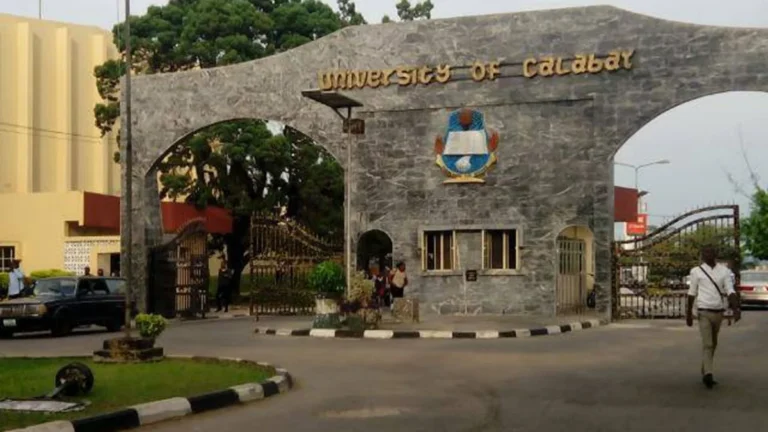
The administration of higher education institutions in Nigeria has once again been thrown into the spotlight following a massive legal showdown involving the University of Calabar (UNICAL) and a significant cohort of its student body. Over 200 aggrieved students of the prestigious institution, located in Cross River State, have taken the bold step of filing a lawsuit at the Federal High Court in Abuja. The legal action targets the university institution itself, the Vice-Chancellor, the Registrar, and notably, President Bola Tinubu in his capacity as the visitor and ultimate appointing authority of federal universities in the country.
The core of the dispute centers around the controversial and sudden mass removal of 214 second-year Bachelor of Laws (LL.B) students from the Faculty of Law. These students have been directed by the current university leadership to revert to their original departments and faculties where they were initially admitted. In response to what they deem an arbitrary, high-handed, and legally flawed administrative reversal, the affected undergraduates are demanding a staggering N5 billion in general and exemplary damages. The lawsuit, filed on 12 August, highlights deep-seated vulnerabilities in institutional continuity, administrative handovers, and the sanctity of academic admissions processes within Nigeria’s public university system.
Chronology of the Controversy and Administrative Transitions
To fully comprehend the gravity of the legal battle unfolding at the Federal High Court, it is vital to examine the timeline of events that culminated in the mass transfer directive. The genesis of the controversy dates back to the 2023/2024 and 2024/2025 academic sessions. During this period, the affected students sought and secured admission into the University of Calabar’s Faculty of Law. Under the administration of the former Vice-Chancellor, Florence Obi—a professor of special education who steered the institution from December 2020 until the conclusion of her five-year tenure on 1 December 2025—the admissions were processed, verified, and integrated into the university’s official framework.
Upon receiving their admission offers, the students meticulously followed the prescribed institutional protocols. They paid their acceptance fees, successfully completed mandatory physical and online screenings, paid their school tuition across nearly three academic sessions, and actively participated in lectures. Furthermore, they sat for continuous assessments and university-supervised examinations, successfully transitioning from the 100 level to the 200 level, with some advanced cohorts even progressing into the 300 level.
Complications began to surface when the university mandated the students to undergo Joint Admissions and Matriculation Board (JAMB) regularisation. The students complied, paying the requisite processing fees. However, friction emerged following the assumption of office of the current Vice-Chancellor, Offiong Offiong, a professor of Chemistry. According to court filings, Mr. Offiong reportedly refused to sign or validate the initial regularisation documents processed during his predecessor’s tenure, citing the absence of his name on the documents. Consequently, the students were compelled to restart the entire JAMB regularisation process and bear additional financial costs.
The crisis reached its boiling point in August 2026. On 5 August, university management convened a high-stakes meeting at the Senate Chamber, involving representatives from the Faculty of Law, the Law Students’ Association of Nigeria (LAWSAN) UNICAL chapter, and the affected undergraduates. During this gathering, Vice-Chancellor Offiong dropped a bombshell: out of the 435 students currently enrolled in the second-year LL.B programme, only 221 were officially and legitimately admitted into the Faculty of Law. The remaining 214 students, he asserted, had irregularly transitioned into the faculty from other departments.
Immediate Fallout and Operational Lockout
Following the August 5 pronouncement, the university administration moved swiftly to enforce its directive. Management declared that the 214 students would not be certified eligible for mobilization to the Nigerian Law School under their current admission status, framing the rollback as a corrective measure to protect the integrity of the institution’s legal training. To effect this transition, the university temporarily locked the academic portals of the affected students, effectively cutting off their access to lecture materials, ongoing academic transcripts, library resources, and result checking platforms.
As a palliative measure, the university offered to refund the tuition fees paid by the affected students for the 2025/2026 academic session, or alternatively, grant them free tuition for the 2026/2027 session should they accept transfer back to their original, parent departments. However, this administrative olive branch was flatly rejected by the students, who viewed the proposal as an insulting remedy to a systemic failure for which they bore zero responsibility.
Legal Arguments and the Doctrine of Executive Continuity

In their substantive suit, filed by a legal team led by Okpi Bernard, the 214 claimants argue that their admission letters, payment of prescribed fees, official course registrations, successful examination milestones, and completed JAMB regularisation created valid, binding, and subsisting legal contracts between them and the University of Calabar.
A central pillar of the students’ legal argument rests on the principle of executive continuity and administrative estoppel. They contend that a sitting vice-chancellor cannot arbitrarily repudiate, invalidate, or nullify official acts, admissions, JAMB regularisation approvals, and institutional commitments legally executed by his predecessor in office. In an affidavit deposed to by Ogana Lawrence Lukpata, the second claimant, the students emphasized that they acted in absolute good faith throughout their academic journey.
Furthermore, the legal team raised critical questions for the court’s determination, focusing heavily on due process and statutory compliance. Specifically, the plaintiffs asked whether the vice-chancellor possesses the unilateral authority to demote, eject, or transfer students, or lock their academic portals without adhering to Section 18 of the University of Calabar Act. They highlighted the glaring absence of prior administrative queries, notices of allegations, or disciplinary panel hearings, noting that none of the 214 students had been investigated, indicted, or found guilty of examination malpractice, fraud, or gross academic misconduct.
The students also directed their legal scrutiny upward, questioning whether President Bola Tinubu, as the visitor and appointing authority of the federal university, bears a statutory responsibility to intervene and halt what they describe as oppressive, unlawful, and damaging administrative overreach.
Specific Reliefs and Interim Injunctions Sought
The plaintiffs have outlined a comprehensive set of demands in their originating summons. Beyond the N5 billion in damages claimed for psychological trauma, academic disruption, and financial loss, they are seeking several declaratory and injunctive orders:
- A judicial declaration that the admission processes, fee payments, and academic progression of the claimants established valid contractual obligations binding on the university.
- A declaration that the current vice-chancellor is legally bound by the doctrine of executive continuity, barring him from reversing valid admissions granted by the previous administration.
- A declaration that the sudden removal of the students from the Faculty of Law and the blocking of their portals constitute a gross violation of Section 18 of the University of Calabar Act and their constitutional right to a fair hearing.
- A permanent injunction restraining the university, the vice-chancellor, and the registrar from taking any adverse academic or administrative actions against the claimants as law students.
- An order compelling President Tinubu to exercise supervisory oversight over the university administration to redress the administrative anomaly.
Alongside the substantive suit, the students filed a motion on notice for an interlocutory injunction. This application seeks immediate, temporary protection from the court, compelling the university to unblock and restore full, uninterrupted access to their academic result portals, learning platforms, and course registration systems while the main suit is adjudicated.
Broader Implications for Nigerian Tertiary Education
This unfolding legal battle at the University of Calabar highlights deep structural vulnerabilities within Nigeria’s higher education framework. Administrative inconsistency, poor record-keeping, and the tendency of incoming vice-chancellors to overhaul or disown policies initiated by their predecessors frequently place innocent students in precarious positions.
Admissions scandals and quota compliance issues are not entirely new to Nigerian federal universities, particularly within competitive professional disciplines like Law and Medicine, where regulatory bodies such as the Council of Legal Education and the National Universities Commission (NUC) strictly enforce carrying capacities. However, legal experts note that when administrative lapses occur due to internal institutional oversights, the burden of rectification should rest squarely on internal accountability—such as sanctioning erring staff members—rather than retroactively punishing students who met all published institutional requirements and invested years of their lives and financial resources into their education.
As the Federal High Court in Abuja prepares to hear the substantive arguments and the application for interim relief, the eyes of the academic community, legal practitioners, and civil society organizations remain fixed on Calabar and Abuja. The outcome of this landmark suit is expected to establish a crucial legal precedent regarding executive continuity, contractual obligations in public university admissions, and the limits of administrative discretion in Nigerian tertiary institutions.