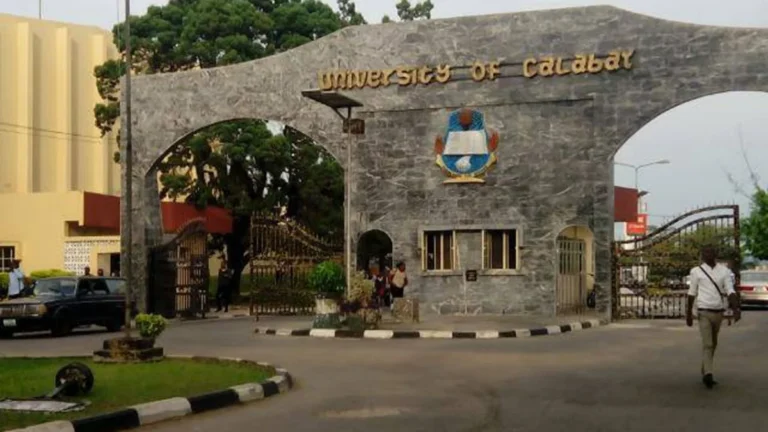
The halls of justice in Nigeria’s Federal Capital Territory have become the latest battleground for a high-stakes academic dispute involving the University of Calabar (UNICAL). In a sweeping legal challenge filed at the Federal High Court in Abuja, a group of 214 second-year Law students has dragged the institution, its Vice-Chancellor, the Registrar, and President Bola Tinubu to court. The students are seeking an astronomical N5 billion in general and exemplary damages following an abrupt administrative directive that stripped them of their status as Law students and forced them back into their original, foundational departments.
The lawsuit, lodged on 12 August, presents a profound test of administrative continuity, institutional accountability, and the legal sanctity of university admissions in Nigeria. At the heart of the litigation is the question of whether a newly minted vice-chancellor can legally invalidate institutional contracts, admissions, and academic progressions sanctioned under a preceding administration. As the legal tussle unfolds, it brings to the fore complex questions regarding governance within Nigerian federal tertiary institutions, student rights, and the boundaries of executive discretion in academia.
Anatomy of a Crisis: The Genesis of the Mass Demotion
The controversy that has upended the academic trajectories of over two hundred undergraduates came to a dramatic head in August. According to court filings and university disclosures, the crisis stems from an internal audit of the Faculty of Law’s student population. Out of 435 students currently enrolled in the second-year Bachelor of Laws (LL.B) programme, university management discovered that 214 had originally been admitted into entirely different departments and faculties before finding their way into the Faculty of Law.
For the affected students, the transition into law was not a clandestine operation; rather, it was a process they believed was fully backed by the institutional machinery of the university. However, the current administration, led by Vice-Chancellor Professor Offiong Offiong, took a starkly different view. Management argued that these 214 students lacked formal, legitimate admission status into the Faculty of Law ab initio. University authorities maintained that permitting these students to continue their legal education under flawed admission statuses would ultimately render them ineligible for graduation, qualification, and exemption for the mandatory vocational training at the Nigerian Law School.
To "correct" the anomaly, the university leadership invoked sweeping administrative measures. On 5 August, during a tense meeting held in the Senate Chamber with representatives of the Faculty of Law and the Law Students’ Association of Nigeria (LAWSAN) UNICAL chapter, Professor Offiong announced the mass transfer. The university subsequently locked the academic result portals of the affected students, effectively severing their access to digital learning platforms, lecture notes, continuous assessment records, and transcripts. To cushion the blow, management offered a peculiar palliative: a full refund of school fees paid for the 2025/2026 academic year or free tuition for the 2026/2027 session should they accept placement back into their original departments.
The Students’ Narrative: Good Faith Meets Administrative Whiplash
The students’ statement of claim, detailed in an affidavit deposed by the second claimant, Ogana Lawrence Lukpata, paints a vivid picture of students caught in the crosshairs of bureaucratic disarray. Mr Lukpata stated that he and 213 others were formally admitted into the Faculty of Law between the 2023/2024 and 2024/2025 academic sessions.

Relying on these offers of admission, the claimants maintained they fulfilled all institutional prerequisites. They paid acceptance fees, completed mandatory physical and online screenings, and diligently paid their prescribed school fees for nearly three academic years. Beyond financial commitments, the students immersed themselves in rigorous academic life. They registered for approved law courses, attended lectures, submitted continuous assessment assignments, and sat for examinations duly supervised and invigilated by the university’s academic staff.
Having successfully passed their examinations, the students progressed from the 100 level to the 200 level, with some advanced cohorts even reaching the 300 level. Furthermore, when the institution instructed them to undergo Joint Admissions and Matriculation Board (JAMB) regularisation to harmonize their records, the students complied, paying the requisite processing fees.
Complications allegedly began to mount following a change in the university’s leadership. Professor Florence Obi, who served as Vice-Chancellor from December 2020, completed her five-year tenure and handed over the reins to Professor Offiong, a professor of Chemistry, on 1 December 2025. According to the affidavit, the initial JAMB regularisation documents processed under Mrs Obi stalled because Professor Offiong allegedly "refused to sign" or complete paperwork initiated by his predecessor. The students were subsequently told that the forms did not bear the current vice-chancellor’s name, compelling them to restart the arduous JAMB regularisation process and cough up additional processing fees.
The culmination of these events was the 5 August directive. The students argue that the university’s decision to lock their portals and expel them from the faculty was done arbitrarily, without prior queries, issuance of formal notices of allegation, or the convening of an administrative panel to grant them a fair hearing. Crucially, the claimants emphasize that none of the 214 students have ever been investigated, indicted, or found culpable of examination malpractice, gross misconduct, or any breach of matriculation oaths. Instead of penalizing university staff or admissions officers who oversaw the processes, management chose to punish students who acted entirely in good faith.
Legal Arguments and the Core Questions Before the Court
Represented by a legal team led by Okpi Bernard, the aggrieved students have asked the Federal High Court to resolve several fundamental questions of law and administrative practice.
First, the court is asked to determine whether a vice-chancellor can arbitrarily and unilaterally invalidate official acts, admissions, and JAMB regularisation approvals granted under a predecessor in office. The students anchor their argument on the legal doctrines of executive continuity and administrative estoppel, suggesting that an institution is a continuous legal entity bound by the lawful commitments of its past leaders.
Second, the plaintiffs seek a judicial interpretation of Section 18 of the University of Calabar Act. They question whether the university possesses the statutory authority to demote, eject, or transfer enrolled students, or lock their academic portals, without first investigating them or establishing culpability for academic fraud or gross misconduct through due process.
Third, the suit tests the supervisory obligations of the executive arm of government. The students have asked the court to examine whether President Bola Tinubu, acting as the visitor and ultimate appointing authority for the federal university, has a statutory duty to intervene and halt institutional actions that violate fundamental human rights and disrupt public education.

The plaintiffs are urging the court to issue sweeping declarations. They want an explicit ruling that their admission letters, fee payments, course registrations, and compliance with JAMB protocols constituted valid, binding legal contracts between them and the University of Calabar. Furthermore, they are praying for a permanent injunction to restrain the university, its vice-chancellor, and the registrar from executing any form of demotion, transfer, portal restriction, or denial of learning opportunities.
In addition to the substantive suit, the students have filed an application for an interlocutory injunction. This motion seeks immediate, temporary court protection to force the university to unblock and restore full access to their portals pending the final determination of the substantive suit, thereby preventing irreversible damage to their academic calendar.
Broader Implications for Nigerian Tertiary Education
The legal battle unfolding at the Federal High Court in Abuja has sent shockwaves through the Nigerian academic community, casting a harsh spotlight on systemic flaws within university admissions and record-keeping systems.
For years, allegations of compromised admission quotas, over-enrollment, and irregular back-door admissions have plagued various federal and state tertiary institutions across Nigeria. Often, departments succumb to political pressure, internal lobbying, or administrative oversights, admitting students beyond approved carrying capacities set by the National Universities Commission (NUC) or professional bodies like the Council of Legal Education.
However, legal experts note that this case diverges from typical admission scandals because the students themselves were passive participants in the administrative pipeline. Having spent years paying fees, attending classes, and passing examinations, the sudden imposition of collective punishment raises serious constitutional questions regarding the right to a fair hearing guaranteed under Section 36 of the 1999 Constitution of the Federal Republic of Nigeria (as amended).
If the court rules in favor of the students, it could establish a landmark precedent reinforcing the doctrine of executive continuity, making it legally perilous for incoming vice-chancellors to unilaterally dismantle the administrative actions of their predecessors at the expense of innocent students. Conversely, a victory for the university could empower institutional management to aggressively purge irregular admissions, albeit leaving a trail of institutional liability and financial claims for breached educational contracts.
As the legal wheels begin to grind in Abuja, all eyes remain fixed on the judiciary. For the 214 young scholars whose dreams of donning the wig and gown hang in a perilous balance, the courtroom represents the final bastion of hope in preserving their academic futures.