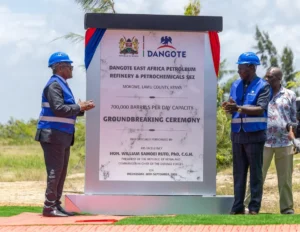
Kenyan President William Ruto has traveled to Nigeria to tour the monumental Dangote Petroleum Refinery in the Lekki Free Zone, marking a critical step forward in East Africa’s ambitions to transform its energy sector. The official visit comes ahead of a scheduled groundbreaking ceremony on September 30 for a massive new 700,000-barrel-per-day petroleum refinery in Lamu, Kenya. President Ruto is slated to be personally hosted by Africa’s richest man and the president of Dangote Group, Aliko Dangote, to study the operational blueprint of the world’s largest single-train petroleum refinery.
The high-level diplomatic and industrial engagement underscores a growing push toward intra-African trade, industrial collaboration, and energy security. By adopting the successful execution model of the multi-billion-dollar Lekki facility, Kenya hopes to revitalize its dormant refining sector and establish itself as a primary petroleum product export hub for the greater East African region.
A Strategic Pivot to Lamu: The Genesis of the East African Refinery Project
The journey toward a major East African refinery has been under discussion for several years, gaining critical momentum earlier this year. In April, President Ruto publicly revealed that regional East African Community (EAC) governments were actively exploring the development of a unified regional refinery. Initial discussions centered around Tanzania’s Tanga port as a strategic location to process crude petroleum harvested from Kenya, Uganda, South Sudan, and the Democratic Republic of Congo (DRC).
Aliko Dangote was notably present at the infrastructure financing meetings in Nairobi where these regional energy frameworks were first conceptualized. Expressing profound confidence in the economic viability of East Africa, Dangote signaled his readiness to replicate the industrial and financial model that brought the Lagos refinery to life.
However, logistical evaluations and strategic consultations later prompted a geographic shift from Tanzania to Kenya. Dangote’s engineering and logistics teams initially inspected the coastal port city of Mombasa before ultimately settling on Lamu. The Lamu location offers distinct strategic advantages, granting the proposed mega-facility direct access to the Indian Ocean and seamless integration with the Lamu Port-South Sudan-Ethiopia Transport (LAPSSET) corridor. This interconnected transport and infrastructure network positions the refinery to serve not only the domestic Kenyan market but also landlocked neighboring economies seeking reliable, locally refined petroleum products.
Reviving Kenya’s Refining Legacy After a Decade of Dormancy
The impending construction of the Lamu facility marks a major milestone in Kenya’s industrial history, effectively reviving the nation’s petroleum refining ambitions more than a decade after its legacy infrastructure went dark. Kenya’s historical footprint in the refining sector centers around the Changamwe-based Kenya Refinery in Mombasa, which served the country for decades before halting crude processing operations entirely in 2013.
The closure of the Mombasa facility followed years of financial distress, operational inefficiencies, and a failure to secure the substantial capital required to upgrade the aging plant to modern technical standards. In an effort to salvage the strategic asset, the Kenyan government progressively increased its stake, eventually taking full ownership of the refinery in 2016 after buying out the remaining 50% shares previously held by Essar Energy. Despite state ownership, the refinery could not be economically revived as a crude processor and was subsequently transitioned into a storage and distribution facility.
The proposed $15 billion Lamu refinery represents a complete paradigm shift. Rather than attempting to patch up legacy infrastructure, the project introduces a world-class, greenfield facility capable of matching the scale and efficiency of modern global refineries.
High-Level Diplomacy and International Partnerships
The current momentum behind the Lamu project crystallized earlier this week during high-level strategic meetings in New York. President Ruto met directly with Aliko Dangote and Samaila Zubairu, the President and CEO of the Africa Finance Corporation (AFC). These high-stakes discussions successfully ironed out the foundational frameworks required to transition the project from the planning phase into critical execution stages.
In a clear signal of the project’s technical readiness, Aliko Dangote has already engaged top-tier engineering expertise to oversee the construction. Under a $450 million arrangement, Dangote Industries has retained Engineers India Ltd. (EIL)—the renowned Indian engineering firm that provided crucial project management and consultancy services for the Lagos refinery. Leveraging EIL’s extensive technical pedigree is expected to streamline construction timelines and mitigate engineering risks associated with a project of this magnitude.
Furthermore, the Africa Finance Corporation is anticipated to play a pivotal role in mobilizing the massive capital expenditure required for the development. As an institution dedicated to bridging Africa’s infrastructure deficit, the AFC’s involvement provides vital institutional backing and investor confidence to attract international syndicates and private equity.
Broader Economic Implications and Regional Impact
The establishment of a 700,000-barrel-per-day refinery in Lamu carries profound geopolitical and economic implications for East Africa. For decades, nations within the EAC region have exported crude oil and raw minerals while remaining heavily dependent on the importation of refined petroleum products. This structural anomaly has historically exposed East African economies to severe vulnerability against global supply chain disruptions, foreign exchange volatility, and fluctuating international oil prices.
By establishing a domestic refining powerhouse, Kenya and its neighbors stand to achieve significant macroeconomic benefits:
- Foreign Exchange Conservation: Importing crude oil and processing it locally drastically reduces the outflow of hard currency spent on purchasing finished petroleum products.
- Job Creation and Skills Transfer: The construction and operational phases of the LAPSSET-linked refinery will generate tens of thousands of direct and indirect jobs, fostering local technical expertise and engineering capabilities.
- Enhanced Energy Security: Regional nations will no longer rely solely on international trading hubs for refined fuels, ensuring stable domestic supplies for transportation, agriculture, and manufacturing sectors.
- Boosting Intra-African Trade: Under the African Continental Free Trade Area (AfCFTA) framework, a refined petroleum hub in Lamu will facilitate seamless cross-border trade, lowering transit costs for landlocked nations like South Sudan, Uganda, and the DRC.
Looking Ahead: The September 30 Groundbreaking
As President Ruto inspects the inner workings of the Lekki refinery in Nigeria, anticipation mounts for the official groundbreaking ceremony scheduled for September 30 in Lamu. The event is expected to draw heads of state, international investors, financial titans, and energy sector leaders from across the globe.
While logistical, regulatory, and environmental hurdles inevitably accompany mega-projects of this scale, the strong political will demonstrated by the Kenyan administration, combined with the proven industrial execution capacity of Aliko Dangote, signals a transformative chapter for East Africa’s industrialization agenda. If executed according to schedule, the Lamu refinery will not only restore Kenya’s status as a petroleum processing leader but also permanently alter the energy landscape of the African continent.