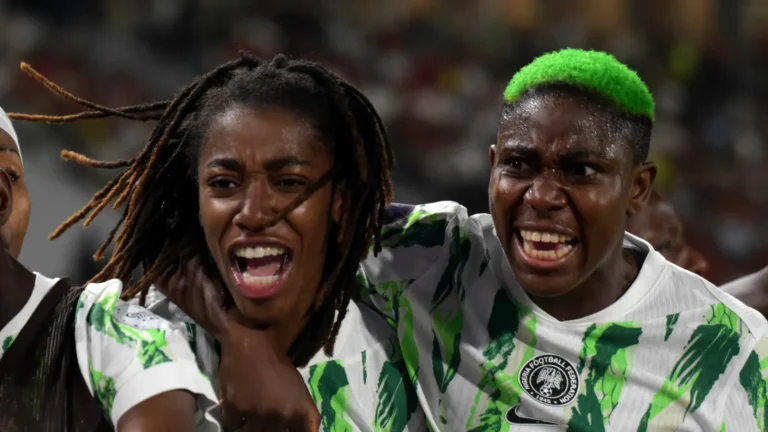
The Nigerian government has officially fulfilled its financial commitment to the Super Falcons, the senior women’s national football team, by disbursing the naira equivalent of $100,000 to each player. This payout marks the conclusion of a 15-month period of anticipation following the team’s historic 10th Women’s Africa Cup of Nations (WAFCON) triumph. The National Sports Commission (NSC) confirmed the development in a formal statement released on Monday, November 2, 2026, noting that the coaching staff and associated officials were also compensated with the naira equivalent of $50,000 per person.
This final settlement addresses a pledge originally made by President Bola Tinubu on July 28, 2025, during a high-profile reception at the Presidential Villa in Abuja. The event was held to celebrate the team’s remarkable comeback victory against Morocco in the WAFCON final in Rabat, where the Super Falcons overcame a two-goal deficit to secure a thrilling 3-2 win.
A Chronology of the 15-Month Wait
The journey from the stadium in Rabat to the bank accounts of the players has been marked by both sporting highs and administrative delays. The timeline of the reward process provides insight into the complexities of government-backed sporting incentives:
- July 2025: The Super Falcons defeat Morocco 3-2 to lift their 10th WAFCON title. President Tinubu hosts the team at the Presidential Villa, where he publicly pledges $100,000 to each player and $50,000 to members of the technical crew.
- August–September 2025: The immediate post-victory phase sees the team receive official state honors, including the Officer of the Order of the Niger (OON) awards and title documents for three-bedroom apartments in Abuja.
- Late 2025 – Mid 2026: As months passed without the disbursement of the cash rewards, concerns were raised by fans, stakeholders, and sports commentators regarding the timeline of the government’s commitment.
- September 2026: D’Tigress, the national women’s basketball team, receives their own government-sanctioned cash rewards following their 2025 AfroBasket victory, setting a precedent that drew renewed attention to the outstanding payments owed to the Super Falcons.
- November 2026: The National Sports Commission announces that the financial obligations have been met in full, involving a cross-ministerial effort from the ministries of Finance, Special Duties and Inter-Governmental Affairs, and Housing and Urban Development.
The Role of the National Sports Commission
Shehu Dikko, the chairman of the National Sports Commission, emphasized that the payment was a priority for the current administration. In the official statement, Dikko remarked, "The Super Falcons made Nigeria proud, and Mr. President has honored his commitment to them in full."
Dikko further acknowledged the historical context of such rewards, noting that in previous eras, athletes often waited years for promised bonuses. By coordinating with the Ministry of Finance to ensure the conversion of the dollar-denominated pledge into the local currency, the NSC aimed to eliminate the uncertainty that had shadowed the team’s recent months. The inter-agency collaboration was framed as a structural improvement in how the state handles athlete welfare, ensuring that departmental bureaucracy does not indefinitely stall the distribution of rewards.
Comparative Analysis: A New Standard for Women’s Sports
The decision to pay $100,000 per player is significant within the landscape of Nigerian sports funding. By applying the same reward structure to the Super Falcons as was applied to the D’Tigress basketball team in September 2026, the government appears to be establishing a standardized incentive framework for female athletes who achieve continental success.
Analysts suggest that this move is intended to foster parity in how national teams are treated, regardless of the sport. However, the 15-month delay highlights an ongoing challenge: the gap between public policy announcements and the actual liquidity of funds. While the headline figures represent a generous investment, the timing of such payments often dictates the morale of the squad, especially as they navigate the volatile cycles of international qualification.
Broader Implications and Sporting Challenges
The arrival of these funds comes at a pivotal, yet difficult, juncture for the Super Falcons. The team has recently faced significant setbacks, most notably the failure to qualify for the 2027 FIFA Women’s World Cup. Missing the global showpiece represents a substantial loss in potential FIFA funding, estimated at $2.5 million, which would have been critical for the development of the team’s infrastructure and grassroots programs.
Furthermore, the team is currently navigating the qualification stages for the 2028 Olympic Games. The pressure to regain their status as the dominant force in African football is immense. With the financial rewards now settled, the focus of the Nigeria Football Federation (NFF) and the technical staff can shift entirely toward rebuilding the squad’s tactical identity.
The payment serves as a form of closure for the 2025 season, allowing the players to move past the distraction of the outstanding debt. For the governing bodies, however, the challenge remains to ensure that future rewards are processed with greater speed. The "15-month wait" has become a case study for sports administrators on the importance of timely execution, as public sentiment is often tied to the efficiency of these financial fulfillments.
Economic and Administrative Context
The disbursement involved the complex reconciliation of foreign currency pledges with domestic budget regulations. By utilizing the naira equivalent, the government avoided the complexities of direct foreign currency transfers, a move that suggests a strategic approach to managing Nigeria’s current fiscal environment.
Experts in sports economics note that while these lump-sum payments provide immediate relief and recognition for the players, they do not replace the need for sustainable funding models. Reliance on presidential "gifts" or special interventions can create instability in team planning. The move by the NSC to centralize the delivery of these funds suggests a transition toward more institutionalized management of sporting rewards, though the reliance on ad-hoc presidential pledges remains a characteristic feature of the Nigerian sports ecosystem.
Future Outlook for the Super Falcons
As the Super Falcons turn their attention to the upcoming international calendar, the financial security provided by this payment may offer a psychological boost to the veteran players, many of whom have been the backbone of the team for over a decade. The acknowledgment of their efforts—not just through titles, but through tangible capital—is viewed by many as a necessary step in professionalizing the women’s game in Nigeria.
The team, which has historically struggled with issues surrounding match bonuses and travel logistics, is now operating in an environment where expectations from both the public and the government are at an all-time high. The success of the 2025 WAFCON campaign set a high bar, and the government’s full payment is a tacit recognition that the Super Falcons remain one of the nation’s most valuable sporting assets.
With the financial matter now firmly in the past, the NFF and the coaching staff are expected to release a roadmap for the next two years. This plan will likely focus on squad rejuvenation, scouting new talent, and ensuring that the team remains competitive in regional and continental tournaments. Whether this influx of capital will translate into improved performances on the pitch remains the primary question for the remainder of the 2026 season and beyond.
Conclusion: Closing the Chapter
The resolution of the $100,000 reward saga serves as a definitive end to one of the most discussed administrative issues in Nigerian sports this year. It concludes the state’s obligation to the 2025 title-winning squad and sets a clear precedent for future national team achievements. While the 15-month timeline was criticized by some as an indicator of bureaucratic inefficiency, the successful delivery of the funds is being celebrated by the players and their representatives as a win for transparency and institutional accountability.
As the Super Falcons move forward, the focus will undoubtedly shift from the bank statements of the past to the scoreboards of the future. The team, now fully compensated, must navigate a new era of African women’s football—one that is increasingly competitive and requires consistent, rather than sporadic, investment. The government, by fulfilling its promise, has cleared the way for a fresh start, ensuring that the legacy of the 10th WAFCON title is defined by the team’s historic victory rather than the administrative delay that followed it.
The legacy of the 2025 team is secure; it is now up to the next generation of Super Falcons to leverage the momentum—and the professional standards established by their predecessors—to reclaim their place at the pinnacle of global women’s football. Through the lens of this final payment, one sees a clear, if sometimes sluggish, trajectory toward a more formal and respectful treatment of national athletes, a goal that continues to be at the heart of Nigerian sports development discussions.