The simmering political tensions within Nigeria’s governing party, the All Progressives Congress (APC), reached a boiling point this week following a scathing public rebuttal from the Minister of the Federal Capital Territory (FCT), Nyesom Wike. The FCT Minister, a high-ranking member of the opposition Peoples Democratic Party (PDP) who has maintained a contentious but strategically significant alignment with the APC-led administration, launched a blistering attack against the Progressive Governors Forum (PGF) following their collective rejection of his proposed political framework in Rivers State.
The controversy centers on what Wike has termed a "Rainbow Coalition," an ambitious political architecture designed to bridge the gap between PDP and APC interests in Rivers State ahead of the 2027 general election. The initiative, intended to foster a power-sharing arrangement or a unified political front in the state, has been met with stiff resistance from APC governors who perceive the move as a threat to party purity and electoral dominance.
The Genesis of the Conflict
The friction surfaced on Monday, September 14, following a high-level, closed-door meeting held by the APC governors in Abuja. The meeting, which was convened to address regional security, economic policies, and internal party cohesion, concluded with a decisive rejection of Wike’s political engineering.
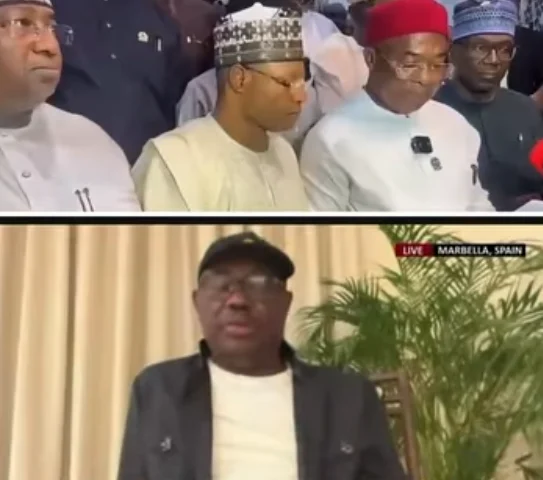
Imo State Governor Hope Uzodinma, acting in his capacity as the Chairman of the Progressive Governors Forum, addressed the media following the session. He explicitly stated that the APC leadership would not entertain, support, or participate in any political arrangement that risks weakening the party’s electoral prospects. For the APC governors, Wike’s "Rainbow Coalition" represents an existential threat to the party’s grassroots structure, as it essentially invites opposition elements to share in the political capital currently reserved for APC loyalists.
Wike’s Counter-Offensive: "Politically Lazy"
In a direct response delivered during an interview with Arise TV, Minister Nyesom Wike dismissed the governors’ concerns with sharp rhetoric, labeling them "smart but politically lazy." Wike’s critique was not merely a defense of his coalition; it was an interrogation of the electoral competence of the governors themselves.
Wike specifically targeted Governor Uzodinma, pointing to the 2023 general election statistics as evidence of the Imo governor’s alleged political underperformance. By referencing the APC’s inability to secure certain margins in Imo State during the presidential polls, Wike sought to undermine the authority of the PGF leadership, suggesting that those who criticize his political strategy are themselves struggling to maintain their own states’ electoral viability for the party.
The FCT Minister further alleged that the animosity toward his political activities intensified only after President Bola Ahmed Tinubu appointed him to the federal cabinet. This, Wike suggested, indicates that the governors’ opposition is rooted in petty grievances and a misunderstanding of the political realities required to navigate a complex state like Rivers, rather than genuine ideological concerns.
Contextualizing the Rivers State Political Landscape
To understand the intensity of this fallout, one must look at the unique political geography of Rivers State. Historically, Rivers has been a volatile battleground for Nigerian politics, characterized by deep-seated rivalries between the PDP and the APC. Nyesom Wike, the former two-term governor of the state, remains the dominant political force in the region.
Since the 2023 elections, Wike has navigated an unconventional path. While he remains a card-carrying member of the PDP, his public support for President Tinubu and his integration into the federal government have created a "split-loyalty" dynamic. His proposal for a "Rainbow Coalition" is an attempt to formalize this dynamic—creating a structure where PDP and APC members in Rivers State operate under a unified, mutually beneficial agenda.

For the APC, however, this is a bitter pill to swallow. After years of fighting for political relevance in the state, the party is wary of a structure that might see them playing second fiddle to a coalition controlled by a PDP heavyweight.
Data and Electoral Implications
An analysis of the 2023 presidential election results provides the backdrop for the current tension. In Rivers State, the electoral outcome was highly fractured, with various parties claiming significant legislative seats. The APC, while successful at the national level, faced significant hurdles in maintaining a cohesive state-level structure.
The APC governors’ fear is rooted in the "weakening of electoral candidates." If a formal coalition is established, it could potentially dilute the APC’s identity in the 2027 polls. If the party cedes legislative seats or local government control to a "Rainbow" bloc, they risk losing the ability to project power in the Niger Delta, a region crucial for both oil revenue and electoral votes.
From a strategic perspective, Wike’s argument rests on the necessity of "big tent" politics. He posits that in a state as politically polarized as Rivers, traditional partisan politics often leads to violence and gridlock. By fostering a coalition, he aims to create a stable environment that can guarantee outcomes for the federal administration. However, the APC governors interpret this as an attempt to erode the party’s foundation for his own long-term survival.
Reactions and Official Stances
While the PGF has maintained its stance through Governor Uzodinma, other stakeholders have remained largely silent, observing the standoff with caution. Political analysts note that this conflict places President Tinubu in a difficult position. As the leader of the APC, the President values the support of his governors; however, as the head of the federal government, he has relied heavily on Wike’s administrative expertise and political networking in the South-South region.
Some observers suggest that the governors’ public outburst is a warning shot to the President to clarify the extent of Wike’s influence within the APC’s internal affairs. Others view it as a necessary pushback against an outsider attempting to dictate the party’s strategy from within.
Broader Impact: 2027 and Beyond
The rift between Wike and the APC governors is a microcosm of the broader challenges facing Nigerian political parties ahead of the 2027 general election cycle. As the electoral map becomes increasingly fragmented, the traditional dichotomy between the APC and PDP is blurring.
The implications of this standoff are significant:
- Party Discipline: The APC must determine whether it will allow "Rainbow" coalitions to persist, effectively legitimizing a non-party-centric approach to local governance.
- Federal-State Relations: The tension suggests a growing divide between the federal cabinet—often focused on national-level alliances—and state governors, who are primarily focused on maintaining local party dominance.
- The Wike Factor: Regardless of the governors’ resistance, Wike remains an influential figure with significant sway over Rivers State politics. His ability to mobilize support—independent of formal party structures—makes him a political asset that the APC cannot easily discard, despite the current friction.
A Path Toward Resolution or Further Fracturing?
As of mid-September, there has been no indication of a de-escalation. Wike’s defiant stance, coupled with the PGF’s insistence on protecting party integrity, suggests that the conflict may escalate further. Observers are now looking toward the upcoming party executive meetings to see if the APC national leadership will issue a formal statement or if they will allow the governors to continue their vocal opposition.
Ultimately, the dispute highlights the evolving nature of Nigerian democracy, where personality-driven politics frequently clash with institutional party structures. Whether Wike’s "Rainbow Coalition" succeeds will depend on his ability to convince the local political class that their interests are better served by his unified model than by the traditional, often exclusionary, partisan approach favored by the governors. For now, the political theater in Abuja and Rivers State remains highly charged, with the 2027 election serving as the ultimate arbiter of these competing visions.