The 18th BRICS Summit commenced at the Bharat Mandapam convention center in New Delhi, India, bringing together global leaders from major emerging economies against a backdrop of escalating geopolitical tensions and transformative economic shifts. India assumes the presidency of the bloc for the fourth time, hosting an expanded coalition that now officially includes eleven full member nations. The two-day diplomatic gathering, running on September 12 and 13, 2026, serves as a critical platform for developing economies seeking to reshape international trade mechanics, bolster supply chain resilience, and mitigate the impact of Western-led economic sanctions.
As high-ranking delegations converge in the Indian capital, international observers are closely monitoring the proceedings. The agenda is heavily shadowed by ongoing conflicts in Eastern Europe and the Middle East, alongside strategic initiatives aimed at reducing global reliance on the U.S. dollar through the promotion of cross-border payment platforms utilizing national currencies.
High-Level Diplomacy and Bilateral Engagements in New Delhi
The summit opened with intensive bilateral diplomacy. Prime Minister Narendra Modi held high-level closed-door discussions with Russian President Vladimir Putin and Iranian President Masoud Pezeshkian ahead of the official plenary sessions. These early meetings underscored the complex diplomatic balancing act required of New Delhi as it navigates traditional partnerships with Western nations alongside deep-seated strategic and energy ties with countries under heavy international sanctions.
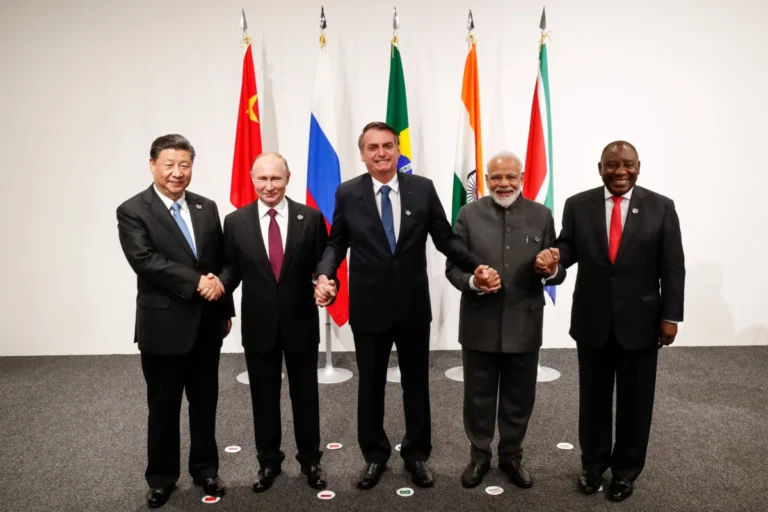
Adding significant diplomatic weight to the summit, Chinese President Xi Jinping arrived in New Delhi for his first official visit to India in nearly seven years. This high-profile arrival signals a potential thaw—or at least a pragmatic willingness to engage on multilateral economic goals—following years of strained bilateral relations along the disputed Himalayan border. Other prominent leaders in attendance include South African President Cyril Ramaphosa, Egyptian President Abdel Fattah El-Sisi, and representatives from the United Arab Emirates, Saudi Arabia, Indonesia, and Ethiopia.
During their bilateral meeting, Prime Minister Modi and President Putin reviewed pressing security concerns affecting international maritime trade and regional stability. According to an official statement released by India’s Ministry of External Affairs, both leaders agreed to remain actively engaged in strengthening the special and privileged strategic partnership between New Delhi and Moscow. However, analysts note that these displays of close cooperation complicate India’s diplomatic standing as Washington and its European allies monitor the bloc’s institutional evolution.
Geopolitical Friction Points: The Shadow of Global Conflicts
Geopolitical flashpoints dominate the background of the New Delhi summit, casting a long shadow over economic discussions. Regional analysts point out that ongoing military conflicts in the Middle East and Eastern Europe present formidable friction points for an increasingly diverse coalition.
Harsh V. Pant, a leading international relations expert at India’s Observer Research Foundation, noted in statements to the AFP news agency that the escalating conflict in the Gulf is poised to become a central fault line during the proceedings. With Iran participating as a full member alongside major Gulf energy exporters like Saudi Arabia and the United Arab Emirates, the summit provides a unique forum where traditional adversaries and non-aligned powers must negotiate shared economic interests despite regional hostilities.
Furthermore, the participation of Russian leadership under the weight of extensive Western sanctions tied to the war in Ukraine brings questions of compliance, secondary sanctions, and alternative financial infrastructure to the forefront of closed-door negotiations.
De-Dollarization and the Push for Local Currency Settlements
Beyond traditional security concerns, the core economic driver of the 18th BRICS Summit revolves around monetary sovereignty and financial independence. Member states are actively reviewing proposals to expand cross-border payment architectures and accelerate the deployment of national currencies for bilateral and multilateral trade settlements.
Originally founded in 2009 by Brazil, Russia, India, China, and South Africa—then known as the BRIC grouping before South Africa joined in 2010—the coalition was established to amplify the voice of major developing economies in international financial governance structures historically dominated by Western institutions such as the International Monetary Fund (IMF) and the World Bank. Over the intervening decade and a half, the bloc has evolved from a conceptual economic acronym into a structured geopolitical force.
The recent expansion phase, which integrated Iran, the UAE, Saudi Arabia, Egypt, Ethiopia, and Indonesia, significantly shifted the economic gravity of the group, particularly regarding global energy supplies. With major oil and gas exporters now sitting at the table alongside industrial manufacturing giants like China and India, the incentive to trade outside the traditional U.S. dollar ecosystem has grown exponentially.
As highlighted in regional financial reporting by outlets like The Hindu, discussions regarding the increased utilization of national currencies are expected to receive broad internal support within the BRICS framework. Nations heavily targeted by Western economic coercion view local currency settlements as an essential shield against extraterritorial financial sanctions.
International Implications and Washington’s Watchful Eye
The institutional momentum toward financial de-integration from Western-dominated systems has not gone unnoticed in Washington and other Western capitals. U.S. policymakers and financial regulators are maintaining a watchful eye on the New Delhi summit, wary of any concrete developments that could erode the long-term dominance of the U.S. dollar as the world’s primary reserve and invoicing currency.
While proponents of the BRICS financial initiatives argue that alternative payment systems are designed simply to foster trade resilience and protect developing nations from external currency volatility, Western analysts view these developments through a more critical lens. Financial economists suggest that while a sudden collapse of the U.S. dollar remains unlikely due to its deep liquidity and institutional depth, a gradual erosion of dollar dominance in regional trade blocs—particularly within the energy sector—could diminish the efficacy of unilateral U.S. sanctions over time.
Moreover, the tension between integrating economies that rely on dollar-denominated global markets and those actively seeking to bypass them creates a delicate balancing act for pivotal swing states within the coalition. India, which maintains robust strategic and economic partnerships with both the United States and sanctioned nations like Russia and Iran, must carefully navigate these competing pressures to ensure the summit yields practical economic cooperation without triggering acute diplomatic blowback from Western capitals.
Chronology and Evolution of the BRICS Bloc
To understand the current scale of the New Delhi summit, it is essential to trace the institutional trajectory of the organization:
- June 2009: The leaders of Brazil, Russia, India, and China hold their first official summit in Yekaterinburg, Russia, officially forming the BRIC economic bloc.
- December 2010: South Africa is formally invited to join the group, expanding the acronym to BRICS and ensuring representation from the African continent.
- July 2014: During the 6th BRICS Summit in Fortaleza, Brazil, member nations sign an agreement creating the New Development Bank (NDB) and a Contingent Reserve Arrangement (CRA), establishing alternative financial institutions to the World Bank and IMF.
- August 2023: At the 15th Summit in Johannesburg, South Africa, leaders announce a major expansion initiative, inviting several nations to join the bloc.
- January 2024: Iran, the United Arab Emirates, Saudi Arabia, Egypt, and Ethiopia officially become full members, doubling the size and significantly expanding the economic and geopolitical footprint of the coalition.
- September 2026: India assumes the rotating presidency for the fourth time, hosting the 18th BRICS Summit at Bharat Mandapam in New Delhi, focusing on supply chain resilience, alternative payment systems, and navigating regional conflicts.
Fact-Based Analysis of Future Implications
As the 18th BRICS Summit draws toward its conclusion, the long-term implications of the New Delhi declarations will depend heavily on the operationalization of its proposed mechanisms.
- Financial Infrastructure: Real progress on alternative messaging systems or clearing platforms outside the SWIFT network will serve as a litmus test for the bloc’s technical cohesion. While political will is high among sanctioned states, non-sanctioned members like India and Brazil remain cautious about creating friction with Western financial systems.
- Energy Trade Dynamics: The inclusion of key Middle Eastern energy exporters fundamentally alters global commodity pricing discussions. Future bilateral contracts denominated in local currencies between suppliers like Saudi Arabia, the UAE, Iran, and consumers like China and India will provide empirical data on the practical limits of de-dollarization.
- Diplomatic Autonomy: India’s successful execution of the 2026 summit demonstrates the growing efficacy of "multi-alignment" foreign policy. By managing to host leaders with deeply divergent interests—ranging from Western adversaries to regional rivals—New Delhi has reinforced its status as an indispensable bridge between the Global South and traditional global powers.
The outcomes of the discussions at Bharat Mandapam will undoubtedly reverberate through international financial markets and diplomatic corridors for years to come, marking a pivotal chapter in the ongoing evolution of the global economic order.