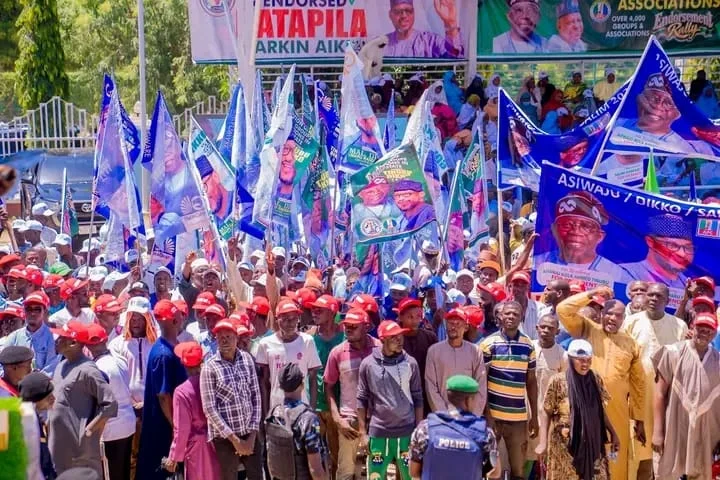
The political landscape in Katsina State witnessed a significant realignment ahead of the 2027 general elections as a massive coalition comprising more than 4,000 political groups and grassroots associations formally pledged their unwavering support for the re-election of President Bola Ahmed Tinubu and Katsina State Governor, Dikko Umar Radda. The formal endorsement, which drew a mammoth crowd to the historic People’s Square in Katsina metropolis, serves as an early bellwether for the ruling All Progressives Congress (APC) in the North-West geopolitical zone.
Leaders of the coalition, spanning all 34 local government areas of the state, predicated their endorsement on the verifiable development footprints and administrative strides recorded by the APC-led governments at both the federal and state levels. The event not only showcased the formidable grassroots machinery of the ruling party in the region but also underscored a strategic consolidation of political alliances ahead of the next electoral cycle.
Chronology and Background of the Coalition’s Mobilization
The road to the historic endorsement at People’s Square was paved by a meticulous, months-long administrative and grassroots mobilization process spearheaded by key political figures within the state. According to the Chairman of the Coalition of Political Groups and Associations, who also serves as the Special Adviser to the Governor on Political Matters, Hon. Yau Umar Gwajogwajo, the formation of the coalition was conceived to streamline political synergy, foster effective coordination, and eliminate redundancy among pro-APC volunteer groups that had previously operated in silos.
The mobilization timeline gained critical momentum following the conclusion of the 2023 general elections. Recognizing the pivotal role that independent political associations played in propelling the APC to victory in Katsina, the state leadership encouraged a formal structuring of these volunteer bodies. Consequently, a comprehensive registration and verification exercise was rolled out across all 34 local government areas.
To date, the coalition has successfully verified and integrated 2,858 distinct political formations into its central database, with the wider network swelling to surpass 4,000 localized groups, youth associations, women’s leagues, and professional bodies. Significantly, organizers emphasized that the entire structural mapping and the subsequent endorsement were executed on a purely voluntary basis, devoid of any financial inducement from the state government. This distinction was underscored to project the endorsement as an authentic referendum on the performance of the incumbent administration rather than a product of transactional politics.
Governor Radda’s Address: Performance as the Ultimate Campaign Strategy
Addressing the tumultuous crowd of supporters, Governor Dikko Umar Radda expressed profound gratitude to the coalition, acknowledging their immense contributions during the hard-fought 2023 electoral campaigns. He noted that the legitimacy of his administration is inextricably linked to the tireless door-to-door mobilization executed by these grassroots bodies.
Moving beyond historical gratitude, Governor Radda pivoted firmly toward the future, anchoring his re-election bid squarely on governance deliverables and tangible infrastructural milestones. In a confident assertion, the governor declared that his administration is fully prepared to run an issues-based campaign driven by measurable achievements across the state’s 361 electoral wards.
"We have projects across Katsina State that we can go out and campaign with. We are not shy to tell the people what we have done because our achievements are there for everyone to see," Governor Radda stated emphatically.
The governor detailed how his administration has systematically addressed critical sectors, including security, education, agriculture, and healthcare, ensuring that dividends of democracy trickle down to the most remote rural communities. He urged party leaders, stalwarts, and coalition members to transition from passive supporters to active ambassadors of the APC’s development agenda. Furthermore, he charged them to aggressively project the accomplishments of the Tinubu/Shettima federal administration alongside state-level achievements, spanning the legislature and the executive arms of government.
Bipartisan and Stakeholder Reactions: Unflinching Unity within the APC
The mega-endorsement event was heavily attended by political heavyweights, serving and former elected officials, party executives, and elder statesmen, all of whom used the platform to project a unified front. The overwhelming consensus among the leadership was that internal cohesion remains the ultimate catalyst for electoral triumph in 2027.
Representing former Katsina State Governor Aminu Bello Masari, the former Deputy Governor, Hon. Tukur Ahmed Jikamshi, commended Governor Radda for surpassing expectations and faithfully executing the promises enshrined in his campaign manifesto. Jikamshi called for absolute loyalty to the established party hierarchy, identifying President Bola Ahmed Tinubu as the undisputed national leader of the APC and Governor Radda as the leader of the party within Katsina State.
The Speaker of the Katsina State House of Assembly, Rt. Hon. Nasir Yahaya Daura, reinforced this sentiment, asserting that the legislative arm remains in robust synergy with the executive branch. He assured the electorate that the state legislature would continue to enact progressive laws and appropriate funds to support developmental projects initiated by Governor Radda.
Similarly, the Katsina State APC Chairman, Hon. Dr. Bishir Gambo Saulawa, expressed absolute confidence in the party’s structural integrity, noting that the ongoing reconciliation and integration efforts have positioned the APC as an unassailable political machine in the state.
Adding a significant voice to the chorus of endorsements, Hon. Yusuf Salisu Majigiri, who delivered a goodwill message on behalf of former Governor Ibrahim Shehu Shema, attested to the widespread impact of the Radda administration. Majigiri, who represents Mashi/Dutsi Constituency in the State House of Assembly, observed that infrastructural and human capital development projects have been equitably distributed across all three senatorial districts and 34 local government areas of the state, effectively neutralizing opposition narratives.
Data-Driven Analysis: Implications of the Katsina Coalition for the 2027 Landscape
The consolidation of over 4,000 political groups in Katsina State carries profound strategic implications for the political calculus of Nigeria’s North-West region ahead of 2027. Katsina, historically considered a major swing-and-bloc-vote state, holds immense demographic and electoral weight in national politics.
-
Grassroots Institutionalization: By moving away from loose, ad-hoc campaign structures to a verified database of 4,000+ groups, the Katsina APC is institutionalizing grassroots mobilization. This data-driven approach minimizes voter apathy and ensures that political messaging penetrates deep into rural settlements where the bulk of the electorate resides.
-
Mitigation of Internal Friction: The public alignment of political actors from diverse factions—including loyalists of past and present administrations—signals a rare degree of intra-party harmony. In past political cycles, factional infighting often weakened ruling parties during primaries and general elections. The unified posture presented by figures like former Governor Masari, former Governor Shema’s representatives, and the current party leadership suggests a calculated effort to present a monolithic front against potential opposition challenges.
-
Federal-State Synergy and Narrative Control: By anchoring their campaign on the combined achievements of the Tinubu federal administration and the Radda state government, the coalition is attempting to localize federal policies. In a region where federal economic reforms have occasionally faced public scrutiny, tying the president’s name directly to tangible state-level infrastructural delivery is a deliberate strategy to bolster federal approval ratings at the grassroots.
Broader Political Outlook
As the political thermometer begins to rise well ahead of the 2027 general elections, the Katsina mega-coalition has effectively set the pace for political alignments in Northern Nigeria. While the opposition parties continue to recalibrate their strategies in the face of economic reforms and shifting voter dynamics, the proactive mobilization demonstrated by the Radda administration highlights the primacy of early organization and visible governance output in modern Nigerian electoral politics.
Ultimately, whether this formidable coalition translates into a seamless electoral victory will depend on sustained economic relief at the national level and the continued execution of people-oriented policies at the sub-national tier. For now, however, the political establishment in Katsina State has drawn its battle lines, anchored firmly on a platform of continuity, consolidation, and grassroots-driven accountability.