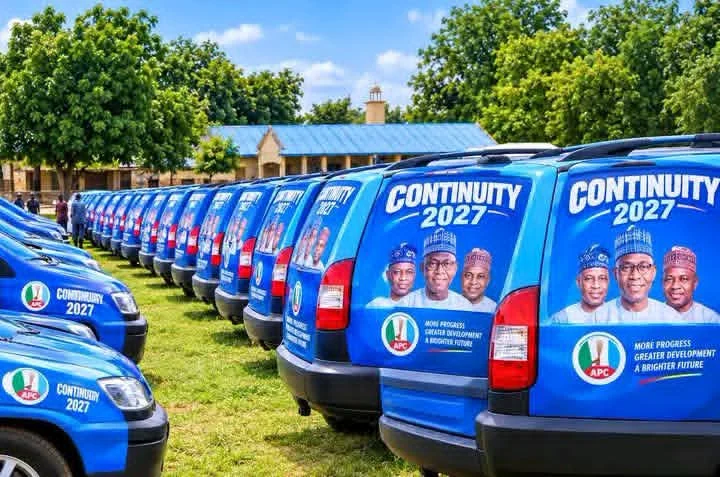
In a sweeping legislative constituency intervention aimed at grassroots economic empowerment and political consolidation, Honorable Abdulmalik Zubairu Zanna Bungudu, the representative for Bungudu/Maru Federal Constituency in the House of Representatives, has distributed 100 vehicles to his constituents in Zamfara State. The high-profile event, held on Thursday in the ancient town of Bungudu, also witnessed the distribution of a wide array of trade and industrial tools, including sewing machines, computers, motorcycles, electricity generators, and community electricity transformers.
The grand empowerment ceremony drew a rare convergence of political heavyweights from across partisan lines in the state. Notably present at the venue were Zamfara State Governor Dauda Lawal and former State Governor and incumbent Senator representing Zamfara West, Abdulaziz Yari. The presence of these prominent figures underscored the significance of the event, transforming what could have been a routine constituency briefing into a major political and socio-economic milestone for the region.
The initiative, according to Hon. Bungudu, serves a dual purpose: providing tangible, income-generating assets to lift vulnerable households out of poverty, and strengthening the operational grassroots capacity of the All Progressives Congress (APC) ahead of the fiercely contested 2027 general elections.
Main Facts of the Constituency Intervention
The empowerment package rolled out by Hon. Bungudu ranks among the largest single-member constituency interventions recorded in Zamfara State in recent years. The central component of the distribution comprised 100 motor vehicles, ranging from commercial transport cars to utility pickup vans designed to enhance mobility, facilitate agricultural produce evacuation, and create employment opportunities within the transport sector.
In addition to the vehicular assets, the empowerment inventory included hundreds of specialized vocational and economic tools. These featured industrial and domestic sewing machines tailored for women and youth cooperative groups, desktop computers and laptops aimed at boosting digital literacy among students and young professionals, and motorcycles intended to ease transportation bottlenecks in rural agrarian communities where road networks remain challenging.
Furthermore, to address critical infrastructure deficits at the community level, the lawmaker distributed heavy-duty electricity generators and community transformers. These power assets are designed to revitalize small-scale businesses—such as welding outfits, tailoring shops, and cold-room storage facilities—that suffer from erratic power supply or complete disconnection from the national grid.
Chronology and Setting of the Bungudu Event
Preparations for the Thursday ceremony began months prior, following extensive needs assessments conducted across the various wards and districts making up the Bungudu/Maru Federal Constituency. Constituency office coordinators compiled data on the socio-economic vulnerabilities of women, unemployed youth, and local artisans, ensuring that the distribution criteria targeted genuine grassroots beneficiaries rather than political cronies alone.
On the morning of the event, thousands of constituents, party stalwarts, traditional titleholders, and youth groups converged on the main arena in Bungudu town. The arrival of Governor Dauda Lawal, Senator Abdulaziz Yari, and Hon. Bungudu electrified the crowd, setting off rounds of cultural displays and speeches.
The program commenced with the recitation of national and religious prayers, followed by an inventory presentation detailing the items to be distributed. Dignitaries were invited to inspect samples of the vehicles and empowerment tools lined up across the venue. Representatives of various beneficiary groups were subsequently called forward to receive the keys to their vehicles and documentation for the industrial tools. The ceremony concluded with goodwill messages from state leaders and a closing charge by the host lawmaker urging peace, unity, and continued loyalty to democratic institutions.
Supporting Data and Socio-Economic Context in Zamfara State
To fully understand the gravity of Hon. Bungudu’s intervention, one must examine the broader socio-economic landscape of Zamfara State. Located in Nigeria’s Northwest geopolitical zone, Zamfara has faced acute developmental challenges in recent years, heavily exacerbated by protracted security crises, banditry, and rural displacement. These security dynamics have severely disrupted farming, commerce, and traditional livelihoods, driving up poverty rates and youth unemployment.
According to data from the National Bureau of Statistics (NBS) and multi-dimensional poverty indices, the Northwest region bears a significant burden of economic vulnerability. In a state where subsistence agriculture and informal micro-enterprises form the backbone of the local economy, the loss of mobility and productive assets due to insecurity has left countless households economically stranded.
Legislative empowerment programs of this scale directly address these gaps. By injecting 100 vehicles into the local transport economy, the intervention creates immediate ripple effects: transport operators can resume inter-city and rural-urban trade, farmers can transport harvested grains to regional markets before spoilage, and youth operators earn daily sustenance. Similarly, the provision of sewing machines and computers addresses the skills-to-market gap, allowing trained youths to establish cottage industries rather than remaining dependent on scarce white-collar employment.
Official Responses and Bipartisan Commendations
A notable feature of the Bungudu empowerment ceremony was the rare display of political synergy between leaders of differing political affiliations. Zamfara State Governor Dauda Lawal, a prominent figure on the platform of the Peoples Democratic Party (PDP), alongside Senator Abdulaziz Yari, a pillar of the All Progressives Congress (APC), both heaped praises on Hon. Bungudu for rising above narrow political divisions to deliver dividends of democracy to the citizenry.
Governor Lawal, speaking through state government representatives at the event, commended the federal lawmaker for complementing the state government’s ongoing efforts to rebuild the economy and alleviate poverty. The governor emphasized that sustainable development requires collaborative synergy between federal lawmakers, state actors, and local stakeholders, noting that initiatives targeting the grassroots go a long way in healing communities affected by security challenges.
On his part, Senator Abdulaziz Yari lauded Hon. Bungudu’s consistency, grassroots loyalty, and commitment to the welfare of the people of Zamfara West and the wider state. Senator Yari noted that effective representation is measured by the tangible impact a leader makes in the daily lives of constituents, urging other elected and appointed officials to emulate the Bungudu/Maru representative’s people-centric approach.
In his address to the mammoth crowd, Hon. Bungudu articulated his vision for his constituents, framing the distribution not merely as an act of philanthropy, but as a fulfillment of his legislative contract.
“The items distributed today are carefully chosen to touch every critical segment of our society,” Hon. Bungudu stated. “The vehicles are provided to boost the economic activities and mobility of our people, while ensuring robust support for our great party, the APC, as we look forward to the 2027 general elections. Furthermore, the other items—ranging from sewing machines and computers to motorcycles, generators, and transformers—are targeted empowerment tools designed to assist women, youths, and vulnerable households to become self-reliant and significantly improve their livelihoods.”
Broader Political Implications and Strategic Impact Ahead of 2027
While framed primarily around poverty alleviation and economic self-reliance, political analysts note that events of this magnitude carry profound electoral implications, especially in northern Nigeria where constituency mobilization is deeply tied to visible patronage and direct community support.
As political parties begin positioning themselves for the 2027 electoral cycle, incumbent officeholders are under intense pressure to justify their mandates through concrete achievements. By distributing 100 vehicles and hundreds of industrial empowerment tools, Hon. Bungudu has strategically reinforced his political capital within the Bungudu/Maru Federal Constituency.
The inclusion of party loyalists and grassroots structures as direct beneficiaries of the vehicular fleet ensures that the APC retains an active, mobile mobilization network across remote settlements. In rural constituencies where logistics pose a major challenge to political campaigns, having supporters equipped with motorcycles and utility vehicles provides a distinct operational advantage.
However, political analysts also point out the challenges inherent in such interventions. Ensuring transparency, equity, and merit in the distribution process is vital to maintaining community trust. While thousands benefit directly, the sheer scale of need in regions affected by economic restructuring means that demand will always outstrip supply. Consequently, lawmakers face the ongoing task of pairing material distributions with sustainable legislative reforms, institutional capacity building, and long-term security stabilization policies.
Conclusion
The distribution ceremony in Bungudu stands out as a watershed moment for legislative constituency outreach in Zamfara State. By bridging the gap between immediate economic survival and long-term political mobilization, Hon. Abdulmalik Zubairu Zanna Bungudu has set a high benchmark for representative governance.
As beneficiaries drive away in their new vehicles and unpack their vocational tools across Bungudu and Maru, the true test of the initiative will lie in its multiplier effect on local commerce, household income generation, and community resilience. With key political leaders from across the aisle uniting in praise of the initiative, the event underscores a shared recognition that grassroots empowerment remains the bedrock of democratic stability and societal progress in Nigeria.