The Nigerian business landscape has demonstrated remarkable resilience over the past year, as evidenced by a 14% increase in the collective brand value of the country’s top 25 brands, reaching a total of NGN 5.01 trillion. This growth, detailed in the Nigeria 25 2026 report by Brand Finance, the world’s leading brand valuation consultancy, reflects a period of significant strategic adaptation and economic maneuvering within West Africa’s largest economy. Despite broader macroeconomic challenges, including currency fluctuations and inflationary pressures, Nigeria’s corporate titans have managed to enhance their market positioning through digital innovation, geographical expansion, and a renewed focus on consumer engagement.
The banking sector continues to serve as the bedrock of the Nigerian corporate identity, accounting for a staggering 61% of the total brand value among the top 25 entities. This sector’s collective valuation stands at NGN 3.05 trillion, underscoring the critical role financial institutions play in the national economy and their success in navigating a complex regulatory and competitive environment. As the Central Bank of Nigeria continues to implement policies aimed at stabilizing the financial system and encouraging recapitalization, these leading banks have leveraged their brand equity to maintain depositor trust and attract investment.
Access Bank Maintains Top Spot Despite Strategic Transition
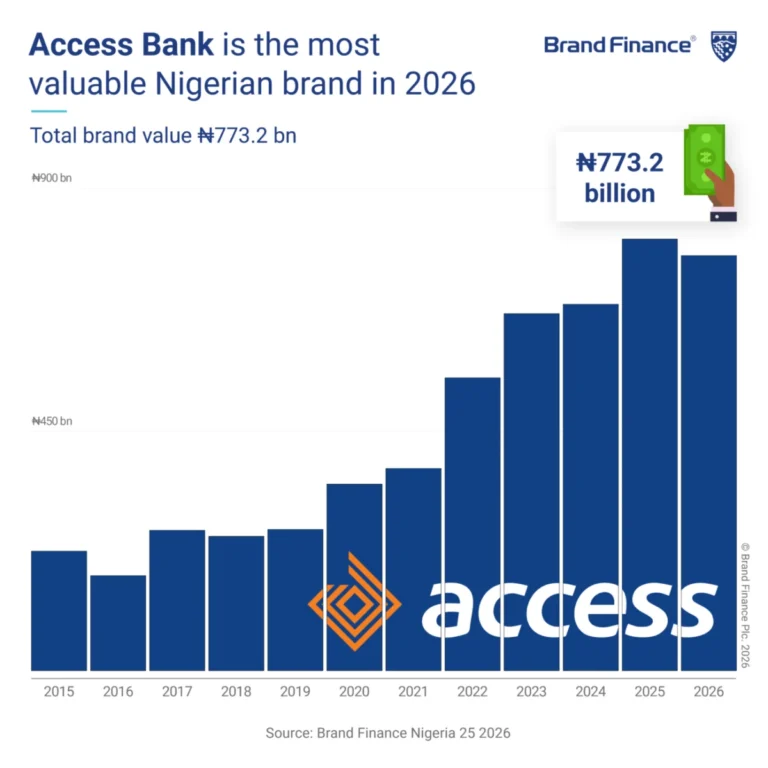
For the fifth consecutive year, Access Bank has been named Nigeria’s most valuable brand. However, the bank’s journey over the past 12 months has been characterized by a complex paradox: while its total brand value saw a 13% decline to NGN 773.2 billion, its underlying brand strength has shown notable improvement. This divergence is a direct result of a calculated strategic shift. Access Bank is currently prioritizing long-term international positioning over short-term domestic margins, marketing itself as “The Gateway to the World.”
The bank’s financial performance highlights the success of this cross-border strategy. While Access Bank experienced a 17% decline in income derived from its Nigerian operations, this was largely offset by a 14% surge in revenue from its broader African and international footprint. By evolving from a local market leader into a cross-continental infrastructure provider, Access Bank is insulating itself against localized economic shocks. This global ambition is further validated by its international standing; the bank currently ranks 320th among the world’s top 500 banking brands, according to the Brand Finance Banking 500 2026 report.
Zenith Bank and GTCO Compete for the Second Position
Zenith Bank has ascended to the second position in the 2026 ranking, following a robust 20% increase in brand value, which now stands at NGN 547 billion. This growth was fueled by strong performance across its core banking activities, with significant gains in both interest and non-interest income. A major driver behind Zenith’s success has been its aggressive pursuit of digital transformation. The bank reportedly invested approximately USD 100 million in upgrading its core banking systems this year, a move designed to enhance customer experience and operational efficiency in an increasingly fintech-driven market. Furthermore, Zenith’s continued expansion into European and other African markets has provided a diversified revenue stream that appeals to investors and customers alike.
Close behind is GTCO (Guaranty Trust Holding Company Plc), which maintains its position as the third most valuable brand in the country. With a brand value increase of 3% to NGN 540.7 billion, GTCO’s performance remains steady. The brand has successfully shifted its strategy from traditional transactional banking toward a more lifestyle-oriented engagement model. This is most visible in its high-profile cultural initiatives, such as the annual GTCO Food and Drink Festival and the GTCO Fashion Weekend. By positioning itself at the intersection of finance and lifestyle, GTCO has maintained high levels of brand recall and emotional connection with a younger, more tech-savvy demographic.
The Rise of Indigenous Energy: Seplat Energy’s Record Growth
One of the most significant developments in this year’s report is the emergence of Seplat Energy as the fastest-growing brand in the ranking. Seplat’s brand value nearly doubled over the last year, surging by 97% to reach NGN 194.5 billion. This exponential growth propelled the oil and gas producer into the top 10 for the first time, where it now sits in the ninth position.
Seplat’s success is a combination of operational discipline and strategic acquisition. The company benefited from higher production volumes and improved cash generation, but the primary catalyst was the consolidation of newly acquired offshore assets. As international oil companies (IOCs) continue to divest from onshore and shallow-water assets in the Niger Delta, indigenous players like Seplat are stepping in to fill the vacuum. This "Nigerianization" of the energy sector has allowed Seplat to build a brand that resonates with national pride while maintaining the technical standards expected by international investors.
First Bank of Nigeria: A Case Study in Brand Strength
While Access Bank holds the title of the most valuable brand, First Bank of Nigeria has emerged as the country’s strongest brand. It achieved a Brand Strength Index (BSI) score of 92.2 out of 100, earning the elite AAA+ brand strength rating from Brand Finance. Brand strength is a measure of the efficacy of a brand’s performance on intangible measures relative to its competitors, looking at factors such as marketing investment, stakeholder equity, and business performance.
As a 132-year-old institution, First Bank has managed a feat that many legacy brands struggle with: staying relevant in the digital age. By positioning itself as a trusted partner for both Small and Medium Enterprises (SMEs) and high-net-worth private banking clients, First Bank has blended its historical heritage with modern digital transformation. Its customer-centric approach has enhanced familiarity and reliability, proving that longevity can be a competitive advantage when paired with a willingness to evolve.
Industry Rankings and the Industrial Powerhouses
The Brand Finance Nigeria 25 2026 report also highlights the continued influence of the manufacturing and industrial sectors. Dangote Cement remains a titan of the Nigerian economy, ranking as the fourth most valuable brand. Despite the high costs of energy and logistics, the Dangote brand benefits from its massive scale and its essential role in Nigeria’s infrastructure development.
Following Dangote is Flour Mills of Nigeria in fifth place, representing the resilience of the consumer goods sector. As a staple provider in the Nigerian household, Flour Mills has maintained its value through supply chain optimization and brand loyalty. Other notable entries in the top 10 include United Bank for Africa (UBA) in sixth place, Stanbic IBTC in eighth, and BUA Cement in the tenth spot. The presence of two cement manufacturers in the top 10 underscores the ongoing construction boom and the importance of industrialization in Nigeria’s growth narrative.
Chronology of Economic Adaptation (2023–2026)
To understand the 14% growth in brand value, it is essential to look at the timeline of economic events that shaped these outcomes:
- Early 2024: The Nigerian government initiated significant currency reforms, leading to a devaluation of the Naira. This forced brands to re-evaluate their NGN-denominated valuations and pivot toward dollar-denominated or export-led revenue streams.
- Mid-2024: The Central Bank of Nigeria announced new minimum capital requirements for banks. This triggered a wave of strategic planning, mergers, and acquisitions, forcing banks to strengthen their brand identities to attract new capital.
- 2025: A surge in digital adoption occurred as traditional banks faced stiff competition from "neo-banks" and fintech startups. This led to the massive IT investments seen in brands like Zenith Bank.
- Early 2026: The stabilization of certain oil production quotas and the integration of divested IOC assets allowed indigenous energy brands like Seplat to see the financial fruits of their long-term investments.
Expert Analysis: Resilience Through Adaptability
Babatunde Odumeru, the Managing Director of Brand Finance Nigeria, emphasized that the current growth trend is a testament to the adaptability of Nigerian leadership. According to Odumeru, the top brands are no longer just reacting to economic headwinds; they are proactively navigating them through strategic expansion and digital investment.
“Nigeria’s top brands are proving that resilience today is defined by adaptability,” Odumeru stated. “While the collective brand value continues to rise, the real story lies in how brands such as Access Bank, Zenith Bank, and GTCO are navigating economic headwinds through strategic expansion, digital investment, and diversified revenue streams. Standout growth from Seplat Energy shows that the market continues to reward operational discipline and strong strategic positioning.”
Odumeru further noted that First Bank’s status as the strongest brand highlights a crucial lesson for the market: heritage alone is not enough, but heritage combined with customer-focused transformation is an unbeatable formula for long-term value.
Broader Implications and Future Outlook
The 14% growth in brand value suggests that despite the volatility of the Naira and high inflation rates, the underlying "brand equity" of Nigeria’s top firms remains a potent asset. For international investors, these rankings provide a roadmap of stability in an otherwise fluctuating market. The dominance of the banking sector suggests that the financial rails of the country are becoming more robust, which is a prerequisite for broader economic recovery.
However, the report also serves as a warning for brands that remain purely domestic. The success of Access Bank’s "Gateway to the World" strategy and Zenith’s international expansion indicates that the future of Nigerian brand value may lie outside its borders. As the African Continental Free Trade Area (AfCFTA) continues to gain momentum, Nigerian brands are well-positioned to become regional champions, exporting their expertise in banking, manufacturing, and energy across the continent.
In conclusion, the Brand Finance Nigeria 25 2026 report paints a picture of a corporate sector that is maturing. By moving away from a reliance on local market fluctuations and toward a model based on technological integration and geographical diversity, Nigeria’s top 25 brands are setting a standard for resilience that will likely define the country’s economic trajectory for the remainder of the decade. Brands that pair relevance with flawless execution will be best placed to sustain and grow their value in this increasingly competitive environment.