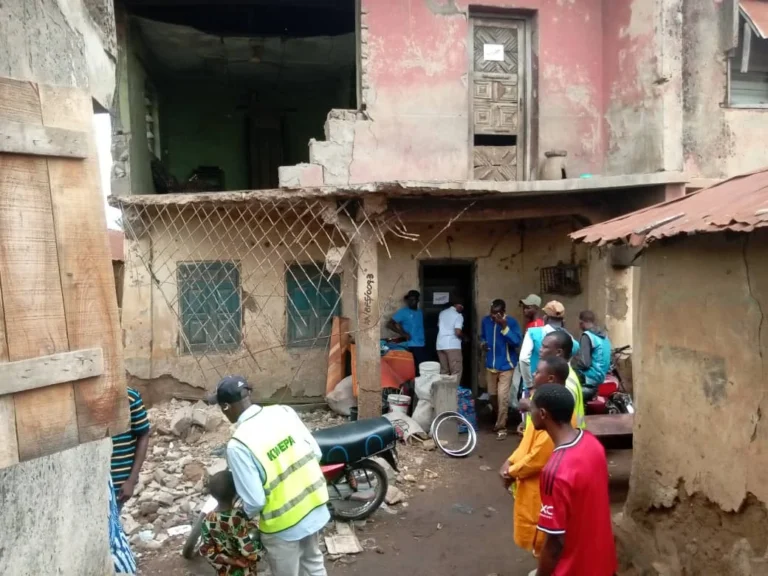
The Kwara State Government has issued an immediate demolition order for a severely dilapidated two-storey building located in the Oke-Suna area of Ilorin East Local Government Area, citing it as structurally unsafe and a significant threat to lives and property. This decisive action, spearheaded by the Kwara State Environmental Protection Agency (KWEPA), follows mounting concerns from local residents and a comprehensive inspection that confirmed the imminent risk of collapse. The structure has been sealed off to prevent any access and mitigate potential casualties while preparations for its removal are underway.
Escalating Community Concerns Prompt Official Intervention
The intervention by state authorities was prompted by a series of persistent complaints from community members who had observed the progressive and alarming deterioration of the building over an extended period. These reports highlighted visible structural failures, including deep cracks in load-bearing walls, noticeable sagging of beams, and a general state of instability that raised profound fears of a catastrophic structural failure. Responding swiftly and decisively to these alarms, KWEPA dispatched a specialized team of inspectors to conduct an urgent on-site assessment of the property.
During their thorough inspection, KWEPA officials verified the perilous state of the building, confirming that its structural integrity was severely compromised. This assessment unequivocally declared the building a clear and present danger, not only to any potential inhabitants but also to surrounding properties and pedestrians in the densely populated Oke-Suna community. An elderly resident, whose identity was withheld to maintain privacy, provided crucial testimony to the inspection team. The resident recounted the community’s persistent and repeated efforts to engage with the property owner regarding the escalating hazards posed by the deteriorating structure. According to the resident, numerous warnings and heartfelt appeals had been made to the owner, urging them to undertake necessary remedial action or proactive maintenance. Regrettably, these pleas for intervention were allegedly ignored, leaving the community in a state of heightened anxiety and fear over the potential for an unforeseen tragedy.
Jide Aina, the General Manager of KWEPA, underscored the extreme gravity of the situation in an official statement released on Monday. He unequivocally described the building as constituting a "grave danger to public safety" and issued a stern, non-negotiable directive for the owner to commence its immediate demolition. Aina further emphasized that any failure to comply with this official order would compel the Kwara State Government to take direct action, undertaking the demolition itself in the overriding interest of safeguarding human lives and property. This resolute directive serves as a stark reminder of the government’s unwavering resolve to enforce safety regulations rigorously and prevent avoidable disasters, thereby protecting its citizens.
A Detailed Chronology of Deterioration and Official Response
The sequence of events that culminated in the demolition order illustrates a critical interplay between sustained community vigilance and prompt governmental responsiveness:
- Pre-Intervention Period: For an extended period, residents of the Oke-Suna community observed and documented the gradual, yet significant, deterioration of the two-storey building. This included the emergence of visible structural defects that progressively escalated the risk profile of the structure.
- Community Advocacy: Concerned residents, acting collectively and individually, made multiple attempts to communicate the dangerous condition of the building to its owner. These efforts were aimed at prompting the owner to undertake essential repairs, reinforcement, or, if necessary, demolition. These warnings, unfortunately, reportedly went unheeded.
- Formal Reporting to Authorities: Faced with the owner’s alleged inaction and growing fears of an imminent collapse, community members formally escalated their concerns by lodging official complaints about the hazardous structure with the Kwara State Environmental Protection Agency. This crucial step activated the regulatory mechanism.
- KWEPA’s Rapid Inspection: Upon receiving the formal complaints, KWEPA promptly mobilized a specialized inspection team. The team was dispatched to the Oke-Suna site with the mandate to conduct a thorough assessment, verify the veracity of the reports, and critically evaluate the structural integrity of the building.
- Official Hazard Verification: The comprehensive inspection unequivocally confirmed the building’s severe state of dilapidation and officially declared it structurally unsafe. This finding corroborated the community’s worst fears of an impending collapse and provided the necessary technical basis for official action.
- Issuance of Demolition Directive: Following the conclusive findings of the inspection, KWEPA’s General Manager, Jide Aina, formally issued a directive for the immediate demolition of the building, emphasizing that public safety was the paramount concern dictating this decision.
- Property Sealing: Concurrently with the demolition order, the building was physically sealed off. This measure was implemented to prevent any unauthorized access to the dangerous structure, thereby mitigating immediate risks to individuals and ensuring public safety during the transition to demolition.
- Public Announcement: On Monday, KWEPA’s Press Secretary, Aliyu Amode, issued a detailed public statement. This communication outlined the enforcement action taken, articulated the critical reasons behind the demolition order, and reaffirmed the Kwara State Government’s unwavering commitment to public safety and environmental protection.
- Enforcement Stipulation and Government Intervention: The directive to the property owner implicitly includes a clear timeline for compliance. It explicitly warns that if the owner fails to initiate the demolition within the stipulated period, the state government will undertake the demolition directly, with the costs incurred likely to be fully recovered from the negligent owner.
This meticulously documented sequence of events underscores a responsive yet firm approach by the state government, highlighting the indispensable role of active community engagement in identifying and reporting potential hazards before they escalate into full-blown tragedies.
The Broader Context: A National Challenge of Building Collapses
The distressing situation in Kwara State is not an isolated incident but rather a localized manifestation of a larger, persistent national crisis concerning building collapses in Nigeria. The nation has regrettably garnered a reputation for frequent structural failures, which routinely lead to significant loss of life, severe injuries, and substantial economic devastation. Data compiled from various authoritative sources, including professional bodies like the Building Collapse Prevention Guild (BCPG) and comprehensive media reports, consistently highlight this alarming and tragic trend. For instance, the BCPG has frequently reported dozens of building collapses across Nigeria annually, with major urban centers disproportionately bearing the brunt of these incidents.
Several systemic and pervasive factors contribute to this entrenched problem:

- Substandard Materials and Practices: A critically prevalent issue is the widespread use of poor-quality building materials by developers and contractors, often driven by an unethical desire to cut costs. These materials frequently do not meet the stringent specifications required for structural integrity, fundamentally compromising the safety and longevity of the entire building. Furthermore, the employment of untrained or unqualified laborers, coupled with inadequate supervision by certified professionals, often leads to construction practices that deviate dangerously from approved designs and established engineering standards.
- Pervasive Flouting of Building Codes: Despite the existence of comprehensive and well-articulated building codes and regulations, their consistent and effective enforcement remains a formidable challenge across Nigeria. Developers frequently bypass mandatory approval processes, proceed with construction without obtaining proper permits, or unilaterally modify approved plans without seeking new authorization, thereby creating inherent risks.
- Foundation Weaknesses: A significant number of collapses are directly attributed to faulty or improperly constructed foundations. This often stems from inadequate geotechnical surveys or the construction of structures on unsuitable land without appropriate reinforcement or remedial measures, leading to instability from the ground up.
- Illegal Construction and Alterations: Unauthorized additions, extensions, or structural modifications to existing buildings, especially when undertaken without professional engineering assessment and approval, can critically overload the original design parameters and precipitate catastrophic failure.
- Age, Neglect, and Lack of Maintenance: Older buildings, particularly those that have not undergone regular maintenance, timely repairs, or periodic structural assessments, are highly susceptible to collapse. This vulnerability is due to material fatigue, environmental degradation over time, and a chronic lack of necessary repairs, which appears to be a significant factor in the case of the Oke-Suna building.
- Corruption and Regulatory Lapses: Corruption within regulatory agencies poses a profound threat to building safety. It can lead to the illicit approval of substandard projects, the overlooking of critical violations, and the issuance of occupancy permits for unsafe structures, thereby exacerbating the problem and undermining public trust.
The human cost of these collapses is immeasurable, often involving individuals trapped beneath rubble, severe life-altering injuries, and numerous fatalities. Economically, beyond the immediate destruction, there are substantial costs associated with emergency response operations, complex debris removal, significant property devaluation in affected areas, and a broader erosion of public confidence in the construction sector. The Kwara incident unequivocally underscores the urgent and imperative need for stringent adherence to building codes and relentless enforcement to safeguard public safety effectively.
Regulatory Framework and Persistent Enforcement Challenges
In Nigeria, a multi-tiered system of governmental and professional bodies is tasked with regulating the construction industry and ensuring structural integrity. At the state level, these typically include Ministries of Physical Planning and Urban Development, various Town Planning Authorities, and specialized Environmental Protection Agencies like KWEPA, whose expanded mandate often encompasses identifying and mitigating both environmental and structural hazards. Additionally, prominent professional bodies such as the Nigerian Society of Engineers (NSE), the Council for the Regulation of Engineering in Nigeria (COREN), and the Nigerian Institute of Architects (NIA) play crucial roles in establishing industry standards, certifying qualified professionals, and actively advocating for the adoption of best practices.
Despite the existence of this comprehensive regulatory framework, effective and consistent enforcement remains a formidable challenge across the nation. Persistent issues such as chronic manpower shortages within regulatory bodies, insufficient budgetary allocations for robust inspection regimes, and convoluted bureaucratic bottlenecks frequently hinder proactive monitoring and timely intervention. Furthermore, the sustained political will to consistently enforce regulations without fear or favour, regardless of the individuals or entities involved, is absolutely critical. The Kwara State Government’s decisive action in this particular instance, however, signals a renewed and commendable commitment to overcoming these systemic challenges and prioritizing the paramount safety of its citizens. KWEPA’s prompt and robust response to community complaints serves as a powerful testament to the potential effectiveness of a responsive regulatory body when adequately empowered, supported, and allowed to operate autonomously.
Official Statements and Unwavering Commitment to Public Safety
General Manager Jide Aina’s stern directive is a clear reflection of the Kwara State Government’s broader and unwavering commitment to ensuring the safety, security, and overall well-being of its citizens. In his official public statement, Aina emphatically reiterated this commitment, affirming that the government "remains committed to safeguarding residents through proactive environmental enforcement, strict compliance with safety regulations, and the timely removal of environmental hazards capable of causing avoidable tragedies." This declaration is not merely a reactive response to the immediate incident but rather a profound articulation of an ongoing governmental policy and strategic priority.
Further reinforcing this resolute stance, state officials, while not directly quoted beyond the KWEPA General Manager, would undoubtedly echo sentiments emphasizing a zero-tolerance policy for negligence on the part of property owners and developers. For example, the Commissioner for Environment or the Commissioner for Physical Planning would likely issue comprehensive statements urging all property owners to regularly assess, maintain, and certify the structural soundness of their buildings, simultaneously warning of severe penalties for any non-compliance. The Governor’s office would typically lend its full support to such decisive actions, highlighting the administration’s overarching dedication to urban regeneration, public safety, and the strict adherence to the rule of law in all development initiatives.
The crucial call to action from KWEPA for residents to "continue supporting the government’s efforts by promptly reporting abandoned buildings, distressed structures, environmental nuisances and other environmental hazards to KWEPA for swift intervention" is a critical and indispensable component of their overarching strategy. This initiative effectively empowers citizens to become active and vigilant participants in maintaining public safety, serving as an invaluable early warning system for potential dangers that might otherwise escape the attention of official channels. This collaborative and synergistic approach between government agencies and engaged citizens is absolutely essential for the effective and sustainable management of environmental and structural safety.
Implications and Future Outlook for Urban Safety
The immediate demolition order for the Oke-Suna building carries several significant and far-reaching implications for Kwara State, and indeed, potentially serves as a powerful model for other regions grappling with similar challenges:
- Precedent-Setting Action: This decisive and public action establishes a strong precedent, sending an unequivocal signal to property owners across Kwara State that the government will not hesitate to stringently enforce safety regulations, even if it necessitates the demanding order for the demolition of private property deemed hazardous. This firm stance could effectively encourage other owners of dilapidated or structurally compromised structures to undertake necessary repairs, renovations, or voluntary demolitions proactively.
- Enhanced Public Awareness and Engagement: The gravity of this incident and the subsequent comprehensive media coverage will undoubtedly significantly raise public awareness regarding the inherent dangers of structurally unsound buildings and underscore the paramount importance of promptly reporting such hazards. It also serves to educate citizens on their vital role in collaborating effectively with government agencies to ensure collective safety.
- Increased Regulatory Vigilance: The proactive and rapid response by KWEPA may serve as a catalyst, encouraging other regulatory bodies within the state, and indeed across Nigeria, to significantly increase their vigilance and conduct more regular, thorough, and unannounced inspections, rather than passively waiting for complaints.
- Emphasis on Preventative Measures: The incident starkly underscores the critical and urgent need for robust preventative measures. These include mandatory regular structural audits, strict adherence to maintenance schedules, and the exclusive engagement of qualified and certified professionals in all construction, renovation, and alteration projects. It powerfully highlights the long-term cost-effectiveness and societal benefits of proactive maintenance over reactive and often tragic disaster management.
- Legal and Economic Ramifications for Owners: For the owner of the Oke-Suna building, beyond the immediate and significant loss of property, there could be profound legal ramifications if negligence in maintenance or adherence to building codes is conclusively proven. Furthermore, if the state government is compelled to undertake the demolition, the owner will most certainly be charged for all costs incurred, adding a substantial financial penalty to the inherent loss of the asset. This serves as a potent deterrent to other property owners who might be tempted to neglect their fundamental responsibilities.
- Reinforcement of Urban Planning Principles: This event profoundly reinforces the foundational principles of sound urban planning and sustainable development, which unequivocally prioritize public safety, orderly urban growth, and the development of resilient and safe infrastructure. It serves as a powerful reminder to all stakeholders that economic development and urban expansion must never come at the expense of fundamental safety standards and the well-being of the populace.
Looking ahead, the Kwara State Government’s commitment, as articulated by KWEPA, strongly suggests a sustained and intensified effort to curb the persistent menace of building collapses. This will likely involve continuous and robust public enlightenment campaigns, enhanced professional training and capacity building for inspection personnel, and potentially the comprehensive review and strengthening of existing building codes and their associated enforcement mechanisms. The ultimate effectiveness of these vital measures will be judiciously judged by a measurable reduction in structural failures and a palpable increase in public confidence in the safety and integrity of built environments across the state. The Oke-Suna demolition, therefore, stands as a critical and symbolic step in this ongoing, crucial endeavor, transforming a potential tragedy into a powerful and enduring lesson in accountability, public safety, and proactive governance.