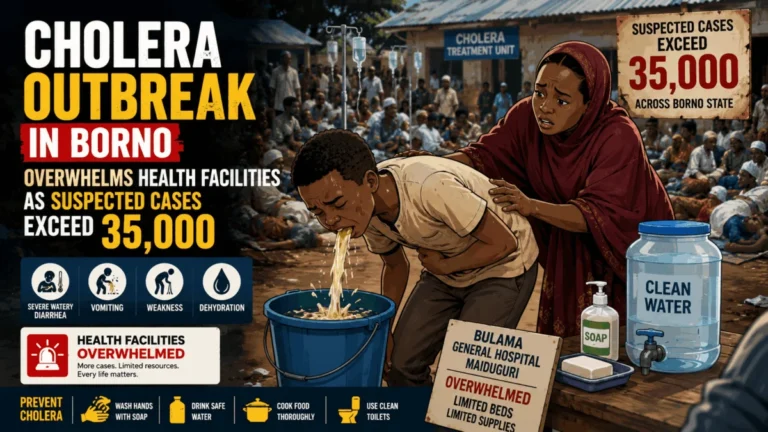
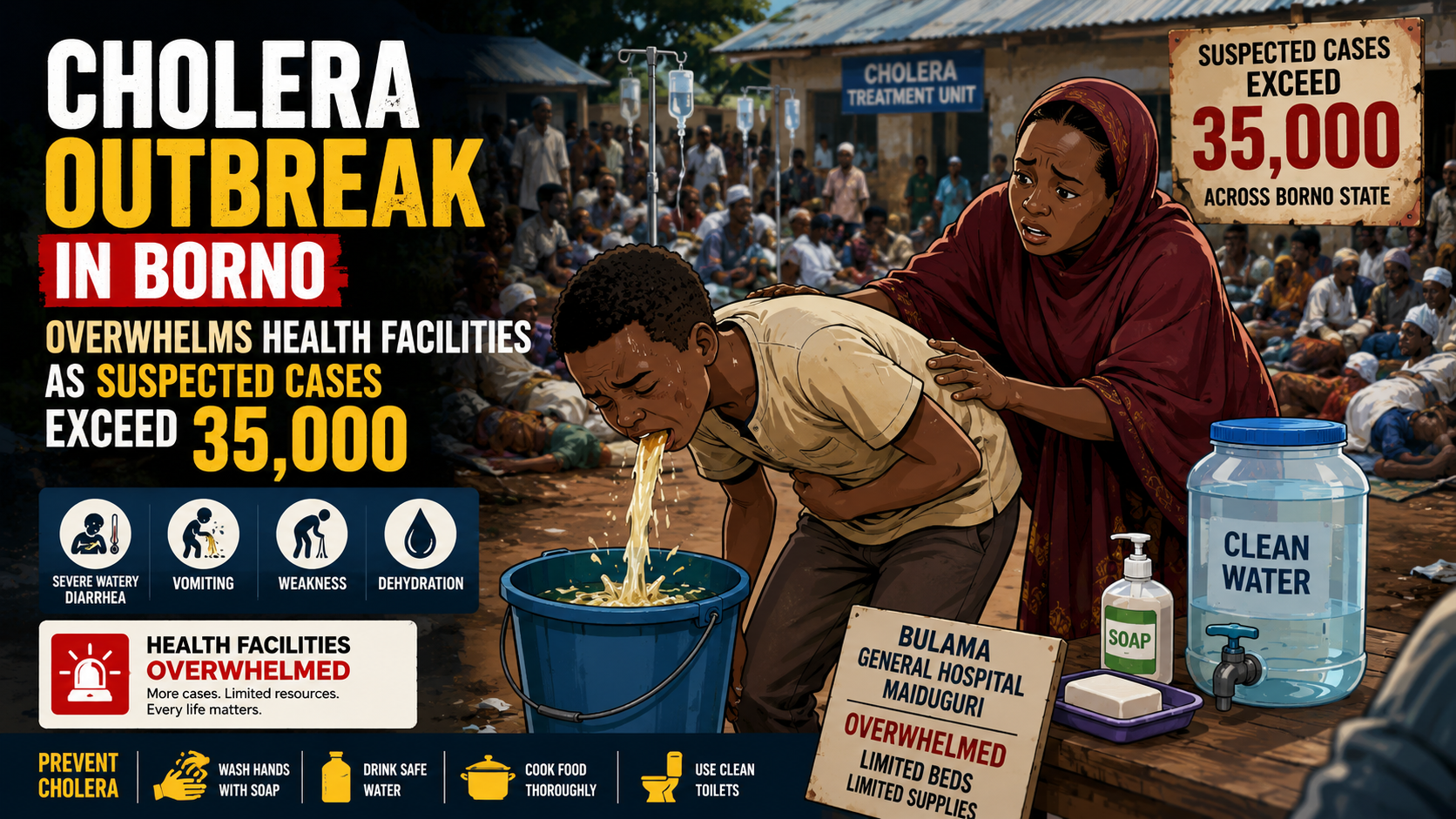
Healthcare facilities across Borno State are currently grappling with an unprecedented surge in suspected cholera cases, as official data reveals that more than 35,500 people have been infected since the onset of the outbreak in May. The humanitarian medical organization Médecins Sans Frontières (MSF), also known as Doctors Without Borders, confirmed in a recent communication that the death toll has reached 198, signaling a severe public health emergency in Nigeria’s northeastern region. The outbreak, which began with the first reported cases on May 1, has spread with alarming velocity, placing an immense strain on an already fragile medical infrastructure weakened by years of regional instability.
According to data released by the Borno State Ministry of Health and analyzed by MSF, the rapid transmission of the disease is inextricably linked to the precarious living conditions prevalent in the state. The surge is primarily attributed to overcrowded informal settlements, many of which house internally displaced persons (IDPs). In these environments, access to safe drinking water is critically limited, and the lack of functional sanitation systems or adequate waste management creates a fertile breeding ground for the Vibrio cholerae bacterium. As the rainy season continues to impact the region, the risk of further water source contamination remains a primary concern for health officials and humanitarian actors.
The Pathogenesis and Progression of the Outbreak
Cholera is an acute diarrheal infection caused by the ingestion of food or water contaminated with the bacterium Vibrio cholerae. It is characterized by its rapid onset; the disease can cause severe dehydration and systemic shock, potentially leading to death within hours if left untreated. In the context of Borno State, the severity of the current strain is evidenced by the high volume of patients requiring intensive medical intervention. MSF reported that as of July 12, they had treated more than 24,000 suspected cases. Notably, more than one in four of these patients arrived at treatment facilities presenting with severe symptoms, requiring immediate rehydration through intravenous fluids to prevent organ failure.
The timeline of the outbreak highlights a sharp escalation in the infection rate over a ten-week period. Following the initial reports in early May, the number of cases grew exponentially throughout June. By early July, the scale of the crisis necessitated a massive mobilization of resources. While health authorities have worked to manage the influx, the sheer volume of patients has frequently overwhelmed local clinics, forcing many to operate beyond their designed capacities.
Humanitarian Response and Clinical Interventions
In response to the escalating numbers, MSF has significantly expanded its emergency operations in collaboration with the Borno State Ministry of Health and other international humanitarian partners. The organization’s current infrastructure includes the support and management of two major Cholera Treatment Centres (CTCs), five smaller Cholera Treatment Units (CTUs), and 17 oral rehydration points strategically located throughout the state. These rehydration points serve as a first line of defense, providing oral rehydration salts (ORS) to patients with mild to moderate symptoms, which helps prevent their condition from deteriorating into the severe stage that requires hospitalization.
Bienfait Tombola, the MSF project medical coordinator in Maiduguri, emphasized the gravity of the situation, noting that despite the expansion of medical facilities over the past two months, the disease continues to outpace containment efforts. "The scale of this outbreak is a direct reflection of the systemic gaps in basic infrastructure," Tombola stated. He highlighted that while medical treatment saves lives, it does not address the root cause of the transmission. Without a fundamental shift in access to clean water and sanitation, the cycle of infection is likely to persist even as clinical interventions are scaled up.
The Role of Vaccination and Preventative Measures
Recognizing the need for a multi-faceted approach, health authorities launched a massive oral cholera vaccination (OCV) campaign in early July. Supported by MSF and other partners, the campaign successfully reached more than 2.6 million people across high-risk areas in Borno State. Vaccination is considered a vital tool in slowing the transmission rate, particularly in densely populated areas where social distancing and hygiene protocols are difficult to maintain.
However, medical experts warn that vaccination is not a panacea. The OCV provides temporary protection but does not eliminate the risk if the environmental factors—such as contaminated wells and open defecation—remain unaddressed. Consequently, MSF has intensified its community awareness campaigns. These initiatives focus on educating the public about the importance of boiling water, frequent handwashing, and the early recognition of symptoms. Furthermore, the organization has implemented water, sanitation, and hygiene (WASH) interventions, including the chlorination of water at key collection points to ensure that the water being carried back to homes is safe for consumption.
Regional Spread and the Impact on Plateau State
The cholera crisis is no longer confined to the borders of Borno State. The highly contagious nature of the bacterium, combined with the movement of people across state lines for trade and displacement, has led to a geographic expansion of the outbreak. As of mid-July, the Plateau State Ministry of Health reported 102 suspected cases, with at least five confirmed deaths. The emergence of cases in Plateau State has raised fears of a wider national epidemic, similar to those seen in previous years when cholera swept through multiple Nigerian states during the peak of the rainy season.
The spread to neighboring regions underscores the necessity for enhanced disease surveillance and cross-border cooperation between state health ministries. Epidemiologists suggest that the strain on Borno’s resources may be replicated in other states if preventative measures are not localized and implemented immediately. The National Centre for Disease Control (NCDC) has been monitoring the situation, but the primary burden of care remains on state governments and non-governmental organizations (NGOs) on the ground.
Environmental and Structural Challenges in Borno
The persistence of cholera in Borno State is deeply rooted in the state’s socio-political history. Over a decade of conflict in Northeast Nigeria has displaced millions of people, many of whom reside in "informal settlements" or overcrowded IDP camps. These settlements often lack the basic urban planning required for safe waste disposal. In many instances, latrines are located too close to water sources, or they overflow during heavy rains, leading to the direct contamination of the groundwater that communities rely on for drinking and cooking.

Furthermore, the destruction of existing healthcare infrastructure during years of insurgency has left many rural areas without functional clinics. This forces residents to travel long distances to reach Maiduguri or other urban centers for treatment, often arriving in a state of advanced dehydration. The logistical challenge of delivering clean water to these remote or insecure areas remains one of the greatest hurdles for humanitarian agencies.
Analysis of Public Health Implications
The 2024 cholera outbreak in Borno serves as a stark reminder of the intersection between environmental health and regional security. While the immediate focus is on reducing the case fatality rate through clinical care, the long-term solution requires a massive investment in the "WASH" sector. Fact-based analysis suggests that unless there is a structural overhaul of water delivery systems in Maiduguri and the surrounding local government areas (LGAs), cholera will remain an endemic threat that resurfaces annually.
Moreover, the strain on healthcare workers cannot be overlooked. Many of the staff currently managing the Cholera Treatment Centres have been working under high-stress conditions for years, dealing with malnutrition crises and other infectious diseases like measles and meningitis. The addition of a large-scale cholera outbreak leads to burnout and a dilution of resources that could impact other essential health services, including maternal and child health and routine immunization programs.
Conclusion and Recommendations for Future Mitigation
To curb the current transmission and prevent future outbreaks of this magnitude, MSF and other health stakeholders have outlined several critical requirements. First, there must be a sustained effort to strengthen disease surveillance systems to ensure that new clusters of infection are identified and contained within 24 to 48 hours. Second, the international community and the Nigerian government must prioritize the funding of permanent water and sanitation infrastructure in Borno State, moving beyond temporary emergency measures.
Additionally, expanding the reach of vaccination campaigns to include mobile populations and those in hard-to-reach areas will be essential. Finally, the integration of cholera management into the primary healthcare system—rather than relying solely on emergency centers—will ensure a more resilient response to future health threats. As the death toll in Borno nears 200, the urgency of these interventions has never been more apparent. The international community’s support remains vital in ensuring that the 35,500 suspected cases do not continue to climb and that the most vulnerable populations are protected from a preventable and treatable disease.