The future of global the human immunodeficiency virus (HIV) response has narrowly avoided a terminal fracture. In a decisive special meeting of the UNAIDS Programme Coordinating Board (PCB), member states, civil society delegates, and international donors officially rejected a controversial proposal by United Nations Secretary-General António Guterres to “sunset” the Joint United Nations Programme on HIV/AIDS by the end of the year. Rather than closing the doors on a decades-old institution that helped bend the curve of the global epidemic, the board voted to fundamentally restructure the entity into a streamlined, highly focused “hub” designed to operate within a harsher global financial reality.
The high-stakes meeting, led by PCB Chair Ambassador Erica Schouten—who also serves as the Netherlands’ permanent representative to the UN in Geneva—convened to evaluate a comprehensive final report submitted by a dedicated working group on the future of UNAIDS. The mandate was clear: find a way to preserve the core architecture of the global HIV response while drastically shrinking administrative bloat in the face of widespread UN budget deficits and donor fatigue.
For the international public health community, the decision represents a hard-fought victory. However, it also opens the door to a complex, high-pressure transition period that will test the resilience of global health governance over the next several months.
Background and Context of the UN80 Pressure
The push to shutter UNAIDS did not emerge in a vacuum. As part of broader administrative reforms and cost-cutting initiatives—often discussed under overarching UN modernization frameworks such as the UN80 institutional reviews—the United Nations has faced acute liquidity crises. Strained by overlapping geopolitical conflicts, escalating humanitarian demands, and flatlining contributions from major donor governments, the multilateral system has been forced to audit redundant programs, consolidate operations, and eliminate overlapping mandates.
UNAIDS, established by a landmark ECOSOC resolution in the 1990s and operationalized in 1996, was uniquely vulnerable. As a joint program pooling resources and mandates across multiple specialized UN agencies, its sprawling administrative footprint and regional country offices were frequently scrutinized for duplication alongside agencies like the World Health Organization (WHO), the UN Development Programme (UNDP), and others. When the proposal to sunset UNAIDS by late 2026 was formally tabled, it sparked immediate alarm among affected nations, particularly across sub-Saharan Africa, and mobilized a robust defense from global civil society organizations, grassroots activists, and human rights defenders who argued that dismantling the specialized agency would reverse hard-won gains against the global epidemic and stall progress toward the 2030 Sustainable Development Goal target of ending AIDS.
The Working Group Roadmap and the Leaner Hub Concept
Under the newly approved framework, UNAIDS will avoid liquidation, but it will no longer resemble the institution of the past decade. The working group’s blueprint calls for a dramatic evolution from a sprawling bureaucratic machinery into a tight, agile secretariat focused strictly on four foundational pillars:

- Leadership and high-level political advocacy.
- Strategic convening and multi-sectoral coordination.
- Rigorous data collection, epidemiological accountability, and target tracking.
- Robust community support and human rights defense.
This tighter secretariat will serve as the cross-cutting engine for the Global AIDS Strategy, maintaining global normative leadership while shedding direct operational and technical burdens.
The structural shift fundamentally reallocates responsibilities. Country-level technical execution and direct programmatic implementation are slated to be ceded entirely to the joint program’s ten co-sponsoring agencies and the World Bank. These co-sponsors—which collectively possess sprawling operational footprints in more than 130 countries and harbor extensive internal expertise—are expected to step into a primary implementation role. Notably, several co-sponsors already maintain substantial internal HIV workforces, including the WHO with 117 dedicated HIV staff, the UN Population Fund (UNFPA) with 75, the UN Development Programme (UNDP) with 74, and the UN Children’s Fund (UNICEF) employing more than 60 specialists.
Despite decentralizing technical execution, the new hub will maintain a regional presence where it proves most cost-effective. Regional offices will be tasked with specialized duties such as monitoring and evaluation, facilitating South-South technical learning, managing acute crisis responses, and liaising with high-level political and technical bodies.
Downsizing, Staffing Realities, and Financial Constraints
The survival of UNAIDS comes on the heels of deep, painful internal contractions. Long before the recent PCB vote, the agency was forced to aggressively right-size its operations in response to shrinking donor contributions. Global staffing levels have already been slashed by more than half, dropping precipitously from 608 personnel down to just 294.
The footprint of the organization has similarly contracted: only 19 staff members remain stationed at the large headquarters in Geneva. The vast majority of the remaining workforce—roughly two-thirds of the total secretariat—is deployed across sub-Saharan Africa, anchoring the organization close to the epicenter of the epidemic.
Financially, the organization is operating on a tightly managed budget. For the 2026 fiscal year, the UNAIDS secretariat budget stands at $85.1 million. Personnel and staffing costs consume approximately 55% of this allocation, while the remaining 39% is funneled directly into programmatic activities and core operations. A specialized funding pool will be preserved specifically to sustain co-sponsor-led and co-sponsor-facilitated initiatives at the national level, ensuring that decentralization does not result in a total vacuum of resources.
Leadership Transitions and Institutional Hurdles
The immediate operational landscape is complicated by impending leadership changes. UNAIDS Executive Director Winnie Byanyima, whose vocal defense of the program galvanized donor and civil society resistance against the sunset proposal, will complete her term at the end of December. Her departure means the UN Secretary-General must swiftly appoint an interim executive director to oversee the delicate and intricate transition phase.
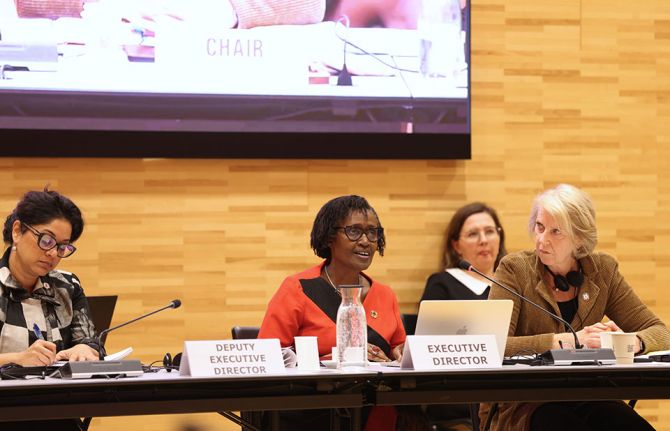
The PCB has officially mandated Byanyima—and subsequently the incoming leadership—to establish a specialized “transition task team.” This team will comprise representatives from the secretariat, the co-sponsoring agencies, and two civil society delegates nominated directly by the PCB NGO delegation. The task force is charged with consulting implementing countries, engaging multilateral stakeholders, and delivering a fully costed, transparent implementation plan to the board.
Concurrently, PCB Chair Ambassador Erica Schouten has been formally tasked with communicating the board’s binding decision to the United Nations Economic and Social Council (ECOSOC), cementing the institutional shift within the broader UN architecture.
Lingering Uncertainties and Strategic Implications
While the threat of outright dissolution has been lifted, significant strategic and operational questions remain unresolved. The working group’s final documentation candidly highlights notable divergences of opinion among stakeholders regarding several foundational issues:
- The optimal timeline and duration of the transition process.
- Whether the UNAIDS Joint Programme should maintain a standalone country-level presence or be entirely absorbed into existing national institutions and broader UN country team frameworks.
- Whether institutional budgeting should be driven strictly by programmatic functions or constrained rigidly within fixed, pre-allocated funding envelopes.
- Whether a permanent executive director should be selected immediately or if an interim steward should manage the initial structural overhaul before a permanent appointment is made.
Fact-Based Analysis of Broader Implications
The decision to preserve UNAIDS in a modified, leaner format carries profound implications for global health governance. By rejecting the sunset proposal, member states have signaled that specialized, disease-specific global architectures still hold irreplaceable value—particularly in maintaining political momentum, defending vulnerable and marginalized populations, and holding governments accountable to human rights commitments in public health.
However, the transition to a co-sponsor-led implementation model introduces coordination risks. Ensuring that ten distinct UN agencies and the World Bank can seamlessly absorb technical responsibilities without administrative friction or drops in service delivery will require rigorous oversight. Furthermore, as international donors pivot attention and financial resources toward emerging global crises, climate resilience, and broader pandemic preparedness architectures, the newly minted UNAIDS hub will have to prove its cost-effectiveness, agility, and unique value proposition to secure its long-term financial viability.
The coming months will serve as an intense operational crucible. How the transition task team navigates budget allocations, leadership succession, and institutional integration will determine whether the saved joint program can successfully reinvent itself or merely linger in a diminished state. For millions of people worldwide relying on sustained, equitable access to HIV prevention, treatment, and care, the stakes could not be higher.