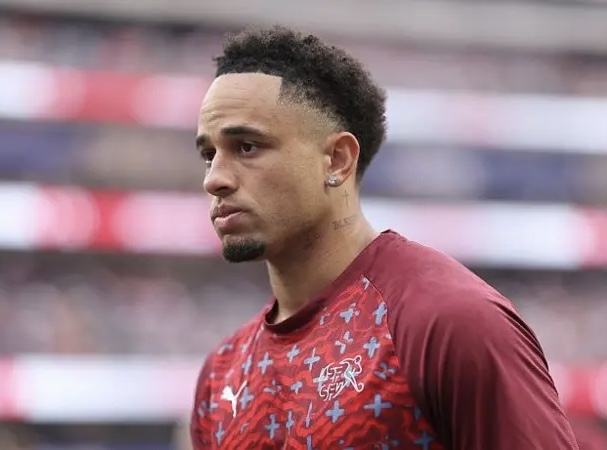
The 26-year-old forward, who has established himself as a prominent figure in European football following his £18 million move to Leeds United from AC Milan in August 2025, confirmed his departure from the international fold via a formal statement released on social media. The decision marks a significant rupture in the relationship between one of Switzerland’s most promising talents and the national team hierarchy, leaving a void in the squad ahead of the upcoming UEFA Nations League campaign.
A Relationship Fractured by Perceived Mistreatment
The core of Okafor’s grievance centers on his treatment during the recent World Cup cycle. Despite earning 26 caps since his senior debut in 2019, Okafor saw limited action in the tournament, logging only 19 minutes during a substitute appearance in the Round of 32 clash against Algeria. However, the player was quick to emphasize that his resignation was not a product of frustration over playing time, but rather a reaction to the internal culture and communication style maintained by manager Murat Yakin.
In his public statement, Okafor revealed that his grievances were rooted in specific incidents that occurred following his cameo against Algeria. He described a environment where minor, inconsequential errors made during the match were met with a level of criticism and reaction from the coaching staff that he felt was disproportionate and deeply damaging to his morale. According to the player, these interactions—compounded by perceived broken commitments—led him to conclude that the working environment under Yakin had become untenable.
"Things happened that hurt me deeply," Okafor wrote. "Trust was broken. Commitments were not kept. When I was allowed to play against Algeria, people reacted to minor mistakes far away from our goal in a way that hurt me deeply. In the weeks that followed, I thought a lot and decided for myself that I no longer want to play for the national team under the current manager."
Chronology of an International Career
Noah Okafor’s journey with the Swiss national setup has been a long-standing commitment that began in his teenage years. Born in Binningen to a Nigerian father and a Swiss mother, Okafor’s multicultural heritage has often been a point of interest for football analysts. His rise through the ranks was steady and impressive, beginning with his early involvement in the U-15 and U-17 youth squads.
- May 2018: Made his debut for the Switzerland U-18 team, featuring in a 1-1 draw against Italy.
- June 2019: Earned his first senior cap, appearing as a 113th-minute substitute in the UEFA Nations League third-place play-off against England.
- November 2021: Scored his first international goal for the senior team in a pivotal World Cup qualifying match against Bulgaria, a victory that proved instrumental in securing Switzerland’s automatic qualification for the 2022 tournament.
- May 2026: Named to the 26-man squad for the FIFA World Cup, capping his progression as a regular squad member.
This trajectory suggests that Okafor viewed his international career as a serious professional obligation, making his sudden departure a jarring development for the Swiss Football Association (SFV).
The Stance of the Swiss Football Association
The SFV responded to the news with measured professionalism, acknowledging the player’s right to withdraw from consideration while maintaining a neutral position on the internal conflict. A spokesperson for the association confirmed on Thursday that they had been formally notified of Okafor’s decision. "We respect his decision and wish him every success with his club," the statement read, avoiding any direct confrontation or rebuttal regarding the specific claims made by the player against Yakin.
The timing of this resignation is particularly difficult for the SFV, as the national team is currently preparing for their opening match of the 2026-27 Nations League. Switzerland is scheduled to travel to North Macedonia on September 26. With Yakin having served as head coach since August 2021, the federation will now have to navigate the fallout of this public dispute while maintaining squad cohesion for the upcoming qualifying cycle.
Club Support and Future Implications
The reaction from Leeds United, Okafor’s current club, has been one of staunch support. Manager Daniel Farke, who has been instrumental in integrating the forward into the Premier League following his high-profile transfer from AC Milan, praised the player for his transparency and maturity in handling a difficult situation.
Farke emphasized that while the international stage is significant, the club’s priority is the player’s well-being and his performance at the domestic level. "He came to inform me and explained the reasons why, and I appreciate that he spoke with me beforehand," Farke told reporters. "It’s more or less Noah’s decision; he has to decide what is best at this stage for his career. All I can say is we have a home here for Noah, where he feels really comfortable, appreciated, and for us he will be a key player."
Farke’s comments highlight a common trend in modern football where clubs are increasingly protective of their players’ mental health and professional environments. By providing a "home" where Okafor feels "appreciated," Leeds United is positioning itself as a sanctuary for a player who feels alienated by his national team.
Broader Context: The Nationality-Switch Debate
The resignation has also sparked renewed speculation regarding Okafor’s future international eligibility. Because of his dual heritage, there has been long-standing discussion about whether the forward could explore options to represent Nigeria under FIFA’s updated nationality-switch regulations.
While Okafor has already represented Switzerland at the senior level, recent rule changes by FIFA regarding the conditions under which a player can switch their national allegiance—provided they have not played in a competitive official match for their original nation in a significant capacity—have opened doors for dual-nationals globally. However, whether Okafor would pursue such an avenue remains purely speculative at this stage. Any move would require formal approval from FIFA and would be contingent on his desire to restart an international career with a different federation.
Analysis of the Management Climate
The situation reflects a broader challenge for national team managers in the modern era: the management of player expectations and the cultivation of trust within a short-term, high-pressure environment. Murat Yakin, who has overseen the Swiss team since 2021, now faces the difficult task of managing the public perception of his leadership style.
The criticism leveled by Okafor suggests a perceived disconnect between the coaching staff’s feedback methods and the psychological needs of the players. In professional football, where the margin for error is razor-thin, the way in which a manager critiques a player—especially a young talent—can define the longevity of that player’s commitment to the national jersey. By publicly citing a "breakdown in trust," Okafor has essentially challenged the current leadership to justify their man-management techniques.
As Switzerland moves forward into the Nations League, the absence of a player of Okafor’s caliber will be felt on the pitch, but the long-term impact on the dressing room morale remains to be seen. If other players share similar concerns, the SFV may find itself facing a broader crisis of confidence. For now, the focus shifts to how the Swiss team performs in North Macedonia, and whether Yakin can steady the ship in the face of this high-profile departure.