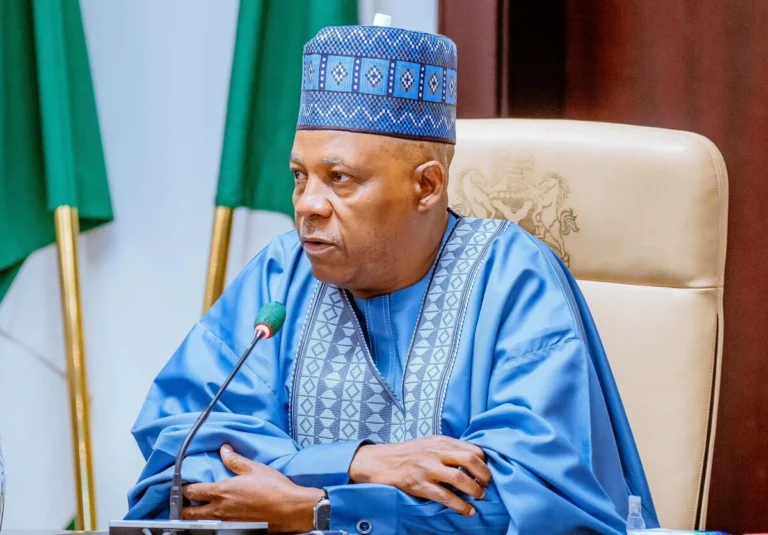
The landscape of Nigerian public administration came under intense focus on Monday as top government officials, veteran statesmen, and policy analysts gathered to dissect the core tenets of sustainable governance. Speaking at the formal presentation of a new biographical publication chronicling the life and legacy of Brigadier Musa Usman—the pioneering military governor of the defunct North-Eastern State—Vice President Kashim Shettima delivered a compelling call to action. He challenged contemporary political actors to look beyond immediate electoral cycles and partisan boundaries, advocating instead for the establishment of robust, enduring institutions capable of withstanding the test of time and serving citizens long after leaders have vacated public office.
Represented at the high-profile event by his Special Adviser on Special Duties, Aliyu Modibbo, the Vice President emphasized that the true metric of effective leadership is not found in temporary popularity or short-term achievements. Rather, true leadership is defined by the enduring utility of policies and structures left behind. The book, meticulously authored by veteran journalists and researchers Mallam Mahmud Jega and Dr. Theophilus Aba, serves as both a historical archive and a contemporary mirror, reflecting a bygone era of public service characterized by selflessness, infrastructural foresight, and an unyielding commitment to regional development.
Contextualizing the historical significance of the event, stakeholders noted that the gathering transcended a mere book launch. It served as a critical platform for national introspection, prompting a comparative analysis between the foundational governance framework established by post-independence leaders and the structural challenges confronting modern Nigeria. As the nation grapples with complex socioeconomic realities, escalating development costs, and regional security concerns, the insights shared by prominent figures at the event offered a strategic blueprint for administrative renewal.
Historical Horizons: The Genesis of the North-Eastern State and Brigadier Musa Usman’s Stewardship
To fully appreciate the legacy of Brigadier Musa Usman, historians and political scientists must examine the geopolitical architecture of Nigeria during the late 1960s. Following the creation of 12 states by the military administration of General Yakubu Gowon in May 1967, the vast North-Eastern State was carved out, encompassing an enormous landmass of approximately 289,421 square kilometers. This sprawling territory shared critical international borders with neighboring countries, including Niger, Chad, and Cameroon, making its security, administration, and economic integration matters of profound national interest.
Assuming office at the remarkably young age of 27, Brigadier Musa Usman inherited a region that was largely agrarian, geographically isolated, and critically lacking in modern infrastructural facilities. Despite these formidable constraints, his eight-year tenure as military governor—spanning from 1967 to 1975—was marked by visionary planning and tireless execution. Former National Security Adviser, Maj-Gen. Babagana Monguno (rtd), who delivered a keynote assessment at the event, highlighted that Usman’s administration transformed the North-East into a vibrant nerve center for national development.
The administrative footprint of the Usman era remains visible across the six contemporary states that now constitute the geographical space of the original North-Eastern State: Adamawa, Bauchi, Borno, Gombe, Taraba, and Yobe. Unlike many of his contemporaries who viewed governance through a narrow, localized lens, Usman recognized that the region’s rich diversity in ethnicity, religious beliefs, ecological zones, and cultural traditions required inclusive policies. His administration deliberately engineered fair and credible institutions designed to give every community a deep-seated sense of belonging and stake in the regional project.
Landmark Infrastructural Achievements and Economic Vision
The breadth of Brigadier Musa Usman’s developmental agenda is documented extensively in the newly launched publication. During a tenure defined by meticulous execution, his administration birthed several strategic economic and social institutions that fundamentally altered the trajectory of the North-East. Among the most notable infrastructural milestones highlighted by Maj-Gen. Monguno were the establishment of the Ashaka Cement Company, the Savannah Sugar Factory, the North-East College of Arts and Science (NECAS), the Maiduguri Specialist Hospital, and the National Kidney Centre.
Furthermore, the physical administrative heart of Borno State today—the Musa Usman Secretariat in Maiduguri—stands as an enduring monument to his forward-thinking approach to public infrastructure, housing critical government functions under one cohesive roof. However, perhaps the most profound engineering and economic feat of his administration was the conceptualization and establishment of the Chad Basin Development Authority (CBDA).
The CBDA was designed as an ambitious vehicle to harness water resources for intensive irrigation, mechanized agriculture, and long-term economic resilience. Speaking on the foresight behind this initiative, Monguno noted that Usman had proactively identified ecological vulnerabilities surrounding the Lake Chad Basin and issued early warnings regarding the catastrophic consequences of failing to sustain environmental and agricultural development initiatives. Regrettably, subsequent administrations failed to maintain the momentum and institutional focus required to protect and expand upon these foundational projects. This administrative vacuum inadvertently contributed to the emergence of ungoverned spaces, leaving the region increasingly vulnerable to environmental degradation, economic stagnation, and the eventual rise of violent extremism and criminal insurgencies.
Collegiate Leadership and the Human Element of Governance
In addition to his infrastructural and economic accomplishments, Brigadier Musa Usman’s leadership style offers profound lessons in organizational psychology and public administration. Former Secretary to the Government of the Federation (SGF), Babagana Kingibe, who formally presented the book to the public, paid glowing tribute to Usman’s distinctive approach to authority, describing it as fundamentally collegiate.
Kingibe observed that despite holding absolute executive powers as a military governor, Usman possessed the rare humility to recognize his own limitations. Rather than ruling as an autocrat or a military czar, he cultivated an environment of collaborative governance. He actively encouraged rigorous debate, consulted widely with experienced civil servants and civilian commissioners, and treated members of his administration as professional colleagues and trusted friends. This inclusive management style not only fostered high morale within the public service but also ensured that policy formulation benefited from diverse expertise and grounded administrative wisdom.
The book also shines a light on the personal integrity and humility that permeated the highest echelons of the state government during that era. Kingibe specifically commended the former governor’s wife, Hajiya Jummai Usman, portraying her as an exemplary figure of modesty and professional dedication. Notably, while her husband served as the chief executive of the state, Hajiya Jummai chose to continue her career as an ordinary civil servant, maintaining a strict boundary between public office and private family life—a standard of conduct that modern public commentators view as increasingly rare in contemporary Nigerian politics.
Contemporary Imperatives: Bridging the Past and Future of Nigerian Public Service
Vice President Shettima’s address at the book presentation served as a bridge connecting the illustrious administrative history of the First and Second Republics with the pressing governance challenges of present-day Nigeria. He implored current political officeholders across all tiers of government to recover the uncompromising spirit of purposeful public service that defined leaders like Musa Usman.
Addressing the multifaceted crises facing the nation, Shettima outlined critical sectors requiring urgent institutional recalibration. He stressed that contemporary leaders must apply strategic foresight to issues encompassing post-conflict reconstruction, agricultural revitalization, educational reform, public transportation networks, energy security, industrialization, employment generation, environmental restoration, and comprehensive internal peace and security.
Political analysts note that the Vice President’s remarks highlight a persistent structural flaw in Nigeria’s governance model: the tendency of successive administrations to abandon viable legacy projects initiated by predecessors for political expediency. When projects are tied solely to individual political figures rather than institutional frameworks, changes in leadership frequently result in policy abandonment, wasted public resources, and stalled national development.
Broader Implications and Policy Recommendations
The reflections generated by the Musa Usman legacy book launch carry significant policy implications for Nigeria’s political and administrative future. As the nation navigates complex economic reforms—marked by rising inflation, fiscal pressures, and structural adjustments—experts argue that sustainable development can only be achieved through institutional continuity.
- Institutionalization Over Personalization: Governments at federal, state, and local levels must codify development plans into legal frameworks that survive political transitions. This ensures that critical infrastructure, agricultural initiatives, and educational reforms are immune to the whims of incoming administrations.
- Meritocracy and Collaborative Governance: Re-adopting a collegiate approach to leadership, as demonstrated by Brigadier Musa Usman, can significantly enhance policy efficacy. Involving seasoned technocrats, civil servants, and subject-matter experts in decision-making reduces policy errors and fosters broader stakeholder buy-in.
- Environmental Stewardship: The historical trajectory of the Chad Basin Development Authority serves as a stark reminder of the dangers of neglecting ecological management. Modern leaders must prioritize climate resilience, environmental restoration, and sustainable resource management, particularly in ecologically fragile regions like the North-East.
- Rebuilding Public Trust: Restoring the ethical standards, humility, and dedication once exemplified by public servants of the past is essential for rebuilding citizens’ confidence in democratic institutions. Emphasizing transparency, accountability, and selflessness in public office remains paramount.
As Nigeria continues to confront the dual imperatives of rapid modernization and socio-economic transformation, the life and legacy of Brigadier Musa Usman stand as an inspiring reminder of what can be achieved when visionary leadership, institutional integrity, and genuine dedication to public service converge. The challenge for contemporary Nigerian leaders is not merely to celebrate these historical ideals, but to actively translate them into the daily practice of governance for the benefit of current and future generations.