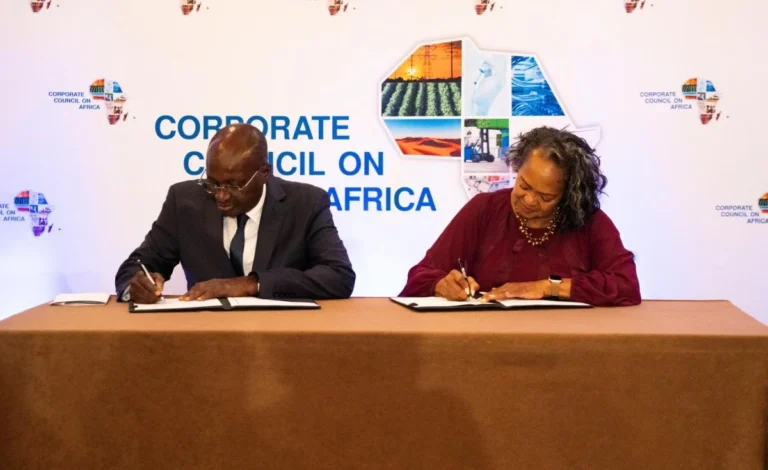
New York City served as the backdrop for a significant shift in the landscape of U.S.-Africa economic relations this week, as the Corporate Council on Africa (CCA) officially designated the Republic of Côte d’Ivoire as the host nation for its 2027 U.S.-Africa Business Summit. The announcement, made during the high-stakes atmosphere of the 81st United Nations General Assembly at The Westin New York at Times Square, signals a deliberate pivot toward strengthening commercial corridors between the United States and the Francophone West African economic powerhouse.
This selection represents a strategic milestone for the CCA, marking the first time its flagship summit will be hosted in a French-speaking West African nation. By choosing Abidjan, the organization is acknowledging the shifting gravity of African markets, where rapid urbanization, digital transformation, and regional trade integration are creating a fertile environment for American capital and expertise.
A Chronology of Economic Diplomacy
The U.S.-Africa Business Summit has evolved from a niche diplomatic gathering into one of the most influential platforms for private-sector engagement on the continent. The decision to move the summit to Côte d’Ivoire in 2027 follows a well-established trajectory of recent host cities that highlight the diversity of the African business landscape:
- 2023: Gaborone, Botswana – Focused on the role of democratic stability and sustainable resource management in attracting global investment.
- 2024: Dallas, Texas – Represented a homecoming to a major U.S. commercial hub, emphasizing the role of American cities as launchpads for African trade.
- 2025: Luanda, Angola – Highlighted the importance of infrastructure, energy transition, and large-scale industrial partnerships.
- 2026: Mauritius – Scheduled to focus on financial services, the blue economy, and the role of island nations in regional logistics.
- 2027: Abidjan, Côte d’Ivoire – Set to become the premier venue for West African industrialization and the expansion of the African Continental Free Trade Area (AfCFTA).
The progression of these locations reflects a broader strategic shift: moving away from capital-to-capital dialogue and toward localized, sector-specific deal-making that connects U.S. multinational corporations with regional African hubs.
The Strategic Value of the Ivorian Market
Côte d’Ivoire is not merely a symbolic host; it is an economic engine. As one of the largest and most resilient economies in the West African Economic and Monetary Union (WAEMU), the nation has maintained robust growth rates even in the face of global economic headwinds. Its strategic location, supported by the Port of Abidjan—one of the most modern and busiest ports in West Africa—makes it a natural logistics hub for the sub-region.
The 2027 Summit is expected to focus on critical sectors that align with both Ivorian national development goals and U.S. investment priorities:
- Agribusiness: Leveraging Côte d’Ivoire’s status as a global leader in cocoa and cashew production, with an emphasis on value-added processing.
- Infrastructure and Energy: Expanding the national grid and leveraging public-private partnerships for transport networks.
- Digital Economy: Capitalizing on Abidjan’s growing reputation as a regional technology and fintech center.
- Healthcare: Building on recent regional initiatives to modernize medical supply chains and hospital infrastructure.
The Shift from Dialogue to Deal-Making
Florizelle Liser, President and CEO of the Corporate Council on Africa, has been a vocal proponent of moving the summit’s objective from high-level rhetoric to tangible commercial results. The success of the 2025 Luanda summit, which facilitated more than $4 billion in business deals and investment commitments, serves as a blueprint for the 2027 gathering.
"The opportunity is not simply to talk about the potential of U.S.-Africa trade and investment, but to put companies in the room where partnerships can actually happen," Liser remarked during the announcement. The 2027 program is designed to facilitate this, with a four-day agenda packed with B2B (business-to-business) and B2G (business-to-government) sessions. These structured interactions are intended to lower the barrier to entry for American firms looking to navigate the regulatory and operational complexities of the West African market.
Official Perspectives and Regional Implications
H.E. Tiémoko Meyliet Koné, Vice President of the Republic of Côte d’Ivoire, underscored the government’s readiness to facilitate this international influx. "Hosting the U.S.-Africa Business Summit is an opportunity to demonstrate that Côte d’Ivoire is not only open for business but positioned to serve as a gateway to one of the world’s most dynamic markets," Koné stated.
The Ivorian government views the summit as a catalyst to boost Foreign Direct Investment (FDI). By showcasing the country’s legal reforms, improving business climate, and ongoing commitment to infrastructure development, Abidjan hopes to position itself as the primary alternative to more traditional regional hubs, offering a more integrated and accessible market for U.S. investors.
Analyzing the Economic Impact
The implications of this summit extend beyond the borders of Côte d’Ivoire. For U.S. firms, the event offers a unique vantage point into the AfCFTA, the world’s largest free trade area by number of countries. As tariffs are reduced and regional trade standards are harmonized, American companies that establish a foothold in Côte d’Ivoire today will be well-positioned to access a unified African market of over 1.3 billion people.
However, challenges remain. Skeptics of such large-scale summits often point to the "implementation gap"—the period between signing a Memorandum of Understanding (MoU) at a conference and seeing actual ground broken on a project. To bridge this, the CCA has increasingly prioritized technical workshops, policy advocacy, and risk-mitigation discussions that go beyond the flash of the main stage.
Broader Context: The U.S.-Africa Commercial Relationship
The U.S. government has been intensifying its efforts to deepen economic ties with Africa through initiatives like Prosper Africa and the U.S.-Africa Leaders Summit. The CCA’s work complements these government-led initiatives by providing the private sector with a platform to voice concerns regarding market access, capital repatriation, and regulatory transparency.
The choice of Abidjan also reflects the evolving linguistic and cultural diplomacy of trade. By moving into the Francophone space, the CCA is actively diversifying its reach and ensuring that the "new chapter" of the U.S.-Africa commercial relationship is truly continental in scope.
Looking Toward 2027
As the global business community navigates a period of uncertainty, characterized by geopolitical shifts and the need for energy security, the 2027 U.S.-Africa Business Summit presents a unique value proposition. It offers a structured environment for long-term capital to find reliable, high-growth partners.
For now, the focus shifts to the preparatory phase. Stakeholders in both Washington and Abidjan are expected to begin the multi-year process of policy alignment and project identification. While dates and specific venue details are yet to be disclosed, the intent is clear: to transform the economic partnership between the United States and Africa from a narrative of potential into a reality of sustained, shared prosperity.
The Corporate Council on Africa, with its three-decade history of facilitating these connections, remains the central coordinator for this endeavor. For businesses and government agencies looking to participate, the 2027 summit in Abidjan represents the next critical milestone in a decade of profound transformation for U.S.-Africa trade relations.