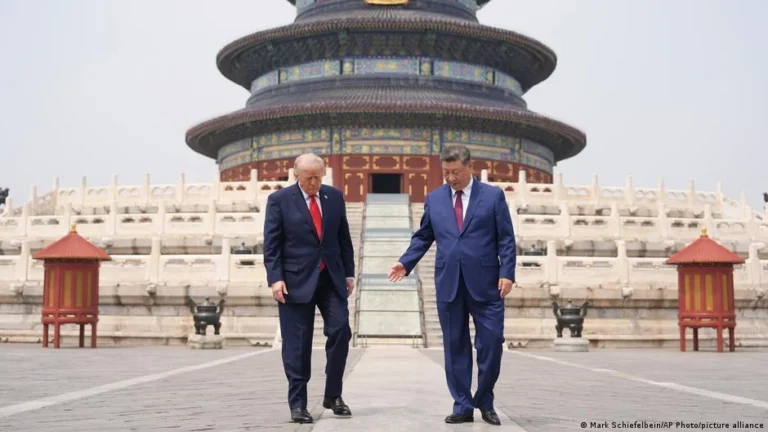
In the corridors of power from Düsseldorf to Washington, a profound shift in the global economic architecture is underway, characterized by an entrenched strategic stalemate between the United States and China and the emergence of a "variable geometry" diplomacy among middle powers. Last week’s economic dialogue in Germany served as a microcosm of this tension, where European and Chinese business leaders grappled with the reality that their trade relationship is increasingly dictated by the gravitational pull of US-China geopolitical rivalry. As President Donald Trump and President Xi Jinping prepare for high-stakes deliberations in Washington, the global community watches, aware that the traditional post-WWII order is fraying under the pressure of protectionism, technological competition, and a re-evaluation of sovereignty.
A Chronology of Escalation and Stagnation
The current atmosphere of mistrust is the culmination of years of deteriorating relations, defined by a series of failed diplomatic resets. The trajectory of this rivalry can be traced through key milestones that have dismantled the era of unfettered globalization:
- 2001: China’s accession to the World Trade Organization (WTO), which initiated the "first China shock," characterized by the rapid integration of Chinese manufacturing into global supply chains.
- 2018–2024: The onset of the US-China trade war, marked by tit-for-tat tariff escalations and the systematic decoupling of critical technology sectors.
- May 2026: A Beijing summit between Xi and Trump concludes without a joint communiqué or significant policy breakthroughs, solidifying the perception of a diplomatic impasse.
- September 2026: Tensions peak as the US continues to enforce stringent export controls on high-performance semiconductors, while Beijing restricts the flow of rare earth elements, effectively weaponizing the building blocks of the digital economy.
The upcoming Washington summit is viewed by analysts not as a precursor to a grand bargain, but as a management exercise in "strategic containment." As Mikko Huotari, director of the Berlin-based think tank MERICS, suggests, both leaders are operating under the assumption that the other is a permanent adversary. "Xi really doesn’t need a breakthrough in Washington," Huotari noted during a recent briefing. "He needs time. And the same is true for Washington. We have this strategic stalemate situation, which is the best description of what we see currently."
The AI Frontline: Guardrails vs. Dominance
Central to the current friction is the battle for supremacy in artificial intelligence. This is no longer merely a trade dispute; it is a competition for existential technological superiority. The US government’s prohibition on high-performance chip exports to China—designed to hobble Beijing’s ability to train advanced AI models—has been met with Chinese restrictions on rare earth minerals, which are essential for everything from semiconductor fabrication to electric vehicle (EV) batteries.
There is a burgeoning, albeit fragile, hope that the two powers might find common ground on AI safety. Treasury Secretary Scott Bessent, following discussions with Chinese Vice Premier He Lifeng in New York, confirmed that both nations have explored a "notification mechanism" to share information regarding AI-related security incidents. However, the ideological chasm remains wide. While Xi Jinping has publicly advocated for international cooperation on AI development, the Trump administration views any form of regulation as a potential handicap to American technological hegemony. The outcome of these discussions will likely determine whether AI becomes a field of managed competition or an unbridled arms race.
The Second China Shock: Europe’s Industrial Crisis
For the European Union, the economic landscape is increasingly fraught. European Commission President Ursula von der Leyen, in her 2026 State of the Union address, characterized the current situation as a "second China shock." Unlike the first, which flooded global markets with consumer goods, this iteration focuses on high-tech dominance in battery technology, green energy, and e-mobility.
The economic implications for the EU are stark. Brussels is currently balancing the need for a rapid green transition—which requires affordable Chinese-made components—against the pressure to protect European industrial heartlands from deindustrialization. The EU’s consideration of punitive tariffs on Chinese electric vehicles has met with fierce resistance from German automotive giants, including Volkswagen and BMW, who fear that retaliatory measures from Beijing would effectively shut them out of their most profitable growth market.
"China’s economy is currently facing significant structural headwinds," a Chinese executive with experience in state-owned enterprises remarked on condition of anonymity at the Düsseldorf summit. "Domestic consumption is insufficient to absorb the output of our manufacturing sector. Our firms are desperate to tap into foreign markets, and they are willing to price aggressively to do so."
The Rise of Variable Geometry Diplomacy
In response to the volatile nature of the US-China conflict, middle powers are increasingly adopting what Canadian Prime Minister Mark Carney calls "variable geometry"—a flexible approach to foreign policy that prioritizes national interest over traditional, rigid bloc alignments. The strategy is simple: if middle powers negotiate only with hegemons, they do so from a position of weakness.
Canada’s recent pivot provides a blueprint for this new diplomacy. By engaging in a "new-era strategic partnership" with China and drastically reducing tariffs on Chinese EVs, Ottawa has demonstrated a willingness to hedge against the unpredictable protectionism of the Trump administration. This has not gone unnoticed in Washington; Trump has publicly disparaged the potential for an EU-Canada associate membership, threatening "very serious tariffs" on any nation that deviates from the US-led economic orbit.
However, the middle powers appear undeterred. As Carney emphasized at the 2026 World Economic Forum, "If we’re not at the table, we’re on the menu." This sentiment is gaining traction across the G20. China, sensing an opportunity to exploit the fissures between the US and its allies, has launched a "charm offensive" toward nations that feel marginalized by Washington’s demands for total loyalty. From Xi’s attendance at the BRICS summit in India to China’s hosting of the upcoming G-20 summit, Beijing is positioning itself as an alternative pole of gravity for states looking to avoid the binary traps of the new Cold War.
Implications for the Global Order
The geopolitical landscape of late 2026 is defined by a paradox: while the world is more economically interconnected than ever, the political will to maintain that interconnection is evaporating. The implications of this are manifold:
- Fragmentation of Standards: As the US and China move toward separate technological ecosystems, global standards for everything from data privacy to AI ethics may bifurcate, forcing nations to choose between "technological zones."
- Inflationary Pressure: The shift toward reshoring and "friend-shoring" supply chains is inherently inflationary. As manufacturing leaves low-cost jurisdictions for higher-cost domestic environments, the era of cheap consumer goods—a cornerstone of the post-2000 economic order—may be coming to an end.
- The Crisis of Multilateralism: Institutions like the WTO, designed to mediate trade disputes, are increasingly bypassed by bilateral power plays. If the US and China cannot find a framework for coexistence, the ability of smaller nations to leverage international law to protect their interests will diminish significantly.
As the Washington summit approaches, the rhetoric from both sides remains uncompromising. Whether these talks produce a meaningful de-escalation or merely confirm the permanence of the strategic stalemate, the global economy is clearly in the midst of a historic realignment. The "old order" is not returning, and as Prime Minister Carney noted, mourning its departure is a luxury that middle powers can no longer afford. The future belongs to those capable of navigating the complex, overlapping, and often conflicting interests of a world no longer anchored by a single hegemon, but rather pulled by the competing gravity of two superpowers, with the middle powers frantically attempting to carve out a path of sovereignty in between.