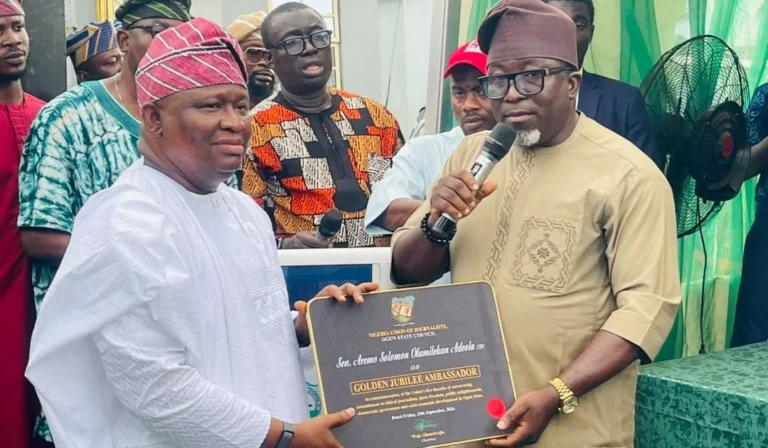
In a significant political development ahead of the 2027 general election, Senator Solomon Adeola, the All Progressives Congress (APC) governorship candidate for Ogun State, has formally unveiled a comprehensive policy blueprint aimed at reshaping the state’s socio-economic landscape. During a high-profile courtesy visit to the Nigerian Union of Journalists (NUJ) Ogun State Council at the Iwe Iroyin Press Centre in Abeokuta on Friday, the senator—widely known as "Yayi"—framed his campaign platform not merely as a series of political promises, but as a binding "covenant" with the electorate.
The proposed agenda, which focuses heavily on industrialization, infrastructure, and institutional reform, aims to address the state’s most pressing challenges, specifically the high rate of youth unemployment and the need for localized governance. By prioritizing fiscal transparency and structural modernization, Senator Adeola is positioning his potential administration as a bridge between the current momentum in the state’s internally generated revenue and a future of decentralized, technology-driven development.
A Chronology of Policy Intent
Senator Adeola’s visit to the press center marks a strategic shift in the gubernatorial race, signaling an early transition from political mobilization to policy-based campaigning. The senator, who currently chairs the Senate Committee on Appropriations, brings extensive experience in public finance to the table. His legislative background includes serving as the chairman of the finance and appropriations committees at both the state and federal levels, providing him with a unique vantage point on the mechanics of budget implementation and fiscal oversight.
The "covenant" document outlines a clear timeline for implementation. Key milestones include:
- First 6 Months: Launch of the primary Youth Enterprise Hub in Abeokuta.
- 2027–2028: Implementation of full local government financial autonomy in compliance with the 2024 Supreme Court ruling.
- 2031: Targeted completion of digital training for 100,000 youths and the attainment of a 40 percent reduction in youth unemployment.
- Long-term: Development of the 200-kilometer Coastal Energy Corridor and the establishment of the Olokola Deep Seaport.
Addressing the Unemployment Crisis
At the heart of the senator’s platform is a bold commitment to economic empowerment. Current labor statistics indicate that approximately one in four young Nigerians between the ages of 15 and 24 remains unemployed, a figure that remains a critical concern for the state’s social stability. Adeola’s plan to create 500,000 jobs relies on a multi-pronged approach: the modernization of the agricultural sector through mechanization, the promotion of artisanal mining, and the stimulation of a digital economy.
The proposed "OgunRide" initiative serves as a cornerstone of this job creation strategy. By formalizing the transport sector—which currently employs thousands in the informal economy—the administration intends to integrate drivers into a structured system that provides vehicle financing, health insurance, and cooperative support. This formalization is expected to not only boost the tax base but also improve the livelihoods of thousands of families across the state’s major urban corridors, including Abeokuta, Sango-Ota, and Sagamu.
The Mandate of Local Government Autonomy
Perhaps the most legally significant aspect of Adeola’s proposal is his explicit pledge to enforce the 2024 Supreme Court judgment regarding local government autonomy. For decades, the relationship between state governments and local councils in Nigeria has been fraught with disputes over the management of state-joint accounts. By promising that allocations will flow directly to the 20 local government areas without state-level interception, Adeola is signaling a departure from the traditional centralized governance model.
"Government that cannot be felt where people live is not government at all," Adeola remarked during the press event. Analysts suggest that if fully implemented, this policy would represent a landmark change in how public services—such as primary healthcare, market management, and sanitation—are delivered at the grassroots level. It effectively shifts the burden of performance directly onto local chairmen, necessitating a higher degree of accountability and administrative competence at the ward level.
Infrastructure and Energy Development
Senator Adeola’s infrastructure plan is characterized by a focus on high-growth corridors. Recognizing the congestion issues in the Lagos-Ogun axis, he has proposed a partnership with the Nigerian Railway Corporation to establish a commuter rail network connecting Abeokuta to Lagos. This is expected to facilitate the seamless movement of labor and goods, effectively integrating the state deeper into the Lagos economic hub.
Beyond urban mobility, the senator’s vision for the Ogun Waterside and Tongeji Island represents a significant industrial play. By leveraging the state’s natural resources, specifically through the creation of a Solid Minerals Development Company, the administration hopes to facilitate licensed exploration and formalize the activities of artisanal miners. The "200-kilometer Coastal Energy Corridor" is envisioned as a long-term economic catalyst that could redefine the state’s maritime and energy potential, provided the projects are managed with the transparency the candidate has promised.
Institutional Reforms and Fiscal Responsibility
While Adeola has been critical of structural inefficiencies, he maintained a balanced tone regarding the current administration’s progress. He acknowledged the incumbent government’s efforts in growing the state’s internally generated revenue (IGR) between 2021 and 2024. His proposed "Single Window Revenue Collection System" is intended to build upon this foundation, aiming to integrate disparate tax systems—including PAYE, levies, and land fees—to achieve a 40 percent increase in IGR by 2031.
This fiscal rigor extends to the state’s asset management. The senator proposed an immediate audit and valuation of underutilized public lands and industrial parks. The intent is to shift from static asset ownership to active commercialization, ensuring that government property generates revenue for the state rather than serving as a liability.
Healthcare, Education, and Environmental Sustainability
The "Clean Ogun Initiative" represents a major push toward public health and environmental hygiene. By introducing licensed private operators for door-to-door waste collection and investing in waste-to-energy technology, the candidate aims to address the persistent challenges of improper waste disposal. This is complemented by an ambitious health goal: the enrollment of two million residents in the "Ilera D’ero" health insurance scheme.
In the education sector, the focus remains on closing the skills gap. By prioritizing technical and vocational training, the administration aims to align the educational curriculum with the demands of the modern industrial sector. This, paired with the promise to revitalize primary healthcare facilities and support the welfare of health workers, suggests an administration focused on human capital development as a prerequisite for sustained economic growth.
Implications and Public Expectations
The reaction from the media and the public to Adeola’s "covenant" has been one of cautious optimism. By inviting journalists to hold him accountable on a "page by page" basis, the senator has set a high bar for his potential term in office. This level of transparency is rare in regional politics and underscores a desire to build institutional trust.
However, the implementation of such a broad program faces significant hurdles, including the complexities of inter-agency cooperation, the volatility of the national economy, and the necessity of legislative support. The success of the "covenant" will depend largely on the candidate’s ability to maintain a collaborative relationship with the state’s diverse stakeholders, from traditional rulers to the private sector and the civil service.
As the 2027 election cycle approaches, Senator Adeola’s platform serves as a benchmark for the discourse on governance in Ogun State. Whether the "covenant" will transition from a campaign document to a reality remains to be seen, but the proposal has undeniably shifted the conversation toward specific, measurable, and time-bound commitments. For the people of Ogun State, the promise of a more autonomous, technologically advanced, and economically robust future is a prospect that will likely dominate the political debate for the coming years.