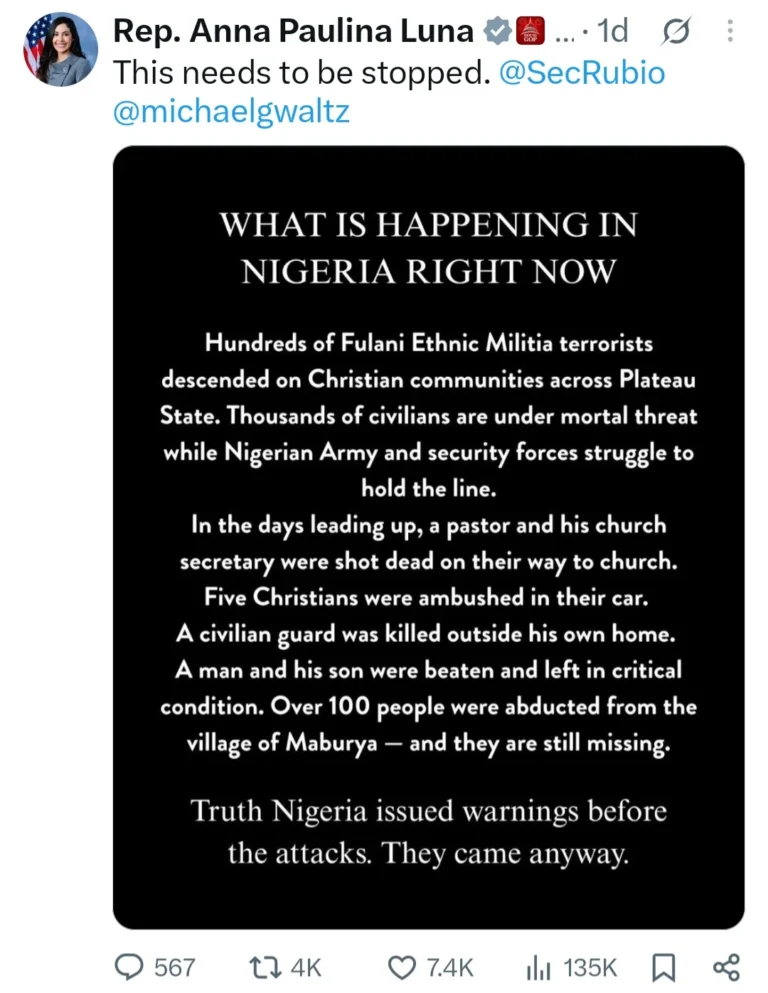
The humanitarian crisis in Nigeria’s Plateau State has garnered international attention following a strongly worded statement from United States Representative Anna Paulina Luna. On Friday, September 25, the Florida congresswoman utilized her verified X (formerly Twitter) account to sound a global alarm regarding what she characterized as a systematic campaign of violence targeting Christian communities. Her intervention, titled "What is happening in Nigeria right now?", underscores a growing concern among international observers regarding the security architecture in Nigeria’s Middle Belt, where ethnic, religious, and socio-economic tensions have frequently manifested in lethal conflict.
Representative Luna’s statement detailed a series of harrowing incidents, alleging that Fulani ethnic militia and Islamist extremists are responsible for an incessant pattern of attacks. She expressed deep skepticism regarding the efficacy of the Nigerian state and federal government’s response, questioning why security alerts provided to authorities prior to these violent episodes appear to have been disregarded. Her public critique serves as a stark reminder of the persistent security challenges that continue to plague the Plateau region, a state historically known for its diverse demographic composition and its susceptibility to localized communal violence.
The Anatomy of the Conflict in Plateau State
To understand the gravity of the allegations raised by Representative Luna, it is necessary to examine the historical and socio-political context of Plateau State. Located in the Middle Belt of Nigeria, the state has long served as a microcosm of the country’s broader ethnic and religious fault lines. The conflict is frequently described as a multifaceted struggle involving indigenous agrarian communities and nomadic herders, often complicated by religious identity.
In recent years, the nature of these attacks has evolved. While land disputes and the competition for water and grazing resources were once the primary drivers of localized skirmishes, the emergence of armed non-state actors has introduced a more lethal dimension. Analysts point to the proliferation of small arms and the encroachment of extremist ideologies as factors that have exacerbated the mortality rate of these encounters. The "Middle Belt" region, of which Plateau is a central part, has recorded thousands of casualties over the past decade, leading many international human rights organizations to classify the situation as a burgeoning humanitarian emergency.
Chronology of Recent Escalations
Representative Luna’s report highlights a chilling series of targeted attacks that have left local communities in a state of terror. Her account includes specific instances of violence that underscore the vulnerability of the civilian population:
- Targeted Clergy Attacks: The report documents the killing of a pastor and his church secretary, who were ambushed while traveling to a religious service. This incident has been viewed by observers as a direct attempt to destabilize communal leadership.
- Targeted Ambush: The assault on five Christians traveling in a private vehicle serves as evidence of the mobility of the armed groups operating in the region.
- Home-based Violence: The killing of a civilian guard outside his residence, coupled with the brutal beating of a father and his son, illustrates the pervasive reach of these militias into the private lives of Plateau residents.
These events are not isolated; they represent a continuum of violence that has intensified throughout the 2024 calendar year. According to local monitoring groups, the frequency of these attacks has increased in rural districts surrounding the state capital, Jos, placing significant strain on local healthcare facilities and the regional economy.
Assessing the Security Response
Central to Representative Luna’s critique is the perceived inaction or inability of Nigerian security forces to mitigate these threats. The Nigerian Army and the Nigeria Police Force have maintained a consistent presence in the state, often operating under the umbrella of specialized task forces like Operation Safe Haven. However, critics, including the U.S. Representative, argue that the reactive nature of these security operations is fundamentally flawed.
The core of the criticism lies in the intelligence-to-action pipeline. Reports from civil society organizations in Plateau State frequently allege that communities often receive advanced warnings of impending attacks through local intelligence networks. When these alerts are communicated to the relevant security authorities, the absence of a proactive deployment often results in devastating consequences. This gap between the receipt of intelligence and the execution of protective measures has led to a collapse in public trust between the citizenry and the state security apparatus.
Data and Humanitarian Impact
The data emerging from the region is sobering. According to the Armed Conflict Location & Event Data Project (ACLED), the Middle Belt region has seen a steady uptick in fatalities linked to communal violence. While specific death tolls for the most recent period are difficult to verify independently due to the remoteness of some villages, local reports suggest that thousands have been displaced, creating an internal refugee crisis.
The economic implications are equally severe. Plateau State is a significant agricultural hub. When farmers are forced to abandon their lands due to fear of violence, the regional food supply chain is disrupted, leading to increased food insecurity and inflationary pressure on basic commodities. The displacement of families also puts immense pressure on urban centers, where displaced populations often lack adequate shelter, sanitation, or access to education for their children.
Official Reactions and International Perspectives
While the Nigerian government has historically maintained that it is working to neutralize all security threats, the international community is becoming increasingly vocal. The U.S. State Department has, in previous years, placed Nigeria on watchlists regarding religious freedom, citing the need for the government to take more aggressive action against extremist groups.
The involvement of a sitting U.S. Representative in the discourse surrounding Plateau State signals a potential shift in how the international community approaches the Nigerian security dilemma. By elevating these concerns to the legislative level in Washington, D.C., Representative Luna is effectively pressuring the U.S. executive branch to reconsider its diplomatic and security assistance policies toward the Nigerian government. If the U.S. conditions future security aid on measurable improvements in the protection of vulnerable communities, the Nigerian administration may face significant diplomatic pressure to restructure its internal security strategy.
Implications for Future Stability
The situation in Plateau State is a litmus test for the Nigerian federal government’s commitment to the rule of law and the protection of its citizens, regardless of their religious or ethnic background. The failure to curb these attacks could lead to a cycle of reprisal violence, which has historically proven difficult to contain once it begins.
Furthermore, the persistent nature of the attacks suggests that traditional military tactics—such as checkpoints and mobile patrols—may be insufficient against militias that utilize guerrilla warfare techniques. Experts suggest that a more comprehensive approach is required, one that includes:
- Community-Based Intelligence: Investing in trust-building measures between security forces and local villagers to ensure that early warning signs are acted upon immediately.
- Judicial Reform: Ensuring that those arrested for participating in these militias are prosecuted effectively, thereby ending the cycle of impunity.
- Socio-Economic Development: Addressing the underlying competition for land by modernizing agricultural practices and establishing clear legal frameworks for land ownership and grazing rights.
Conclusion
The statement issued by Representative Anna Paulina Luna serves as an urgent call for transparency and accountability. As the international community watches, the Nigerian government faces a critical juncture. The protection of Christian communities in Plateau State is not merely a regional security matter; it is a fundamental human rights issue that carries significant weight in global diplomatic circles.
Whether this intervention leads to concrete changes in security operations remains to be seen. However, the documentation of these incidents has ensured that the plight of the residents of Plateau State will not be ignored by the international stage. As the violence continues to threaten the fabric of the region, the focus will remain on whether the state and federal authorities can restore order, provide justice for the victims, and ultimately, guarantee the safety of all Nigerian citizens. The coming months will be decisive in determining whether the current security trajectory can be reversed or if the region will continue to descend into further instability.