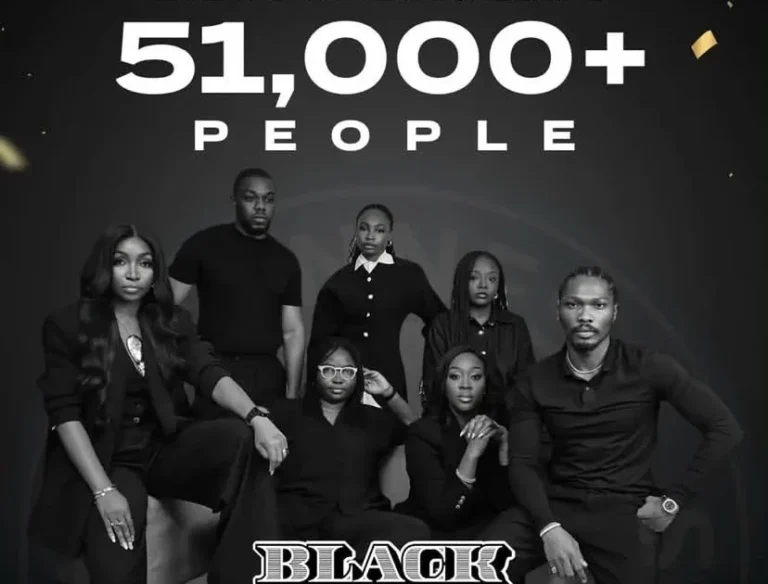
Lagos, Nigeria — In a landmark achievement that underscores the exponential global growth and cultural dominance of Nigeria’s film industry, Nollywood has officially rewritten the record books. On a Saturday evening filled with electric anticipation, more than 51,000 movie enthusiasts converged upon the historic Tafawa Balewa Square (TBS) in Lagos to witness a single screening of the high-stakes crime thriller, Black Market. The monumental gathering has been officially certified by Guinness World Records (GWR) as the largest audience ever assembled for a movie screening at a single location, obliterating previous benchmarks and cementing a historic milestone for African cinema.
The confirmation illuminated the massive screens at the venue on Saturday night, prompting roaring celebrations among the tens of thousands of attendees who braved long queues and massive crowds to be part of the record-breaking attempt. The event, which successfully married public spectacle with cinematic art, not only achieved its ambitious target of mobilizing over 50,000 people but also showcased the formidable organizational capacity, cultural pull, and economic weight of the Nigerian entertainment ecosystem.
Chronology of a Record-Breaking Evening
The path to breaking the global record was meticulously planned, featuring a tightly choreographed schedule that began hours before the official screening. Organizers, working in tandem with multiple stakeholders, designed the event to accommodate tens of thousands of attendees safely and efficiently.
Gates to the sprawling Tafawa Balewa Square officially swung open at 2:00 p.m. local time, immediately drawing a steady influx of eager film lovers. By 3:00 p.m., the venue transitioned into a vibrant red-carpet session, where celebrities, influencers, and dignitaries walked the path amidst flashing cameras and roaring fan adoration.
As the afternoon rolled into evening, the scale of the turnout became increasingly apparent. Long, winding queues stretched far beyond the perimeter of the venue, extending all the way toward the iconic TBS roundabout as crowds continued to pour in. To keep the massive audience engaged before the main feature, the venue transformed into a festival of sorts. Attendees were treated to live music performances, interactive gaming stations, and diverse culinary offerings from various food vendors, turning a standard movie night into a massive cultural celebration.
As the sun set over the Lagos skyline, anticipation reached a fever pitch. Dignitaries, including the Deputy Governor of Lagos State, Obafemi Hamzat, arrived at the venue around 8:50 p.m. to show state-level support for the monumental undertaking. The main screening of Black Market was scheduled to run between 7:00 p.m. and 8:30 p.m., anchoring the night’s festivities and culminating in the dramatic announcement that history had indeed been made.
Inside Black Market: Plot, Production, and Star-Studded Cast
The record-breaking screening was not merely a numbers game; it served as the grand showcase for a gritty, emotionally charged cinematic production. Black Market is a collaborative product of Rixel Studios, Signet Ring Studios, and FilmOne Studios, with distribution handled by FilmOne.
The film is directed by acclaimed filmmaker Fatimah Binta Gimsay and produced by Nora Awolowo, two creative forces known for narrative depth and visual precision. Written to reflect contemporary socio-economic realities, the crime thriller dives headfirst into the struggles of ordinary citizens pushed to the brink.
The plot centers on five market women who find themselves entangled in a perilous cross-border smuggling operation. Operating against the suffocating backdrop of fuel scarcity and intense economic pressure, the characters make desperate choices in a bid for survival. The narrative takes a harrowing and dramatic turn when the daughter of one of the women is kidnapped, plunging the group into a high-stakes crisis that tests their loyalty, morality, and resilience.
The cinematic weight of the film is carried by an ensemble cast of Nollywood heavyweights and rising stars. The production features stellar performances from Omowunmi Dada, Lateef Adedimeji, Linda Ejiofor-Suleiman, Scarlet Gomez, Teniola Aladese, Susan Pwajok, Ibrahim Yekini (widely known as Itele D Icon), and Uzor Arukwe, among others. Their collective performances have been praised for grounding the high-octane plot in authentic emotional resonance.
Official Reactions and Industry Triumphs
Following the confirmation of the record by the on-site GWR adjudicator, the official distribution partner, FilmOne, released an ecstatic statement across its digital and social media platforms. The declaration captured the collective euphoria of the cast, crew, and the Nigerian public.
"51,000+ people. One screen. One moment that just made history," FilmOne stated in their official social media release. "We’ve officially set a WORLD RECORD for the Largest Audience Gathering Ever for a Movie Screening. Nigeria, we didn’t just watch a movie. WE MADE HISTORY."
The scale of the event required robust institutional backing. The Lagos State Government played a pivotal role in ensuring the success and security of the gathering, extending support through the Ministry of Tourism, Arts and Culture. This public-private synergy highlights how government bodies in Nigeria are increasingly recognizing the creative economy as a vital driver of tourism, job creation, and international prestige. Numerous corporate partners also lent their weight to the production and logistics, ensuring that the massive infrastructure required for an audience of that magnitude operated seamlessly.
Broader Impact and Economic Implications
The successful execution of the Guinness World Record attempt for Black Market carries profound implications for the African film industry. For years, Nollywood has commanded massive domestic viewership and a rapidly expanding global diaspora audience, largely propelled by streaming platforms and international theatrical releases. However, staging a physical gathering of over 51,000 people for a single local film screening redefines the commercial boundaries of African cinema.
Industry analysts note that this feat demonstrates the untapped potential of event-driven cinema in emerging markets. By transforming a traditional movie-watching experience into an immersive public festival, the organizers have mapped out a new blueprint for audience engagement and marketing in the region. Furthermore, the global visibility generated by a Guinness World Record title places Nollywood firmly in the international spotlight, attracting potential foreign co-producers, global distributors, and institutional investors looking to tap into Africa’s booming creative economy.
As the echoes of the celebration at Tafawa Balewa Square fade, the historic night remains a watershed moment. Black Market has proven that Nigerian stories, when told with authenticity and backed by ambitious execution, possess the undeniable power to unite tens of thousands of people under a single screen—and capture the attention of the entire world.