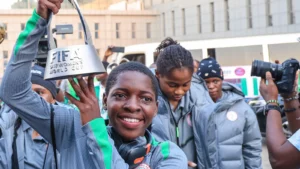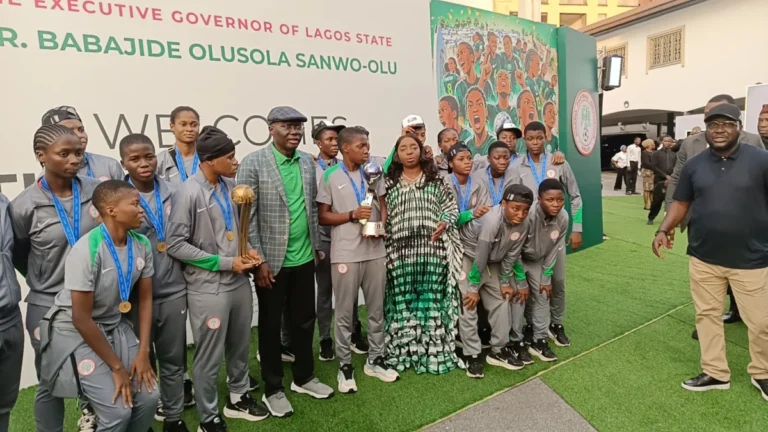
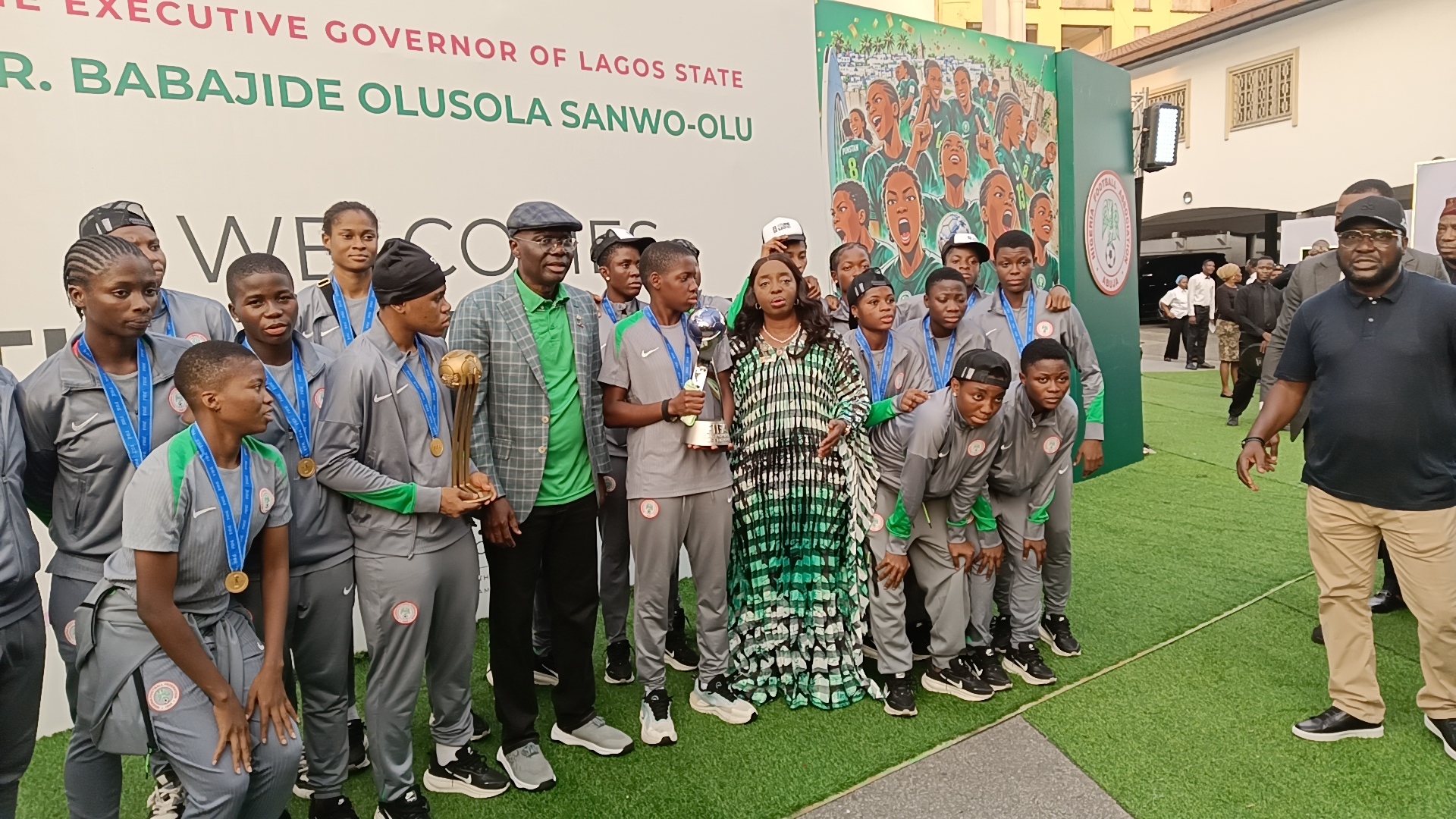
Lagos State Governor Babajide Sanwo-Olu has officially announced a landmark financial reward of N300 million for Nigeria’s U-17 women’s national football team, the Flamingos, following their historic and unprecedented triumph at the 2026 FIFA U-17 Women’s World Cup in Morocco. The announcement, made during a celebratory reception at the Lagos House in Marina, serves as a significant gesture of state recognition for a squad that has etched its name into the annals of global sporting history as the first African nation to ever lift the prestigious trophy.
Under the comprehensive incentive package unveiled by the Governor, each player and member of the technical coaching crew is set to receive a direct cash disbursement of N10 million. Beyond the monetary reward, the state government has provided each individual with high-end technology kits, including the latest iPhone models and premium headphones, signaling an effort to blend financial empowerment with modern, lifestyle-oriented recognition for these young athletes.
A Historic Run to Continental and Global Glory
The journey of the Flamingos in the 2026 tournament was nothing short of cinematic, characterized by resilience and tactical brilliance. Their path to the final in Rabat was fraught with early challenges that tested the team’s mental fortitude. After a rocky start that saw the team suffer a 2-1 defeat to Poland in their opening match, the squad demonstrated extraordinary character, bouncing back to secure six consecutive victories against formidable global opponents.
The road to the championship saw the Flamingos dismantle various football powerhouses. During the group stage, they overcame Puerto Rico and the defending champions, Korea DPR, before advancing to the knockout stages. Their dominance continued with clinical performances against Mexico and Venezuela. In the semi-finals, the team delivered a masterclass in attacking football, dismantling Brazil with a 3-1 scoreline to secure their spot in the final.
On November 7, 2026, the final match against Japan proved to be the ultimate test. Nigeria seized control early, with Awawu Bashiru netting the opening goal in the 39th minute. The lead was extended shortly after the halftime interval by Oluebube Umejiaku, who was later adjudged the Player of the Match. Despite a late rally by the Japanese side, which saw Fuki Ito score in the 80th minute, the Nigerian defense held firm under immense pressure. The final whistle confirmed a 2-1 victory, sparking nationwide celebrations and confirming Nigeria’s status as a burgeoning superpower in women’s football.
A Wave of National Recognition and Financial Incentives
The N300 million reward from the Lagos State Government follows a series of high-profile acknowledgments from the Federal Government and legislative bodies. Earlier in November, President Bola Tinubu hosted the team at a reception in Abuja, where he announced a federal support package including a N100 million Federal Government Savings Bond for each player.
In addition to the squad’s individual rewards, Head Coach Akeem Ishola Busari was granted a personal cash award of N100 million, while members of the technical crew were allocated N50 million each. These announcements, communicated on behalf of the President by the First Lady, Oluremi Tinubu, underscore the high level of political and social capital currently being invested in the women’s game. Furthermore, the Nigerian Senate has pledged a N100 million contribution, demonstrating a rare cross-branch consensus on the importance of celebrating this sporting achievement.
Contextualizing the Investment in Women’s Football
The influx of capital into the Flamingos’ camp raises pertinent questions regarding the future of women’s football in Nigeria. While the current windfall is being celebrated, industry analysts emphasize that these rewards should act as a catalyst for systemic reform. For years, women’s football in Nigeria has faced challenges ranging from inconsistent domestic league structures to the need for better grassroots scouting networks.
The success of the 2026 Flamingos is not an isolated event but rather the culmination of years of talent development. By winning the U-17 World Cup, Nigeria has effectively validated the "catch them young" approach. However, the transition from the U-17 level to the senior Super Falcons squad remains a critical bottleneck. Stakeholders are now calling for a portion of these resources to be redirected toward the sustainable development of the Nigeria Women Football League (NWFL) and the establishment of dedicated high-performance centers that can accommodate the physiological and tactical needs of young female players.

Economic and Social Implications
The rewards provided by Governor Sanwo-Olu and the Federal Government go beyond simple bonuses; they represent an economic lifeline for many of the players who come from humble backgrounds. By providing financial security, the government is enabling these young athletes to pursue their education and professional football careers without the immediate pressure of economic instability.
Furthermore, the public nature of these rewards serves a dual purpose: it incentivizes the current generation to strive for excellence and acts as a powerful marketing tool for the girl child. In a country where gender equality in sports has often been a secondary conversation, the Flamingos have shifted the narrative, proving that women’s football can be a primary vehicle for national pride and global branding.
The Technical Evolution of the Flamingos
From a tactical perspective, the 2026 team displayed a level of maturity rarely seen at the U-17 level. Coach Akeem Ishola Busari’s ability to adapt after the opening loss to Poland was pivotal. By tightening the defensive structure and encouraging more fluid transitions in the midfield, the team was able to neutralize the technically gifted Japanese and Brazilian sides.
Data from the tournament shows that Nigeria maintained a high conversion rate throughout the competition, a testament to the quality of the scouting process. The performance of players like Oluebube Umejiaku indicates that the pipeline for the Super Falcons is overflowing with talent. The challenge for the Nigeria Football Federation (NFF) will be to ensure these players are integrated into the senior setup in a way that preserves their development while keeping them exposed to high-level competition.
Sustaining the Momentum
The recent accolades have placed the Flamingos at the center of the national discourse. However, the history of African sports is replete with instances where initial success was followed by stagnation due to a lack of long-term planning. The "This is just the beginning" sentiment voiced by the players reflects a hunger for more, but that hunger requires the support of consistent infrastructure.

Experts suggest that for Nigeria to replicate this success in 2028 and beyond, the following steps are essential:
- Grassroots Expansion: Increasing the frequency of age-grade tournaments across the six geopolitical zones.
- Professionalization: Improving the welfare of players in the domestic league to prevent the "brain drain" of talent to European academies before they are fully developed.
- Governance: Maintaining transparency in the distribution of grants and rewards to ensure that all members of the team—including the often-overlooked support staff—receive their fair share of the national appreciation.
Conclusion: A Legacy in the Making
The N300 million gesture from Lagos State, combined with the federal incentives, sets a new standard for how Nigeria treats its sporting heroes. By prioritizing the Flamingos, the government is not merely paying for a trophy; it is investing in the potential of Nigerian youth. As the celebrations subside and the team returns to their clubs and academies, the focus must shift from the immediate excitement of the prize money to the long-term project of cementing Nigeria’s place at the pinnacle of international women’s football.
The 2026 FIFA U-17 Women’s World Cup will be remembered as the moment the glass ceiling was shattered. For the players, the journey has only just begun. For the nation, the task is now to nurture this generation so that their historic win in Morocco becomes the foundation for a dynasty of success. The Flamingos have proven that with the right support, the talent inherent in Nigerian football is capable of conquering the world, and in doing so, they have provided a blueprint for future generations of athletes to follow.