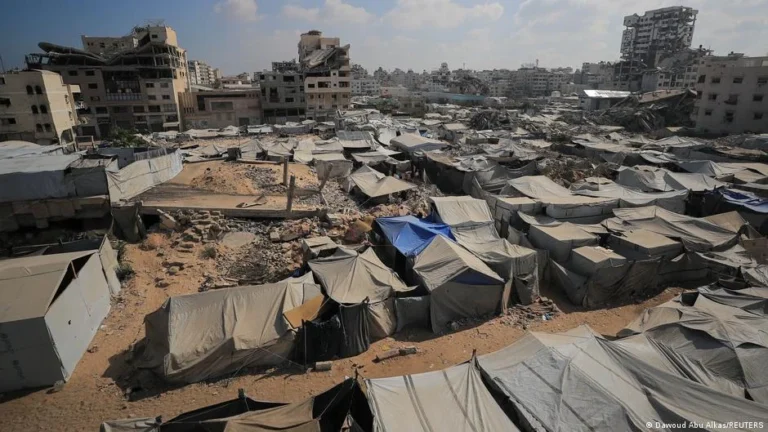
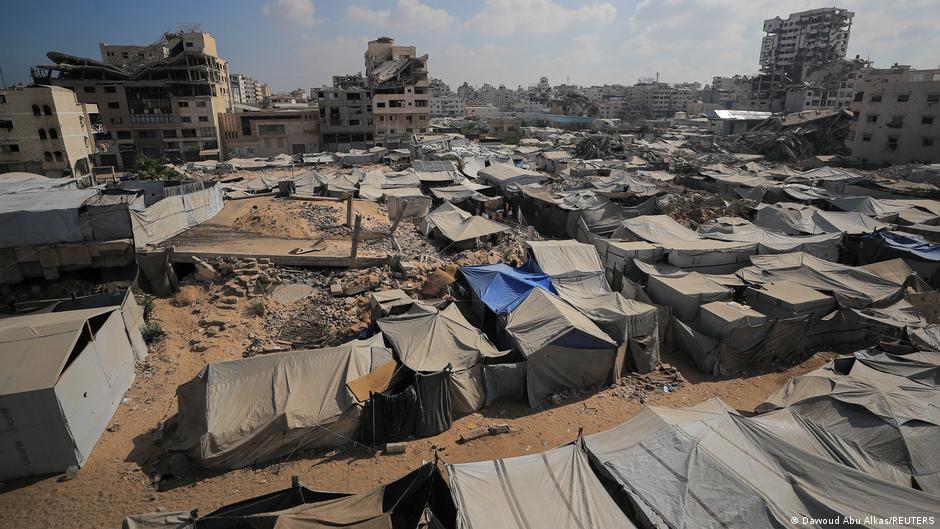
A new report on conditions in the Gaza Strip says that the roughly 1.8 million Palestinians in Gaza, or 86% of the population, living in displacement sites often face inhumane living conditions. The document, published this Thursday by the Danish Refugee Council (DRC), provides a harrowing look at the reality of life in Gaza nearly three years after the October 7, 2023, attacks against Israel ignited the war and one year after the phased October 10, 2025, ceasefire plan was intended to provide a pathway toward stability and the conclusion of hostilities.
The findings, titled "Confined by Design: The Human Cost of Protracted Displacement in Gaza," draw upon intensive group discussions with 195 displaced individuals across five governorates. The report concludes that the ceasefire, while technically active, has failed to alleviate the humanitarian crisis, instead presiding over a period where displacement has transitioned from a temporary emergency measure into a permanent, structural feature of life in the territory.
The Evolution of the Conflict and the Ceasefire Gap
The current situation is deeply rooted in the events of October 2023. Following the initial military escalation, the subsequent months saw massive population shifts, with millions moving from the north to the south and eventually congregating in makeshift tent cities. The October 2025 ceasefire agreement was brokered with the intention of halting combat operations, facilitating the return of displaced persons, and allowing for large-scale reconstruction efforts.
However, the DRC asserts that the ceasefire exists largely in name only. While active kinetic warfare has diminished, the conditions for the civilian population remain dire. The report indicates that the nature of displacement has not ended; rather, it has "changed shape," becoming a state of indefinite confinement. For the 1.8 million people living in these sites, the promise of the ceasefire—that suffering would abate—has remained unfulfilled, as infrastructure remains decimated and basic services are largely non-existent.
The Yellow Line and Territorial Fragmentation
Central to the DRC’s analysis is the emergence and expansion of what is known as the "Yellow Line." This demarcation, established by the Israeli military, separates eastern Gaza—areas bordering Israel—from the rest of the strip. According to the report, this line is not static; it is effectively creeping westward toward the Mediterranean coast.
Alan Moseley, the DRC’s country director for the occupied Palestinian territories, characterized the line as the "defining feature" of the current ceasefire period. By expanding this zone, the Israeli military has effectively sequestered families into approximately 30% of Gaza’s total landmass. This territorial constriction has severe consequences, not only for the density of the population in the remaining "safe" areas but also for the reach of humanitarian aid.
The United Nations and other international monitoring bodies have corroborated the expansion of the Yellow Line. While the Israeli government acknowledges the existence of the line, figures regarding the percentage of territory enclosed vary. Prime Minister Benjamin Netanyahu recently cited the figure as 60%, compared to the 70% estimated by the DRC, while simultaneously confirming that the military intends to maintain and potentially expand these zones as part of its ongoing security strategy.
Humanitarian Access and Operational Constraints
The report highlights a critical logistical failure: the inability of aid organizations to operate within several kilometers of the Yellow Line. The DRC notes that aid workers are frequently blocked by access constraints or security concerns, creating "aid deserts" in areas nearest the boundary.
This restriction is compounded by bureaucratic hurdles regarding the import of goods. Items labeled as "dual-use"—a designation that covers everything from medical supplies and water purification equipment to fuel, pest control chemicals, and rubble removal machinery—are often delayed or denied entry. This creates a cycle where the most vulnerable populations, those living on the fringes of the displacement zones, are the least likely to receive consistent support, leading to a degradation in sanitation, nutrition, and healthcare access.
Life in the Camps: A Study of Systemic Failure
The DRC and the Agricultural Development Association (PARC) paint a bleak picture of the daily existence within the informal tent shelters. With more than eight out of every ten residents of Gaza currently residing in these conditions, the lack of centralized management is a primary driver of the crisis.
According to the report, only 36% of displacement sites have a designated site manager, such as a national NGO, to coordinate essential services. In sites where such management is absent, minor issues—such as a collapsed cesspit, a broken water supply line, or an impassable walkway—often remain unresolved for weeks or months. This lack of structure has direct consequences for public health and safety. The report specifically warns of a sharp rise in domestic violence, which is attributed to the intense overcrowding, the total lack of privacy in makeshift tents, and the deteriorating mental health of adult males who find themselves unable to provide for their families or see a path toward economic recovery.

Official Responses and International Stagnation
To date, the Israeli government has not provided a formal, public response to the specific findings of the DRC report. However, the Israeli military has previously defended its security measures in Gaza, including the establishment of buffer zones and restricted movement, as necessary to prevent the resurgence of militant activities and to secure the border.
The international community, meanwhile, faces a growing challenge regarding donor fatigue. The DRC warns that interest from political actors and international donors has declined significantly in the year since the ceasefire was signed. This waning interest is occurring despite the fact that, by almost every metric—housing, food security, and infrastructure—the situation on the ground has not improved. There is a palpable disconnect between the diplomatic reality of the ceasefire and the humanitarian reality of the displaced population.
Recommendations and Future Implications
The DRC, in conjunction with PARC, has issued a series of urgent recommendations aimed at all parties to the conflict, with a primary focus on Israel as the occupying power. These recommendations include:
- Transparency and Halt of Expansion: A call for the immediate cessation of the westward expansion of the Yellow Line and full transparency regarding the current and future routes of military boundaries.
- Ceasing Permanent Infrastructure: A demand for the cessation of permanent military construction, with a request for credible assurances that current troop positions are not intended to become a permanent feature of the landscape.
- Aid Facilitation: A call for a radical reduction in restrictions on "dual-use" items to ensure that water, sanitation, hygiene, and medical supplies can reach those in need without obstruction.
- Enhanced Site Management: An appeal to international donors to prioritize funding for site management and community support structures to restore a level of dignity and organization to the displacement camps.
Analysis: The Cost of Protracted Displacement
The implications of the DRC’s findings are profound. By allowing a state of "protracted displacement" to continue, the international community risks normalizing a humanitarian catastrophe that is essentially man-made. The "Yellow Line" policy suggests that the security architecture of post-war Gaza is being designed in a way that minimizes the available living space for the civilian population while maximizing military control.
If this policy persists, the prospects for a meaningful, long-term reconstruction of Gaza become increasingly slim. The destruction of homes, combined with the loss of land to buffer zones, leaves the population in a state of permanent dependency. As the report concludes, the transition from active conflict to a "frozen" conflict has not provided the peace or stability promised by the ceasefire; instead, it has created a new, more insidious form of instability where the most fundamental human needs are subordinated to military-strategic requirements.
As the second anniversary of the ceasefire approaches, the pressure on international donors and policymakers will only increase. Without a shift in policy that prioritizes the restoration of civilian life over the maintenance of exclusionary military zones, the "human cost" identified by the DRC is likely to remain the defining characteristic of the Gaza Strip for the foreseeable future. The report serves as a stark reminder that a ceasefire without a political process or a commitment to civilian welfare is, for the people living in the tents of Gaza, merely a continuation of the war by other means.