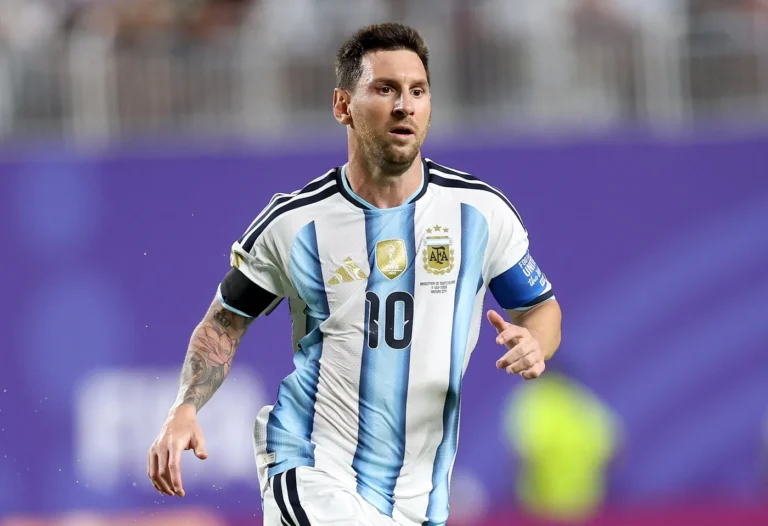
In an intimate and reflective appearance on the podcast Miro de Atrás, Argentine football icon Lionel Messi has offered an unvarnished look at a personal shortcoming that has persisted throughout his illustrious career: his inability to speak English. While the eight-time Ballon d’Or winner has dominated the global sporting landscape for over two decades, his candid admission that he neglected language acquisition during his formative years serves as a rare acknowledgment of vulnerability from one of the most guarded figures in international sports. The discussion, which spanned his professional trajectory and personal growth, underscored the reality that even the most accomplished individuals grapple with the consequences of decisions made during their youth.
The Context of the Disclosure
Lionel Messi’s comments emerged during a wide-ranging conversation on the Miro de Atrás podcast, where the Inter Miami captain discussed his life beyond the pitch. Known historically for his reserved nature and aversion to long-form interviews, the Argentine star provided a nuanced perspective on his upbringing in Rosario, Argentina, and his subsequent move to FC Barcelona at the age of 13.
Messi explicitly identified his failure to master English during his childhood as a significant personal regret. He noted that while he possessed the time and the academic framework to pursue language studies during his formative years in Catalonia, he failed to prioritize them. "I didn’t do it, and I regret it a lot," Messi stated, acknowledging that the lack of linguistic proficiency has remained a persistent challenge throughout his adult life, particularly as his career expanded into global commercial markets and international club settings.
Chronology of a Global Icon
To understand the weight of this regret, one must analyze the timeline of Messi’s professional development. When Messi arrived at FC Barcelona’s La Masia academy in 2000, his immediate focus was survival—integrating into a high-pressure football environment while dealing with significant physical and emotional transitions.
- 2000–2004: Messi’s early years in Spain were dominated by his integration into the Barcelona youth system. Language was not a primary concern, as he was immersed in a Spanish-speaking environment.
- 2004–2021: During his tenure with FC Barcelona, the team was a melting pot of international talent. While he shared the pitch with players from Brazil, France, the Netherlands, and various other nations, the shared language of the locker room was Spanish. This allowed him to excel professionally without the immediate necessity of English.
- 2021–2023: His move to Paris Saint-Germain introduced a new cultural challenge. While he was once again surrounded by a heavy Spanish-speaking contingent, the broader French cultural context highlighted the utility of broader language skills.
- 2023–Present: The transition to Major League Soccer (MLS) in the United States has arguably brought the language barrier to the forefront. Operating in a North American market where English is the primary medium for broadcasting, sponsorships, and fan engagement, the need for English proficiency has never been more acute.
The Role of Language in Elite Athletics
From a professional standpoint, the inability to speak English has not hindered Messi’s on-field performance, yet it has undeniably shaped his off-field footprint. In the modern era of professional sports, elite athletes function as global brands. The ability to communicate directly with an international audience is a vital component of brand management.
Data from the sports marketing industry suggests that athletes who possess multilingual capabilities see a significant uptick in global engagement metrics. According to industry reports from firms like Nielsen Sports, international endorsements often favor athletes who can facilitate cross-cultural communication. For a figure of Messi’s stature, this has necessitated a reliance on interpreters and team-appointed intermediaries. While this structure has successfully protected his image, it has arguably created a distance between the player and his global fan base that he now recognizes as a missed opportunity for authentic connection.
Analytical Perspectives: The Cost of Specialization
The case of Lionel Messi highlights a recurring theme in the development of young athletes: the sacrifice of general education for hyper-specialized athletic training. When a child is recruited into a top-tier academy at the age of 13, the curriculum is heavily skewed toward tactical development, physical conditioning, and match-day preparation.
Sports psychologists note that this "tunnel vision" is often necessary for achieving the level of success Messi has attained. However, the long-term trade-off is often a lack of development in soft skills—including secondary language acquisition. Dr. Helena Rossi, a consultant in athlete welfare, suggests that "the modern athlete is increasingly required to be a CEO of their own brand. Language is no longer an optional luxury; it is a core business competency. Messi’s admission is a powerful lesson for academies worldwide to emphasize holistic education alongside technical mastery."
Official Reactions and Industry Implications
While there has been no official statement from Inter Miami or the Argentine Football Association regarding Messi’s personal reflections, the broader football community has received the comments with empathy rather than criticism. Peers who have navigated similar paths, such as former teammates who have transitioned into global broadcasting, have frequently pointed out the difficulty of learning a new language under the immense pressure of professional competition.
The implication for future talent is clear. Clubs like FC Barcelona, Real Madrid, and those in the Premier League have increasingly integrated language classes into their youth development programs. These initiatives are designed to ensure that players do not arrive at the professional level lacking the communication tools necessary for international careers. Messi’s honesty serves as a catalyst for these programs, reinforcing the notion that professional achievement does not grant immunity from the standard requirements of global citizenship.
Impact on Global Fan Engagement
For the millions of fans who support Messi, his admission humanizes a figure often viewed as an untouchable sporting deity. In the digital age, where fans expect real-time access to their idols via social media and post-match interviews, the barrier of a translator is tangible.
Messi’s reflection has prompted discussions on social media platforms regarding the importance of education. Many educators have praised his honesty, noting that it serves as an influential counter-narrative to the idea that athletic prowess is the only metric of success. By admitting that he regrets a failure in his education, Messi has inadvertently promoted the value of lifelong learning to a demographic that might otherwise prioritize talent over academic rigor.
The Future Trajectory
As Messi nears the later stages of his career, the question arises whether he will take steps to bridge this gap. While he remains a student of the game, his focus is likely to remain on his current responsibilities with Inter Miami and the Argentine national team. However, his acknowledgment of this regret may signal a shift in his personal priorities as he moves toward retirement.
The significance of his statement should not be understated. In a sporting culture that often rewards machismo and the projection of perfection, a global icon admitting to a personal regret regarding his education is a rare and profound moment. It reminds the audience that even those who have conquered the highest summits of their professions remain subject to the universal human experience of looking back and identifying paths not taken.
Ultimately, Lionel Messi’s career will be defined by his goals, his assists, and his trophies. Yet, his legacy will also include this moment of reflection—a reminder that no matter how successful one becomes, the desire for personal growth and the acknowledgment of missed opportunities are fundamental aspects of the human condition. For the young athletes of today, his words serve as a cautionary yet constructive blueprint: develop the body, but never at the expense of the mind. By balancing the demands of high-level sports with the pursuit of diverse skills, the next generation may find themselves better prepared for the multifaceted challenges of the global stage, avoiding the specific regret that has colored the otherwise flawless career of the Argentine legend.