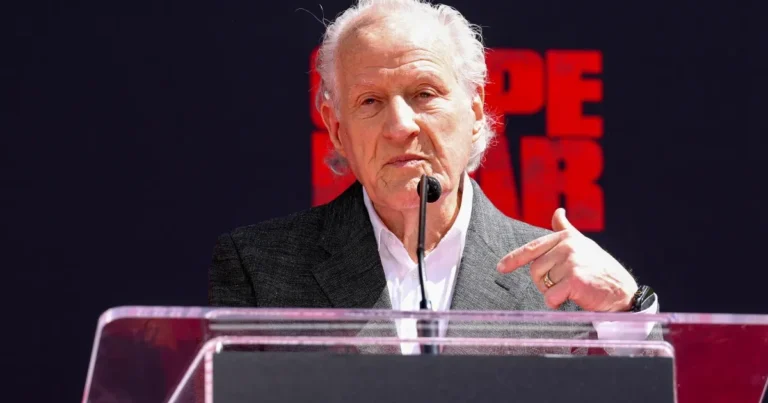
Renowned filmmaker Michael Mann, celebrated globally for his meticulous craftsmanship, gritty urban aesthetics, and defining contributions to the modern crime thriller genre, sustained a minor injury over the weekend following an accidental weapons discharge at a Los Angeles shooting range. The incident, which occurred on a Saturday afternoon, prompted a rapid response from local law enforcement and quickly drew international media attention due to the director’s legendary cinematic preoccupation with firearms, tactical realism, and law enforcement procedures.
According to an official statement released by a representative for the filmmaker on Sunday, the accident took place while Mann was at a local firing range. The representative clarified that the weapon discharged unexpectedly while still in its holster, resulting in a superficial injury to the 83-year-old director. Emergency measures were taken immediately, and Mann was swiftly transported for medical evaluation. Healthcare professionals treated the minor wound, and he was subsequently released, reportedly recovering comfortably at home.
The Los Angeles Police Department (LAPD) corroborated the nature of the event through public safety logs. Authorities confirmed that emergency dispatchers received a "shots fired" call originating from the range facility at approximately 4:00 p.m. local time. Patrol units and emergency medical personnel were dispatched to the scene in accordance with standard protocol. Upon arrival, officers secured the area, interviewed witnesses, and conducted a preliminary investigation. The LAPD officially determined that the discharge was entirely accidental, ruling out any foul play, criminal intent, or third-party negligence.
A Legacy of Cinematic Realism and Firearms Expertise
The irony of the incident has not been lost on film critics, historians, or fans of the director’s expansive filmography. Michael Mann is widely recognized within the motion picture industry as a perfectionist who demands uncompromising authenticity regarding firearms handling, tactical movement, and ballistic behavior on screen. Unlike many Hollywood directors who rely on post-production visual effects or stylized exaggeration, Mann has consistently insisted that his actors undergo rigorous, real-world firearms training with former military and law enforcement operatives.
Born in Chicago in 1943, Mann developed a distinctive visual and narrative style that forever altered the landscape of crime cinema. Over a career spanning more than five decades, he has helmed an array of critically acclaimed and commercially successful feature films. His directorial debut feature, the stylish 1981 neon-noir heist thriller Thief, starring James Caan, established his signature aesthetic: cold urban landscapes, electronic ambient scores, deeply professional protagonists, and an acute attention to procedural detail.
Throughout the subsequent decades, Mann expanded his range across various genres while maintaining his core directorial philosophies. He directed the sweeping historical epic The Last of the Mohicans (1992), which earned widespread acclaim for its visceral combat choreography and historical immersion. He later helmed the cerebral corporate whistleblower drama The Insider (1999), which earned seven Academy Award nominations, including Best Picture and Best Director, as well as the biographical sports drama Ali (2001), chronicling the life of heavyweight boxing champion Muhammad Ali.
However, Mann’s cultural footprint remains anchored primarily in his contributions to the crime thriller genre. Films such as Manhunter (1986)—the cinematic adaptation of Thomas Harris’s novel Red Dragon that introduced Hannibal Lecter to the screen—and Public Enemies (2009), which examined the federal manhunt for Depression-era outlaw John Dillinger, showcase his enduring fascination with the cat-and-mouse dynamics between law enforcement and criminal masterminds.
The Pinnacle of Crime Cinema: Heat and Collateral
No discussion of Michael Mann’s career is complete without examining his masterwork, Heat (1995). The film stands as a monumental achievement in modern cinema, notable not only for its sprawling, operatic depiction of Los Angeles but also for pairing two cinematic titans, Al Pacino and Robert De Niro, on screen together for the first time in a principal narrative capacity. De Niro portrayed Neil McCauley, a meticulous, disciplined master thief, while Pacino starred as Vincent Hanna, an intense, relentless LAPD robbery-homicide detective.
Central to the enduring legacy of Heat is its legendary downtown Los Angeles bank shootout, a sequence that has become a mandatory case study in film schools and tactical training academies alike. Mann famously enlisted former British Special Air Service (SAS) operator Andy McNab to train the actors in weapons handling, movement, and tactical reloading. The resulting sequence utilized live-fire blanks with audio recorded on location, bouncing raw, deafening gunfire off the concrete canyons of downtown Los Angeles to achieve an unprecedented level of auditory and visual realism. The film’s haunting final sequence—featuring Pacino and De Niro stalking one another in the dark beside an active airport runway—cements the picture’s status as a masterclass in tension and character-driven storytelling.
Nearly a decade later, Mann pushed technological boundaries again with Collateral (2004), starring Tom Cruise as a silver-haired contract killer and Jamie Foxx as a weary Los Angeles cab driver held hostage over the course of a single night. Shot primarily on high-definition digital video—a pioneering choice for a major Hollywood studio release at the time—Collateral captured the nocturnal glow of the city with stark, clinical precision. Once more, Mann’s commitment to tactical accuracy shone through, most notably in an explosive alleyway ambush scene where Cruise’s character executes a textbook tactical transition, showcasing professional-grade firearms manipulation that thrilled firearms enthusiasts and tactical experts globally.
Safety Protocols and Industry Response
Beyond his role as an auteur, Mann has maintained a lifelong personal interest in firearms, frequently practicing target shooting to maintain his familiarity with the mechanics and handling of various weapon platforms. Friends and colleagues note that his off-screen dedication to understanding the tools of law enforcement and criminality mirrors the profound research he conducts prior to writing and directing his screenplays.
Yet, the weekend incident at the Los Angeles gun range highlights the inherent risks associated with firearms handling, even for individuals with extensive familiarity, advanced training, and safety-conscious backgrounds. Accidental discharges—often attributed to mechanical failures, holster friction, or momentary lapses in spatial awareness—remain a heavily discussed topic within firearm safety communities. Industry safety advocates emphasize that adherence to foundational rules, such as maintaining proper muzzle direction and utilizing secure, high-quality retention holstering, is paramount regardless of a shooter’s experience level.
Following the release of the official statements from Mann’s representatives and the LAPD, fans and film industry peers took to social media platforms to express relief over the director’s well-being. Given Mann’s advanced age of 83, any physical trauma naturally generates heightened concern among supporters; however, medical professionals and close associates have reassured the public that the injury is superficial, requiring no prolonged hospitalization or medical intervention beyond standard outpatient care.
Broader Implications and Future Projects
As Michael Mann continues his recovery, industry analysts and cinephiles are naturally turning their attention toward the director’s ongoing and future creative endeavors. Despite his octogenarian status, Mann has shown no signs of slowing down his creative output. In recent years, he expanded his literary footprint by co-authoring Heat 2 (2022) with writer Meg Gardiner, a sprawling novel that functions simultaneously as a prequel and a sequel to his 1995 masterpiece. The book debuted at the top of The New York Times bestseller list and immediately sparked intense speculation regarding a potential cinematic adaptation.
Furthermore, Mann returned to the director’s chair for Ferrari (2023), a biographical drama chronicling a turbulent period in the life of automotive entrepreneur Enzo Ferrari during the summer of 1957. Starring Adam Driver and Penélope Cruz, the film was a passion project that Mann spent decades attempting to bring to the screen, demonstrating his continued vitality and commitment to grand, character-driven storytelling.
The weekend’s mishap, while briefly alarming, is expected to have no long-term bearing on the director’s daily life or his ongoing professional commitments. As production landscapes evolve and Mann contemplates his next cinematic venture, the incident serves as an unexpected reminder of the fragile boundary between the cinematic violence he has so brilliantly choreographed for decades and the sobering realities of the physical world. For now, the global community of film enthusiasts can rest easy knowing that one of modern cinema’s most visionary directors has emerged unscathed from a minor mishap, leaving his legendary body of work—and his potential future projects—safely intact.