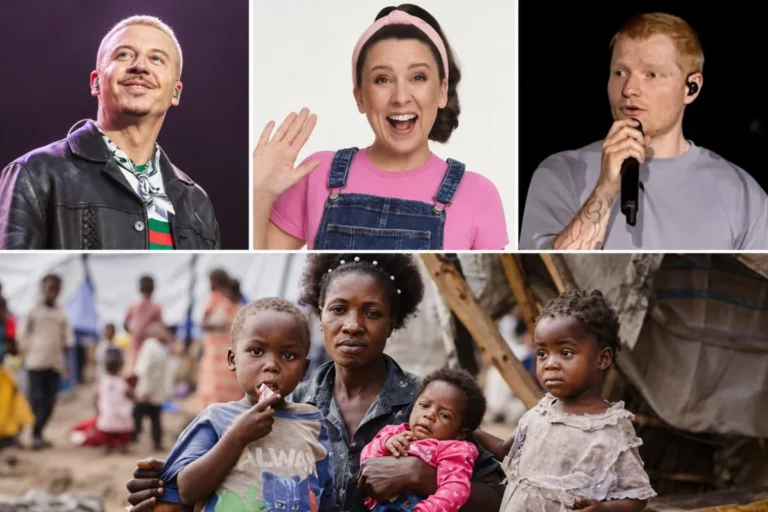
The landscape of modern philanthropy has long been defined by disparities in public attention, media coverage, and financial support. A recent surge of high-profile celebrity donations directed toward humanitarian relief in Gaza has once again cast a sharp light on these inequities. High-profile figures, including American rapper Macklemore, children’s educator Ms Rachel, singer-songwriter Ed Sheeran, and New England Patriots owner Robert Kraft, have collectively pledged $6 million to support Palestinian relief organizations and children’s funds. While these contributions provide critical aid to a population of 2.1 million people facing severe displacement, acute shortages of shelter, and scarce safe water amid ongoing military operations, they also underscore a stark reality: millions of women and children living through similarly devastating humanitarian catastrophes in sub-Saharan Africa—specifically in Sudan and the Democratic Republic of Congo (DRC)—continue to endure chronic neglect, severe funding gaps, and a profound lack of global visibility.
The disparity in international response raises urgent questions about media framing, donor fatigue, and the geopolitical factors that dictate which crises capture the world’s conscience. Humanitarian agencies, including the United Nations Children’s Fund (UNICEF) and the World Food Programme (WFP), struggle annually to bridge massive funding shortfalls for African conflicts that have displaced millions and claimed countless lives. Examining the parallel emergencies in Gaza, Sudan, and the DRC reveals a complex tapestry of overlapping humanitarian failures, resource wealth paradoxes, and institutional struggles to protect the world’s most vulnerable populations.
The Anatomy of the Gaza Crisis and Celebrity Philanthropy
The mobilization of celebrity capital for Gaza represents a notable trend of independent cultural figures stepping in where traditional diplomatic and institutional mechanisms face gridlock. Macklemore’s $1 million pledge to Palestinian relief organizations, coupled with Ms Rachel’s matching commitment to the Palestine Children’s Relief Fund, highlights how digital-age advocacy and direct-to-cause giving can rapidly generate millions of dollars. The subsequent additions of $2 million each from Ed Sheeran and Robert Kraft brought the immediate four-party pledge total to $6 million.
However, these figures, while substantial for grassroots NGOs, represent a fraction of the immense capital required to sustain populations through protracted conflict. UNICEF has actively appealed for $97.5 million solely to address the winterization needs of 540,000 children and their families across Gaza and the West Bank. On a larger scale, the WFP has outlined requirements running into hundreds of millions of dollars to maintain food pipelines through the latter half of the year. The structural devastation of infrastructure—hospitals, water treatment plants, schools, and housing—means that emergency relief is a perpetual race against compounding destruction.
Despite the immense needs in Gaza, the relentless media focus on the Middle East has created an asymmetric awareness ecosystem. While images of devastation in the Gaza Strip routinely dominate global television broadcasts and social media algorithms, parallel emergencies of unprecedented magnitude across the African continent struggle to break through the news cycle.
Sudan: A Catastrophic Collapse of Health, Food, and Security
Nowhere is this invisibility more pronounced than in Sudan, which is currently enduring what humanitarian officials describe as one of the worst displacement and hunger crises in modern history. Following more than three years of brutal warfare between rival military factions, the social fabric of the nation has fractured entirely.
According to UNICEF estimates, a staggering 17.3 million children require urgent humanitarian assistance in Sudan. The conflict has internally displaced roughly 15 million people, with children comprising approximately five million of those forced to flee their homes. The structural collapse has hit education particularly hard: more than eight million children remain completely out of school, threatening to create a lost generation devoid of foundational literacy and vocational skills.
The food security situation has deteriorated into catastrophic phases. Approximately 19.5 million people face acute food insecurity. Projections indicate that 4.2 million children will suffer from acute malnutrition, a figure that includes over 825,000 severe cases requiring immediate, specialized therapeutic feeding—treatments that are frequently unavailable due to access blockades and security risks. Furthermore, the systematic destruction of water, sanitation, and hygiene (WASH) infrastructure has catalyzed outbreaks of waterborne diseases, posing lethal threats to displaced families, young children, and pregnant or breastfeeding women.
The human toll on the ground is starkly documented by field representatives. Sheldon Yett, UNICEF’s Sudan Representative, noted in July that for millions of children, "there is no safe place left." During the first half of the year alone, UNICEF verified that at least 330 children had been killed or maimed directly by the fighting.
Despite these compounding catastrophes, international resource mobilization remains critically deficient. By July, UNICEF had secured only about $352 million of the $963 million required for its comprehensive response plan, leaving a staggering funding gap exceeding 60 percent.
The Democratic Republic of Congo: Beyond Hunger and Displacement
Further south, the Democratic Republic of Congo is experiencing a multi-faceted humanitarian emergency characterized not only by mass displacement and starvation, but also by epidemic levels of sexual violence and systemic protection failures. UNICEF estimates that eight million children require humanitarian assistance in the DRC, while the WFP reports that 26.5 million people face acute food insecurity amid intense regional conflict in the country’s eastern provinces.
Beyond the visible crises of hunger and homelessness, the DRC conflict has exposed women and children to horrific acts of gender-based violence. During periods of intense fighting in eastern DRC, monitoring reports revealed an average of one child raped every half hour. Government and humanitarian registries indicated that children accounted for 35 to 45 percent of nearly 10,000 recorded cases of rape and sexual violence over a two-month reporting window.
The psychological and physical trauma inflicted upon young survivors is profound. UNICEF documented the testimony of a 13-year-old survivor who became pregnant after being raped, capturing the tragic theft of childhood in a single statement: "I am a girl. I don’t know how to be a mother."
Family separation and the targeting of minors have further ruptured communities. In the Ituri province, 15-year-old Pascaline fled her village following armed raids, becoming separated from her parents and learning subsequently that two of her classmates had been brutally killed. When humanitarian workers documented her case, she was attempting to survive with a younger sibling while possessing no information regarding the whereabouts of five other brothers and sisters.
Summarizing the international community’s systemic failure to address the region, UNICEF issued a stark assessment: "Children in DRC are being forgotten, their suffering ignored."
The Resource Paradox: Wealth Beneath the Feet of the Forgotten
A striking paradox unites the crises in Sudan and the DRC: both nations possess immense natural resource wealth that directly fuels the global economy, yet their domestic populations remain impoverished, besieged, and underfunded.
Sudan is a major global producer of gold and serves as an indispensable supplier of gum arabic, a foundational ingredient utilized across the international food, beverage, and pharmaceutical industries. Meanwhile, the Democratic Republic of Congo is of critical strategic importance to the global technology and energy transitions, accounting for approximately 75 percent of the world’s cobalt production, alongside vast reserves of copper and tantalum—minerals essential for the manufacture of smartphones, electric vehicle batteries, and aerospace electronics.
Despite generating billions of dollars in export revenues, this mineral wealth rarely translates into domestic social safety nets, infrastructure development, or security. Instead, resource extraction often fuels corruption, incentivizes proxy warfare, and finances armed militias vying for territorial control. Humanitarian operations in both nations continuously face funding shortfalls running into hundreds of millions of dollars, contrasting sharply with the robust supply chains that extract their natural resources for consumption abroad.
Conclusion: Bridging the Empathy Gap
The humanitarian emergencies unfolding in Gaza, Sudan, and the Democratic Republic of Congo are distinct in their historical roots, political drivers, and tactical manifestations. Yet, they share a common thread of human suffering that demands an equitable global response.
While high-profile celebrity philanthropy and targeted digital campaigns provide essential lifelines to populations in the Middle East, the glaring disparity in public visibility leaves millions of children in sub-Saharan Africa to navigate hunger, extreme violence, and systemic neglect without adequate resources. Addressing these parallel crises requires more than episodic charity; it necessitates sustained geopolitical engagement, equitable media representation, and a fundamental realignment of international aid architecture to ensure that no child’s suffering is rendered invisible simply because it occurs far from the camera’s lens.