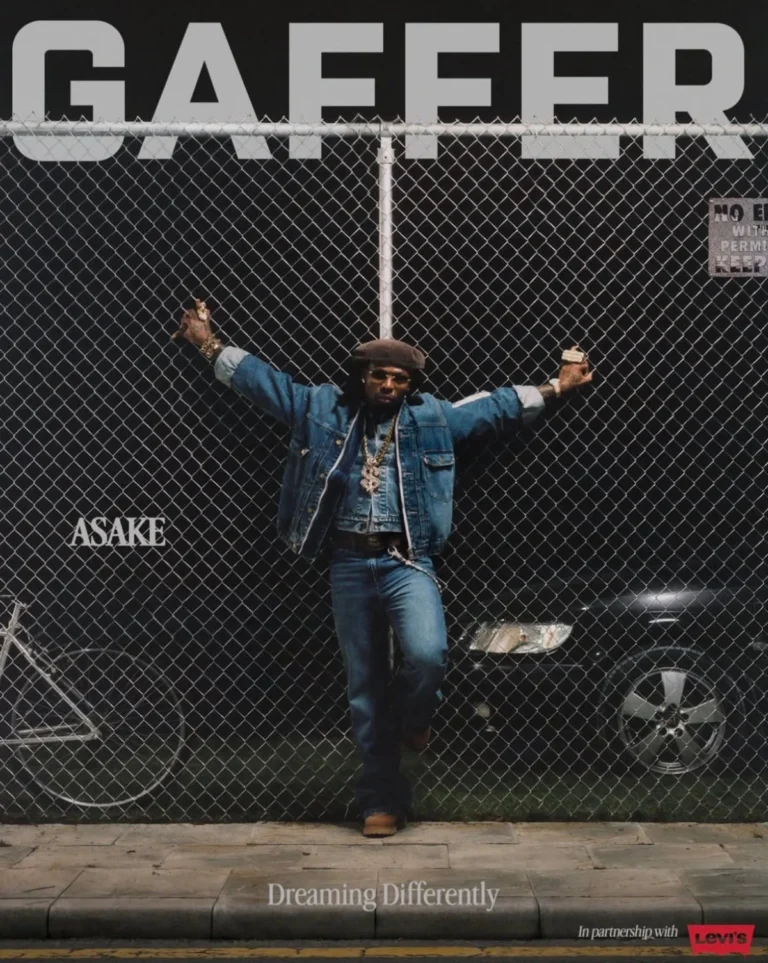
The Nigerian music landscape has witnessed an unprecedented evolution over the past decade, yet few figures have navigated the transition from local street-hop sensation to international cultural icon with the precision of Asake. As he graces the cover of GAFFER Magazine, the artist is not merely celebrating a career milestone but is actively positioning himself as a mentor for the next generation of creative talent. His recent insights serve as a cornerstone for a discourse on identity in the digital age, suggesting that the path to global dominance does not require the dilution of one’s cultural essence, but rather its amplification.
A Philosophy of Unapologetic Heritage
Asake’s artistic trajectory—characterized by his fusion of high-octane Fuji percussion, Yoruba lyrical textures, and modern Afrobeats production—has become a blueprint for modern Nigerian success. In his featured interview with GAFFER, the artist emphasized that the pressure to conform to Western pop standards is a hurdle that many emerging artists feel compelled to jump. However, Asake argues that the global market has moved toward a "hyper-local" appreciation.
"There are no limits," Asake stated during the profile, reflecting on a year that saw him bridge the gap between Lagos street culture and the polished stages of London’s O2 Arena. His message is clear: the specificity of his upbringing, his language, and his rhythmic choices are not barriers to entry but are, in fact, his greatest competitive advantages. By refusing to standardize his sound for international radio play, he has forced the international market to adapt to him, rather than the other way around. This philosophy—staying rooted in his origins while expanding the scale of his operations—has proven to be a financially and creatively sustainable model for his independent imprint, Giran Republic.
The 2026 Chronology: A Year of Unprecedented Milestones
To understand the weight of Asake’s advice, one must examine the timeline of his 2026 fiscal and creative year. His ascent has not been linear but rather a series of strategic, high-impact maneuvers that have recalibrated expectations for what an independent Nigerian artist can achieve.
The year began with a major collaborative effort that signaled his intent to dominate the streaming charts. In January 2026, the release of REAL, Vol. 1, a collaborative EP with industry titan Wizkid, acted as a catalyst for a massive surge in market penetration. The project reached an staggering 122 million on-demand streams in Nigeria within its first quarter alone. Tracks like "Turbulence" and "Jogodo" transcended regional borders, establishing a foothold in key international markets, including the United Kingdom, Canada, and the United States. This collaboration was not just a musical success; it was a demonstration of the power of domestic synergies in driving global interest.
Following this initial momentum, Asake transitioned into his most ambitious solo project to date. In May 2026, he unveiled his fourth studio album, M$NEY. As his first full-length project under his own independent imprint, Giran Republic, the album served as a litmus test for his ability to operate outside the traditional major-label ecosystem. The results were record-breaking: the album secured 37.5 million streams in its first week on Spotify Nigeria, effectively shattering previous industry benchmarks and proving that his independent infrastructure was capable of sustaining major-market demand.
The final piece of the 2026 puzzle involved translating these digital figures into physical, tangible experiences. The "In God We Trust" world tour served as the vehicle for this transition. The tour featured a historic orchestral concert in London, a performance that highlighted the adaptability of his arrangements. This was followed by a sold-out return to The O2 Arena, an achievement that cemented his status as a premier touring act capable of commanding the world’s most prestigious venues.
Data-Driven Impact and Market Implications
The statistics behind Asake’s 2026 run provide a compelling case study for music industry analysts. The sheer volume of his streaming figures, coupled with the success of his independent label, suggests a shifting power dynamic within the African music industry.
Industry observers note that Asake’s average per-stream revenue—when combined with his touring success—places him in a rare tier of artists who possess total creative and financial control. By maintaining ownership of his master recordings via Giran Republic, Asake is not only accumulating wealth but is also setting a precedent for young musicians who are increasingly wary of exploitative label contracts.
Moreover, the success of M$NEY underscores a broader trend in the music business: the "democratization of genre." Asake’s ability to blend traditional Yoruba rhythms with high-fidelity production has allowed him to tap into a diaspora audience that is hungry for authenticity. The data suggests that fans are no longer seeking "globalized" pop music; they are seeking music that feels grounded in a specific sense of place. Asake has successfully commodified this demand for the authentic, turning his background into a brand that travels.
The Role of Infrastructure in Artistic Longevity
While Asake’s talent is the primary engine of his success, his commitment to infrastructure is equally noteworthy. The creation of Giran Republic was a calculated risk that has paid dividends in terms of creative freedom. Many artists who achieve his level of fame often find themselves trapped in complex legal and financial webs that restrict their ability to release music at the pace they desire.
By contrast, Asake’s 2026 schedule indicates a prolific output. The speed with which he transitioned from the REAL, Vol. 1 EP to the M$NEY album demonstrates an agile management style that is rarely seen in artists of his stature. This agility allows him to capitalize on trends and respond to his fan base in real-time, maintaining a level of engagement that is difficult to sustain under the slow-moving bureaucracy of major record labels.
Reflections on the Future of Afrobeats
The GAFFER Magazine feature serves as a timely reminder that the current "Golden Age" of Afrobeats is not merely a product of luck or viral algorithms. It is the result of years of intentional effort by artists who understand the value of their cultural narrative.
Industry stakeholders have lauded Asake’s transparency regarding his process. In a professional context, his willingness to share the "how-to" of his success is seen as a move toward community building within the Nigerian music scene. By demystifying his success, he is effectively raising the floor for every artist coming up behind him.
The implications for the broader industry are profound. Asake’s career trajectory suggests that the future of Afrobeats lies in the hands of artists who are willing to act as their own executives. As the global appetite for African music continues to grow, the ability to maintain creative control while scaling operations will likely become the primary determinant of who stays at the top and who fades into the background.
Conclusion: A Blueprint for the Next Generation
As Asake looks toward the remainder of his career, his message remains rooted in the simplicity of his beginnings. The GAFFER feature is more than just a promotional piece; it is a declaration of intent. For the young musician sitting in a studio in Lagos or a bedroom in London, Asake’s 2026 run provides a clear directive: the identity you hold, the language you speak, and the culture you were raised in are not liabilities in the global marketplace—they are your most valuable assets.
As he continues to headline sold-out arenas and break streaming records, Asake is not just building a legacy for himself; he is creating a template for others to follow. Whether through his independent label, his genre-defying production, or his commitment to his roots, he has proven that the most effective way to reach the world is to be entirely, and unapologetically, oneself. The lessons of 2026 are clear: protect your identity, invest in your own growth, and never lose sight of the journey that brought you to the stage. As the industry looks toward the next cycle of global talent, Asake’s influence is certain to be felt for years to come, marking a definitive shift in how African artists perceive, claim, and command their place on the world stage.